Can I Do My Own Plumbing in Indiana?
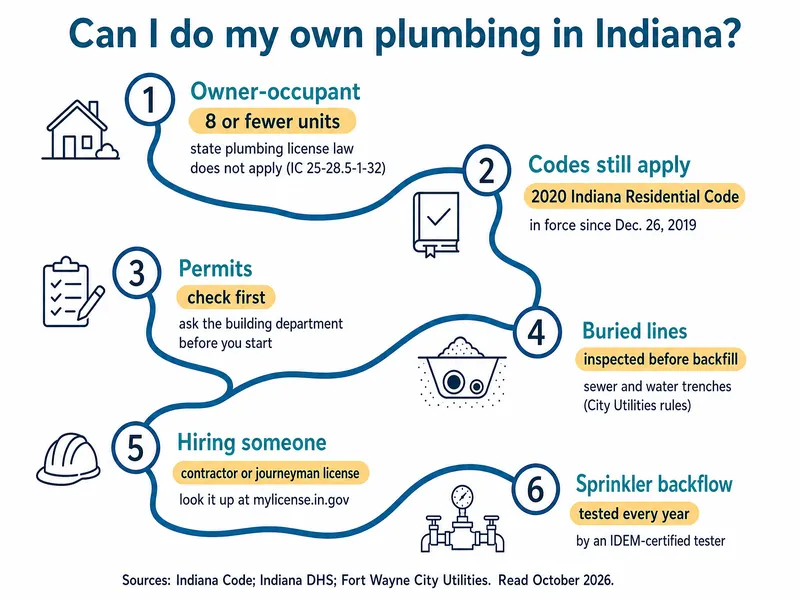
Can I do my own plumbing in Indiana? Yes, if you own and live in the home: the state plumbing license law does not apply to an owner-occupant of a dwelling of eight or fewer units, though codes still do.
Answered by the Three Rivers Home Water desk · Last updated
In this answer
The short version
- IC 25-28.5-1-32(5) says the state plumbing license chapter does not apply to the owner-occupant of a dwelling of 8 or fewer residential units working on its plumbing.
- Acting as a plumbing contractor or journeyman plumber otherwise requires a state license (IC 25-28.5-1-11), issued through the Professional Licensing Agency.
- The exemption covers licensing only: the 2020 Indiana Residential Code, in force since December 26, 2019, still applies to the work (Indiana DHS).
- Permits are a local matter: check with the building department before you start.
- City Utilities' 2026 sewer rules say no sewer installation may be backfilled until City Utilities has inspected it, and the tap contractor or owner must notify Development Services within 48 hours so it can be inspected.
- Backflow devices on lawn sprinklers must be tested every year by an IDEM-certified tester, who files results within 10 days in Fort Wayne.
Can you do your own plumbing in Indiana?
Yes, if you own the home and live in it. Indiana's plumbing licensing chapter lists people it "does not apply to," and item 5 is "the owner occupant of a dwelling of eight (8) or less residential units when the owner occupant is installing, altering, or repairing the plumbing system of the residential units" (Indiana Code Title 25, IC 25-28.5-1-32).
Read that wording closely. It names the owner who occupies the dwelling. The statute's text does not mention a landlord who lives elsewhere, a tenant, or a friend helping out, so this site can't tell you they are covered. For anyone outside the exemption, IC 25-28.5-1-11 makes it unlawful "to act in the capacity of a plumbing contractor or journeyman plumber" in Indiana without that state license.
The exemption is about who may hold the wrench, not about the standard of the work. The same chapter (IC 25-28.5-1-33) lets cities and counties enforce building codes and inspections, so the rules below still apply to a homeowner.
Indiana DIY plumbing rules in numbers
- 8 unitsLargest dwelling an owner-occupant may plumb without a state licenseSource: Indiana Code 25-28.5-1-32
- 36 inAllen County frost depth in the state residential codeSource: 2020 Indiana Residential Code
- 48 hoursTime to notify Development Services after a sewer tap, for inspectionSource: City Utilities wastewater rules, 2026
- 10 daysDeadline for a Fort Wayne backflow test reportSource: City Utilities backflow newsletter, 2026
Do you need a permit for your own plumbing?
Often, yes, but the answer comes from your local building department, not from the state license law. Allen County and Fort Wayne permit rules and fees could not be confirmed for this page, so check with the building department before you start any job that adds, moves or replaces piping.
Some City Utilities rules are written down and apply no matter who does the work. Its 2026 wastewater rules (section 3) say sewer tap permits are issued "only to a property owner, contractor and/or plumber," and that the tap contractor or property owner must notify Development Services within 48 hours so City Utilities can inspect before backfilling. No one may backfill or conceal a sewer installation until it has been inspected and approved.
The water side has the same idea. City Utilities' water rules (2022, PDF p. 24) say the utility and the Allen County Building Department have the right to inspect a customer-owned service line for materials and depth before the trench is backfilled, and that the line must meet state plumbing code. Who owns which part of the pipe is explained in who fixes a sewer backup in Fort Wayne?
Which plumbing jobs suit a homeowner?
Jobs that swap a part on existing piping, without opening walls, trenches, gas lines or the sewer, are the realistic DIY list. Think of a worn faucet cartridge, a running toilet's fill valve or flapper, a sink trap, a supply hose to a washer, or insulation on exposed pipes.
These jobs share three traits: the water shuts off at a fixture valve or the main, nothing is buried or concealed, and a mistake shows up as a drip you can see. Winter prep belongs here too; how do I keep pipes from freezing in Fort Wayne? covers the steps. Know where your main shutoff is before you start.
Which plumbing jobs need a licensed plumber?
Gas, sewer, buried service lines and anything that needs a certified tester are the jobs to hand to a licensed professional. The owner-occupant exemption may technically reach some of them, but each carries inspection rules, safety risk or a certification the homeowner doesn't hold.
| Job | Who may do it | Rule that applies |
|---|---|---|
| Faucet, toilet parts, sink trap | Owner-occupant or licensed plumber | State license law exempts owner-occupants (IC 25-28.5-1-32) |
| Water heater replacement | Licensed plumber advised; gas work especially | Relief valve and discharge rules, IRC chapter 28; pan rule, 675 IAC 14-4.4-162 |
| Sewer lateral or sewer tap | Owner, contractor or plumber with a sewer tap permit | Inspection by City Utilities before backfill (2026 wastewater rules) |
| Water service line, curb stop to house | Owner or contractor; inspection before backfill | City Utilities water rules; at least 12 in deep and 6 in below the frost line |
| Backflow test on a lawn sprinkler | IDEM-certified backflow tester only | Annual test; report within 10 days (Fort Wayne Chapter 52) |
| Sump pump or downspout discharge | Owner-occupant or licensed plumber | Never into a sanitary sewer (2026 wastewater rules) |
Water heaters sit near the top of the list. The 2018 IRC chapter 28 sets the relief valve to open at no more than 210°F and 150 psi, and its discharge pipe must end 6 inches or less above the floor with no valve or threaded end. Gas connections and venting add more risk. How long does a water heater last? covers when replacement is due.
Lawn sprinkler backflow devices are a firm line. City Utilities' 2026 backflow newsletter says the tester must be IDEM-certified and must submit results within 10 days; see does my lawn sprinkler need a backflow test? Private wells are their own field: drillers file a well record with the Indiana DNR within 30 days, under 312 IAC 13.
How do you check an Indiana plumbing license?
Search the state's license lookup at mylicense.in.gov, which covers professions regulated through the Professional Licensing Agency, including plumbing. Enter the person's or company's name and confirm the license type and status.
The Professional Licensing Agency's plumbing page explains the license types. Under IC 25-28.5-1-11, someone acting as a plumbing contractor or journeyman plumber in Indiana needs that license. The same lookup lists IDEM-certified backflow testers, which City Utilities links from its backflow pages.
What code rules apply to DIY plumbing?
The 2020 Indiana Residential Code, based on the 2018 International Residential Code and in force since December 26, 2019, applies statewide, according to the Department of Homeland Security. Owner-occupants are held to it like anyone else.
A few rules come up often in Allen County:
- Frost depth and buried water lines. The code's Allen County frost depth is 36 inches, and a water service pipe must be at least 12 inches deep and at least 6 inches below the frost line (675 IAC 14-4.4).
- Water heater pans. Indiana's amendment drops the pan only when the heater sits on a water-resistant floor sloped to a floor drain in the same room.
- Clear water stays out of the sanitary sewer. City Utilities' 2026 rules bar sump pumps, downspouts, yard drains and subsoil drains from connecting "directly or indirectly" to a sanitary sewer; read can my sump pump drain into the sewer?
- No cross-connections. City Utilities' water rules prohibit cross-connections that could let backflow reach the public system.
How this answer was put together
This answer quotes Indiana Code 25-28.5-1 (2025 edition), the Indiana Department of Homeland Security notice on the 2020 Indiana Residential Code, 675 IAC 14-4.4 (the 2020 Indiana Residential Code rule), the 2018 IRC chapter 28 on water heaters, City Utilities' wastewater rules (revised October 20, 2026), water rules (2022) and 2026 backflow newsletter, and 312 IAC 13 on wells, all read in October 2026. Local permit rules and fees for Allen County and Fort Wayne are left out because the county's pages could not be confirmed. This is a reading of the rules, not legal advice.
Follow-up questions
Can a landlord do plumbing on a rental house in Indiana without a license?
The exemption's text names "the owner occupant" of a dwelling of 8 or fewer units. It does not mention an owner who lives somewhere else. Ask the building department or the Professional Licensing Agency before relying on it.
Can I replace my own water heater in Fort Wayne?
The state license law doesn't stop an owner-occupant, but the code's relief valve, discharge and pan rules still apply, and a permit may be required. Check with the building department first. Gas connections and venting are best left to a licensed plumber.
Can I dig and replace my own sewer lateral?
City Utilities' rules issue sewer tap permits to property owners as well as contractors and plumbers. The trench must be inspected before backfill, and the work must meet the utility's Design Standards Manual. Excavation near the street adds traffic and restoration duties under the same rules.
Can I test my own backflow preventer?
No. Fort Wayne requires an IDEM-certified backflow tester, and only the tester can submit the result.
Does a homeowner need to pass a plumbing exam?
Not under the state license law, which exempts owner-occupants. Inspections, where required, check the work rather than the person.
Can a handyman do plumbing in Indiana?
Someone who isn't the owner-occupant and acts as a plumbing contractor or journeyman needs a state license under IC 25-28.5-1-11. Look the person up at mylicense.in.gov before the job.
Does the owner-occupant exemption cover a duplex?
The wording covers a dwelling of up to 8 residential units when its owner lives there, and a duplex has 2. The building department can confirm how it reads the rule for your address.
More questions on winter, pipes and heaters


Have another question? See every Fort Wayne home water answer.