Topic · 4 questions
Allen County Well Water Questions
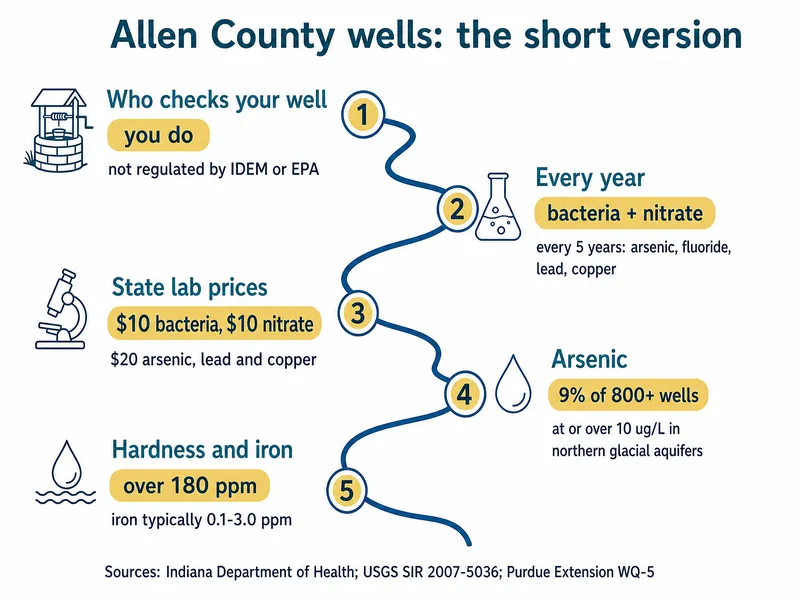
What should Allen County well owners know? The well is yours to look after: test every year for bacteria and nitrate, check arsenic at least every five years, and treat only what a lab test finds.
Answered by the Three Rivers Home Water desk · Last updated
The short version
- The Indiana Department of Health says private wells are regulated by neither IDEM nor EPA and recommends testing at least once a year.
- Its lab tests bacteria and nitrate for $10 each, with arsenic, lead and copper at $20, every five years or after major well work.
- Purdue Extension says much northeastern Indiana groundwater has noticeable hydrogen sulfide, usually under 10 mg/L.
- In a USGS study of 800+ wells in the northern glacial aquifer system, 9% had arsenic at or above 10 µg/L, EPA's limit.
- Purdue puts typical Indiana groundwater iron at 0.1–3.0 ppm and says "virtually all" of it is over 180 ppm hardness.
- No Allen County well-testing program was found; the county health department points owners to state guidance.
This page gathers every well question on Three Rivers Home Water. It covers private wells in Allen County; homes on Huntertown, Woodburn, Monroeville or Leo's Pioneer Water get groundwater from a public system and should read that system's own report.
Allen County wells, by the numbers
- $10State lab fee each for bacteria and nitrateSource: Indiana Department of Health lab
- 9%Northern glacial-aquifer wells at or over 10 µg/L arsenicSource: USGS SIR 2007-5036
- 10 µg/LFederal arsenic limit for public waterSource: EPA
- 25 ftMinimum depth of well casing in IndianaSource: 312 IAC 13-4-1
How often should Allen County wells be tested?
Allen County wells should be tested every year for bacteria and nitrate, and at least every five years for fluoride, arsenic, lead and copper. That is the Indiana Department of Health lab's schedule, which also calls for the five-year tests "whenever any major maintenance is done."
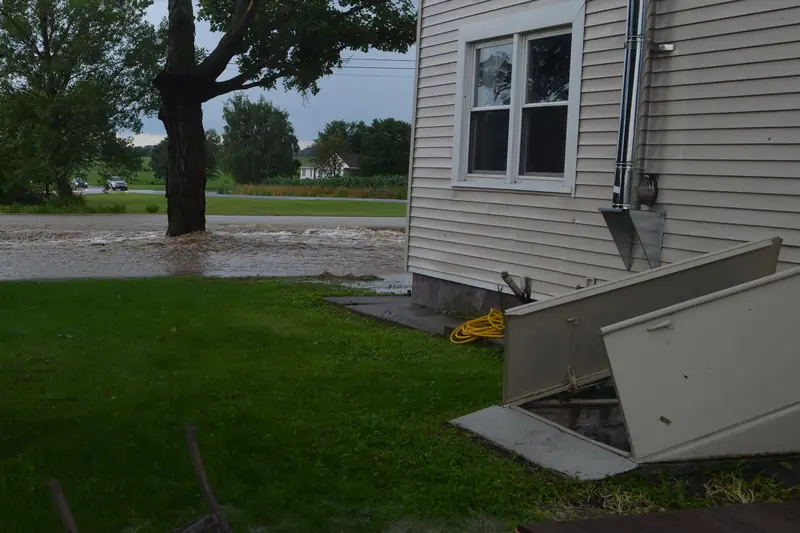
EPA's private well page adds total dissolved solids and pH to the yearly list and says to test right away after flooding, repairs, or a change in taste, odor or color. Reports print results in mg/L or µg/L, the same as ppm and ppb.
Why do wells smell like rotten eggs?
Wells smell like rotten eggs because of hydrogen sulfide gas, which Purdue Extension's WQ-11 says is noticeable in "much of the ground water in northwestern and northeastern Indiana," usually under 10 mg/L. Purdue's WQ-5 adds that the nose detects it at 0.05 ppm and that sulfate-reducing bacteria can produce it.
If only the hot water smells, the water heater may be the source rather than the well. Treatment depends on the level: Purdue says an iron removal filter handles up to around 10 mg/L, and chlorine bleach feed can remove medium to high levels over 6 mg/L.
Is arsenic a concern in Allen County wells?
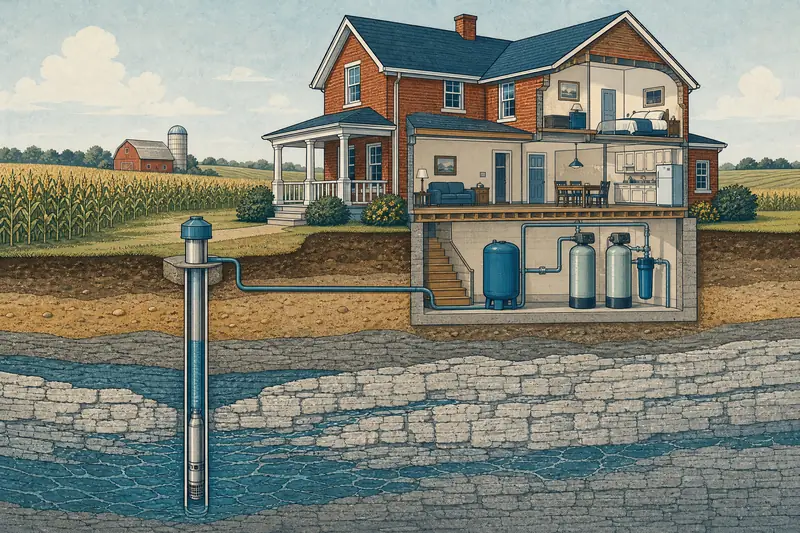
Arsenic is a possibility worth testing for. The Indiana Department of Health's well water page says "glacial deposits of arsenic exist throughout the State of Indiana," and USGS report SIR 2007-5036 found 9% of more than 800 northern glacial-aquifer wells at or above 10 µg/L, linking higher arsenic to low-oxygen, iron-reducing groundwater.
You cannot see, taste or smell arsenic, and no Allen County arsenic survey was found, so the state lab's $20 arsenic, lead and copper test is the way to know. A water softener does not remove it.
How do you choose well treatment?
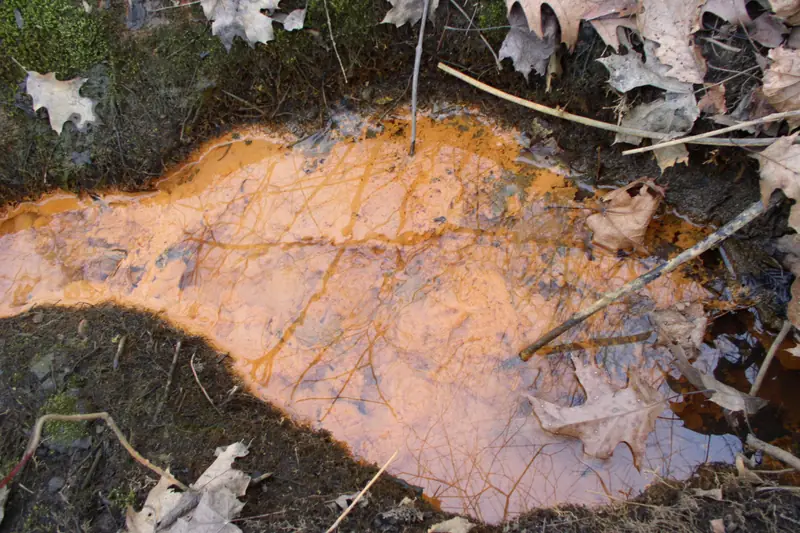
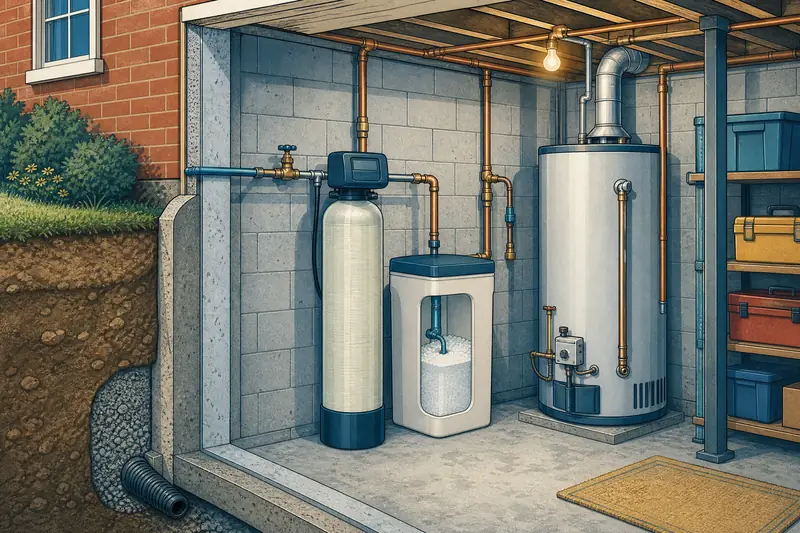
You choose well treatment from your lab result, one stage per problem. Sediment screens go first, iron and sulfur filters next, then a softener, because Penn State Extension's iron and manganese page says oxidized iron fouls softener resin. Penn State recommends a softener for iron only under 5 mg/L of dissolved iron, and oxidation plus filtration above 10 mg/L of combined iron and manganese.
Bacteria are separate. Penn State's shock chlorination guide says to shock chlorinate after a positive coliform test, retest in 10–14 days, and add continuous disinfection such as UV or chlorination if bacteria return. Purdue's WQ-5 notes that softeners remove hardness, "not other chemicals."
Who regulates private wells?
For water quality, nobody but the owner. The Indiana Department of Health says private well water is "unregulated by both the Indiana Department of Environmental Management and the Environmental Protection Agency," and the Allen County Department of Health's water quality page says owners "are responsible for ensuring wells maintained" and links to state testing guidance.
Construction is a different matter. Under Indiana's water well rules, 312 IAC 13, drillers must file a record of each well with the Department of Natural Resources within 30 days, and casing must reach at least 25 feet below the surface unless otherwise approved.
| Question | Short answer | Source |
|---|---|---|
| Testing | Bacteria and nitrate yearly; arsenic, fluoride, lead, copper every 5 years | Indiana Department of Health lab |
| Lab cost | $10 bacteria, $10 nitrate, $10 fluoride, $20 arsenic/lead/copper, plus shipping | Indiana Department of Health lab |
| Rotten-egg smell | Hydrogen sulfide, common in northeastern Indiana, usually under 10 mg/L | Purdue Extension WQ-11 |
| Arsenic | 9% of 800+ northern glacial-aquifer wells at or above 10 µg/L | USGS SIR 2007-5036 |
| Iron | 0.1–3.0 ppm typical; stains above 0.3 ppm | Purdue Extension WQ-5 |
| Hardness | "Virtually all" Indiana groundwater over 180 ppm | Purdue Extension WQ-5 |
How this answer was put together
This topic page condenses its four well questions. Behind them: the Indiana Department of Health's well water and lab pages, EPA's private well page and arsenic rule, Purdue Extension WQ-5 and WQ-11, USGS SIR 2007-5036, Penn State Extension's iron and shock chlorination pages, 312 IAC 13 and the Allen County Department of Health's water page. All were read in October 2026, and each figure matches its question page. The Purdue and USGS figures are statewide or regional, not Allen County surveys; no county-level data was found.
Follow-up questions
Does Allen County test private wells for free?
No free county program was found. The county health department points to state guidance, and the state lab charges $10 per bacteria or nitrate test.
Is a softener enough treatment for a well?
Rarely on its own. It handles hardness and some dissolved iron, but not bacteria, arsenic or nitrate.
Can I drink well water while waiting for results?
The Indiana Department of Health says bottled or filtered water can be a short-term solution if a test comes back positive for bacteria.
Are farm wells different from house wells?
The same testing advice applies to any well used for drinking water. Purdue's WQ-5 notes that nitrate is not held by soil and moves down with infiltrating water, which is why it stays on the yearly list.
How deep are Allen County wells?
Depth varies by property. The state only sets a minimum: casing at least 25 feet below the surface under 312 IAC 13-4-1, and the driller's record filed with DNR shows yours.
Who keeps a record of my well's construction?
The driller does the paperwork: Indiana's well rules (312 IAC 13) require a record of each new well to reach the Department of Natural Resources within 30 days of completion, and casing normally runs at least 25 feet below the surface. That record can tell you the depth and the aquifer, which helps when you read a test result.

Have another question? See the full list of Fort Wayne home water questions.