Is There Arsenic in Allen County Well Water?
Is there arsenic in Allen County well water? It can be: the Indiana Department of Health says glacial arsenic deposits exist throughout the state, and only a lab test shows whether your well is over 10 µg/L.
Answered by the Three Rivers Home Water desk · Last updated
In this answer
The short version
- The Indiana Department of Health says glacial deposits of arsenic "exist throughout the State of Indiana."
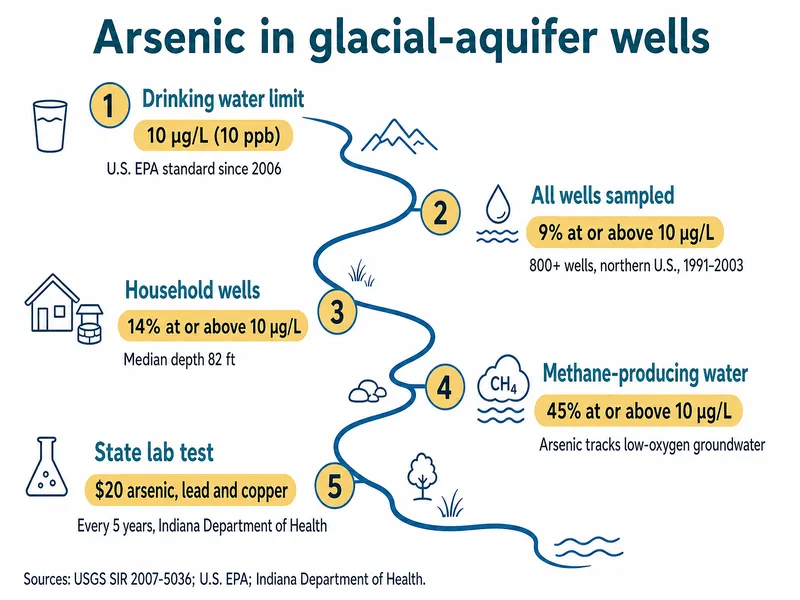
- A USGS study of more than 800 glacial-aquifer wells across the northern U.S. found 9% at or above 10 µg/L, and 14% of the household wells in it.
- The EPA drinking water standard is 10 µg/L (10 ppb), down from 50 ppb, with public systems complying by January 23, 2006 (EPA).
- IDOH says to test private wells for arsenic at least every 5 years; its lab charges $20 for arsenic, lead and copper (IDOH lab).
- No published Allen County figure for arsenic in wells was found, so your own test is the only local number that counts.
- Water softeners and granular activated carbon "do not remove arsenic," says the New Jersey DEP; adsorption media, reverse osmosis, anion exchange and distillation can.
Is there arsenic in Allen County well water?
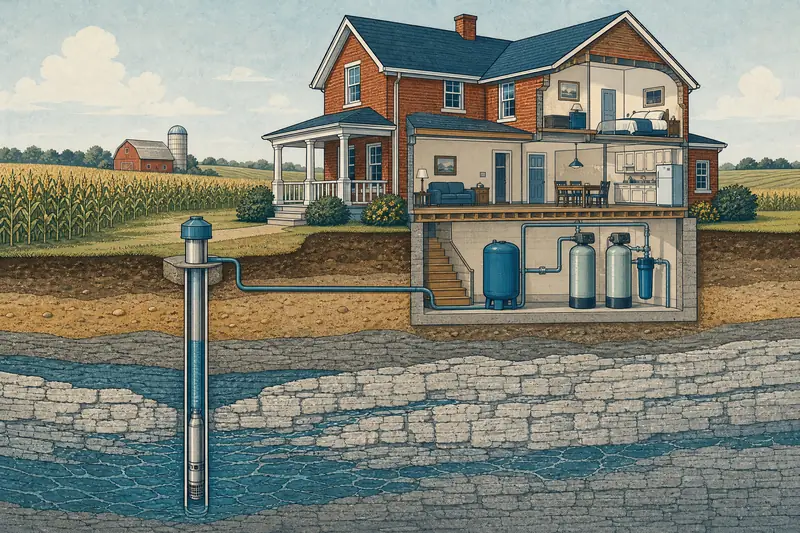
There can be arsenic in Allen County well water, and nobody can say how much is in yours without a test. The Indiana Department of Health's well water page lists arsenic first among natural problems, noting that glacial deposits of it "exist throughout the State of Indiana."
What is missing is a county map. This site found no USGS, IDOH or Allen County Department of Health figures for arsenic in Allen County wells specifically. The closest data is regional: the U.S. Geological Survey's report on arsenic in the glacial aquifer system (Scientific Investigations Report 2007-5036), which sampled more than 800 wells in the glacial deposits that cover the northern U.S., Allen County included.
That study found elevated arsenic, 10 micrograms per liter or more, in 9% of samples taken from 1991 to 2003. Among household (domestic) wells, which had a median depth of 82 feet, the share was 14%. Arsenic has no color, taste or smell, so a well can look and taste fine and still be over the limit.
Arsenic in numbers
- 10 µg/LEPA arsenic standard (10 ppb)Source: U.S. EPA
- 9%Northern glacial-aquifer wells at or above 10 µg/L, 1991–2003Source: USGS SIR 2007-5036
- 14%Household wells in the same study at or above 10 µg/LSource: USGS SIR 2007-5036
- $20State lab arsenic, lead and copper testSource: Indiana Department of Health
- 5 yearsLongest IDOH interval between arsenic testsSource: Indiana Department of Health
Where does arsenic in Indiana wells come from?
Arsenic in Indiana wells comes mostly from natural sediments, not from pollution. The glaciers left thick deposits of sand, gravel and clay, and arsenic attached to iron minerals in those deposits can dissolve into groundwater when conditions are right.
The USGS report ties those conditions to oxygen. Elevated arsenic was found in only 1% of oxic (oxygen-rich) samples, but in 19% of samples classed as iron or sulfate reducing and 45% of methanogenic, or methane-producing, samples. In plain terms, the more oxygen-starved the water, the more likely arsenic was high.
That has a practical upshot for Allen County well owners. Water that smells of sulfur or carries a lot of iron is a sign of those low-oxygen conditions; why does my well water smell like rotten eggs? covers the sulfur side. The IDOH page also warns of naturally occurring methane "throughout Indiana." None of these proves arsenic is present, but they are good reasons not to skip the 5-year metals test.
Depth is not a reliable guide. The USGS found a weak link between arsenic and well depth for household wells, and a well next door can tap a different layer from yours.
What is the arsenic limit?
The arsenic limit for drinking water is 10 µg/L, the same as 10 ppb or 0.010 mg/L. The EPA set that standard under its 2001 Arsenic Rule, replacing the old 50 ppb standard, and public water systems had to comply by January 23, 2006.
That limit binds utilities, not you. The USGS report points out that the arsenic standard applies to public supply systems but not to domestic wells, and IDOH says private wells are not regulated by IDEM or the EPA. Still, 10 µg/L is the sensible yardstick for a household well, and it is the line most lab reports print next to your result.
Lab reports use several units for the same thing. A result of 0.012 mg/L is 12 µg/L, which is 12 ppb and over the limit. Some states set tighter targets: New Jersey adopted 5 ppb as its state standard in 2006, according to its environment department, but Indiana uses the federal figure.
How do you test a well for arsenic?
Test a well for arsenic through a certified lab, at least every 5 years and after any major well work. The IDOH laboratory runs arsenic, lead and copper together for private well owners for $20, plus shipping; kits are ordered through Access Indiana and the bottles arrive by mail.
The yearly bacteria and nitrate tests are a separate $10 each, so many owners add the metals group every fifth year. The full schedule, and how to take a clean sample, is on how often should I test my well?
If a result comes back at or near 10 µg/L, test again before buying anything. New Jersey's environment department, which studied home arsenic treatment in detail, advises re-sampling to confirm and at the same time testing pH, iron, manganese, sulfate and silica, because those numbers decide which treatment will work. IDOH's own advice is similar: if a test comes back elevated, "we recommend additional testing."
| Method | Where it treats | Arsenic forms removed | Notes from the sources |
|---|---|---|---|
| Granular ferric (iron-based) adsorption | Whole house or one tap | As3 and As5 | NJ DEP's first choice; media lasts about 2–3 years whole-house |
| Activated alumina or iron-based cartridges | Usually one tap | Depends on media | Media life depends mostly on pH; longer at pH 6.5–7.5 (Texas A&M) |
| Reverse osmosis | One tap | As5; As3 needs pre-oxidation | Some units remove 90–100% of arsenic; recover only 20–30% of the water (Texas A&M) |
| Anion exchange | Whole house | As5 only | Not the best choice with iron, TDS over 500 mg/L or sulfate over 50 mg/L (Texas A&M) |
| Distillation | One tap | Effective | High energy cost (Texas A&M) |
| Water softener or carbon filter | Whole house | Neither | "Do not remove arsenic" (NJ DEP) |
How is arsenic removed from well water?
Arsenic is removed with adsorption media, reverse osmosis, anion exchange or distillation, and the choice depends on which form of arsenic you have and what else is in the water. Texas A&M AgriLife Extension's Drinking Water Problems: Arsenic lists those four as the common methods for private wells.
Arsenic comes in two forms, often written As3 and As5. The New Jersey DEP's guidance says tests for the two forms are hard to get, so it recommends a system that removes both; its preferred option is a whole-house granular ferric adsorption system, with a backup tank and a sampling tap between the tanks. Reverse osmosis and anion exchange remove As5 well but need As3 converted first, usually by oxidizing it.
Other minerals get in the way. Texas A&M says iron and manganese "hinder effective arsenic treatment and should be removed before arsenic treatment begins," and New Jersey lists iron over 0.5 ppm, manganese over 0.05 ppm and hardness over 300 ppm among things that foul adsorption media. In much of Allen County that means an iron or softening step may come first; what well water treatment do I need? explains the order.
Whatever you install, keep testing. New Jersey says to sample a few days after installation and then every six months, because you cannot see, smell or taste arsenic breaking through. A single-tap reverse osmosis unit for drinking and cooking water is a common small fix; is reverse osmosis worth it for drinking water? covers how those units are certified. Check that any unit's certification lists arsenic reduction specifically.
Does a softener remove arsenic?
No, a water softener does not remove arsenic. The New Jersey DEP's treatment guidance states plainly that "water softeners and granular activated carbon do not remove arsenic," and neither does a sediment filter.
A softener exchanges hardness minerals for sodium or potassium; it is built for calcium and magnesium, not for arsenic. It can still play a part, because hard water and iron foul arsenic media, so a softener ahead of an arsenic system may help that system last. But the softener alone leaves the arsenic number where it was.
Boiling is not a fix either, since it removes water, not arsenic. If your well tests high, use bottled or treated water for drinking and cooking until a confirmed fix is in place and a follow-up test shows it working. Softeners on their own terms are covered in is a softener needed in Fort Wayne?; the remaining well topics sit on the wells page.
How this answer was put together
Sources: USGS Scientific Investigations Report 2007-5036 on arsenic in the glacial aquifer system (2007, data 1991–2003); IDOH's arsenic note and lab price list (October 2026); the EPA's chemical contaminant rules page (read October 2026), the New Jersey DEP's arsenic treatment guidance for residential wells, and Texas A&M AgriLife Extension's arsenic bulletin L-5467 (2020). Out-of-state guidance is used for treatment methods only, not for Indiana rules. Left out: treatment prices (the sources' figures are old and from other states) and health effects, which this page does not describe.
Follow-up questions
Is arsenic more common in deep or shallow wells around Fort Wayne?
No local data answers that. The USGS study found only a weak link between depth and arsenic in household wells, and its strongest link was to low-oxygen water. Test your own well rather than relying on a neighbor's depth or result.
Can I shower in water with arsenic over 10 µg/L?
The EPA standard is set for drinking water. New Jersey's guidance says the main exposure from well water is drinking and cooking, with some possible exposure from bathing and brushing teeth. Ask your doctor or the county health department about your specific result.
Does a neighbor's clean arsenic test mean mine is clean?
No. Wells a short distance apart can draw from different layers of glacial sediment with different oxygen conditions, and the USGS found arsenic tracks those conditions closely.
How often should I retest after installing arsenic treatment?
New Jersey's guidance says to test a few days after installation and then every six months to see when the media starts letting arsenic through. Keep using the same lab so results compare cleanly.
Is the Fort Wayne city water tested for arsenic?
Public systems must meet the 10 µg/L standard and report regulated contaminants in their yearly water quality report. If you are on city water, see where Fort Wayne tap water comes from; this page is about private wells.
Will an iron filter take out arsenic too?
None of the sources reviewed here rates an iron filter for arsenic removal. Treat iron first if needed, then confirm arsenic with a lab test after the system is running.
What does a lab arsenic result of 0.008 mg/L mean?
That is 8 µg/L, or 8 ppb, which is under the 10 µg/L standard. Note it in your records and retest on the IDOH 5-year schedule or sooner after well work.
Keep reading
Have another question? See every Fort Wayne home water answer.