Which Filters Reduce Lead in Drinking Water?
Which filters reduce lead? Only ones certified to NSF/ANSI 53 (pitchers, faucet and under-sink filters) or NSF/ANSI 58 (reverse osmosis) with lead named as a claim for that exact model.
Answered by the Three Rivers Home Water desk · Last updated
About the store links on this page: SoftPro Water Systems and Quality Water Treatment, the two stores linked on this page, have the same owners as Three Rivers Home Water. Answers here lean on Fort Wayne City Utilities' published reports and rules, Indiana and federal agency guidance and makers' certification listings, read in October 2026. What a store says about its own products is quoted as the store's claim. How store links work
In this answer
The short version
- EPA's consumer tool (June 2024) says to look for NSF/ANSI 53 with a lead-reduction claim, ideally also NSF/ANSI 42 for Class 1 particulate reduction.
- Certification means the filter was tested to reduce lead to 5 ppb or less, by one of five ANSI-accredited certifiers: NSF, IAPMO R&T, WQA, UL Solutions or CSA Group.
- Reverse osmosis systems are certified under NSF/ANSI 58; IAPMO R&T lists the Waterdrop G3P600 for lead (file WC-13976), but not the similar G3-W.
- Boiling does not remove lead, and no water softener sold by the two stores on this site holds a lead-reduction listing.
- City Utilities' 2026 report found 3 of 106 Fort Wayne homes above 15 ppb in early 2025 and tells residents to use a filter certified by an ANSI-accredited certifier.
Which filters reduce lead?
Filters reduce lead when they are certified for it, whatever their shape. EPA's June 2024 consumer tool covers pitcher filters, faucet-mounted filters, under-sink cartridges and refrigerator filters, and its test is the same for all of them: the package or listing must show NSF/ANSI Standard 53 together with a claim of lead reduction.
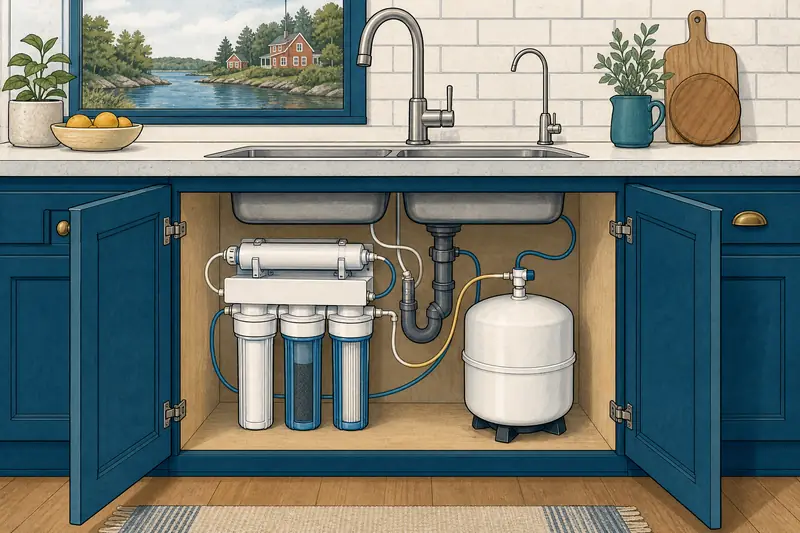
Reverse osmosis systems use a different standard, NSF/ANSI 58, and can carry a lead claim under it. Most RO units also hold carbon stages, so check which standard covers which claim. Is reverse osmosis worth it for drinking water covers what else an RO system does.
What doesn't count: a box that says "reduces heavy metals," a list of contaminants on a product page, or a mark for NSF/ANSI 372 or 61. Those last two cover the materials a product is made of (372 is "lead-free" construction), not what it takes out of the water.
What do NSF/ANSI 53 and 58 mean for lead?
They are the test standards certifiers use to prove a filter lowers lead: NSF/ANSI 53 for health-effect claims on filters and NSF/ANSI 58 for reverse osmosis. EPA's tool says a certified lead claim means the filter was evaluated for reducing lead to 5 ppb or less, and it recommends also looking for NSF/ANSI 42 particulate reduction (Class 1), since lead can come loose from pipes as particles.
The standard number alone tells you little. A filter can be certified to NSF/ANSI 53 for one contaminant and not another, and an RO system can be certified to NSF/ANSI 58 for fluoride but not lead. The claim list for the exact model is what matters.
Here is what the certifier lists for two similar under-sink RO systems, both certified by IAPMO R&T, not by NSF International:
| Model | Standard and IAPMO file | Reduction claims listed | Lead? |
|---|---|---|---|
| Waterdrop WD-G3P600 | NSF/ANSI 58, WC-13976 | TDS, Fluoride, Cadmium, Barium, Radium 226/228, Lead | Yes |
| Waterdrop WD-G3P600 carbon stage | NSF/ANSI 53, WC-14805 | PFOA/PFOS | Not under 53 |
| Waterdrop WD-G3-W | NSF/ANSI 58, WC-13976 | TDS, Fluoride, Cadmium, Hexavalent Chromium and Selenium | No |
| Waterdrop WD-G2 series | NSF/ANSI 372 only | Materials only, no reduction claims | No |
How do you check a filter's lead certification?
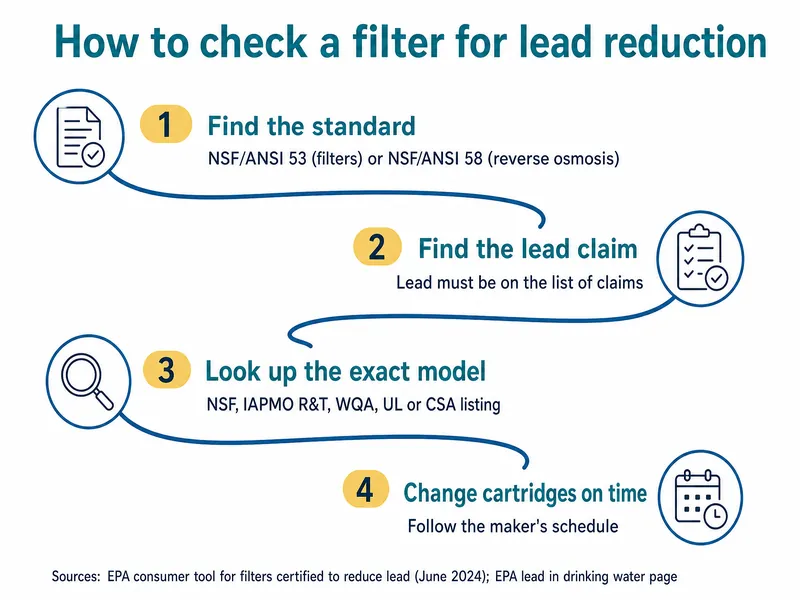
Look the exact model up in the certifier's own directory. EPA lists five ANSI-accredited certifiers for lead filters, each with its own mark and online listing: NSF, IAPMO R&T, WQA, UL Solutions and CSA Group.
Work through it in this order:
- Find the mark and the standard on the box or the performance data sheet inside it: NSF/ANSI 53 for filters, NSF/ANSI 58 for RO.
- Find "lead" in the claims. The performance data sheet lists each contaminant tested.
- Search the certifier's directory by brand and model number. Model letters matter: G3P600 and G3-W share a file number but not a claim list.
- Check the status and dates. IAPMO's certificate for file WC-13976 showed the listing as active, expiring November 21, 2027.
If the seller and the listing disagree, believe the listing. One store's G3-W page names NSF International as the certifier; the certificate is actually from IAPMO R&T and has no lead claim for that model.
Lead filters by the numbers
- 5 ppblead level a certified filter is tested to reach or beatSource: EPA consumer tool, June 2024
- 5ANSI-accredited certifiers that list lead filtersSource: EPA consumer tool, June 2024
- 3 of 106Fort Wayne homes over 15 ppb lead, first half of 2025Source: City Utilities report, 2026
- 23.7 ppbhighest Fort Wayne home result, first half of 2025Source: City Utilities report, 2026
Does boiling or a softener remove lead?
No. EPA and City Utilities both state that boiling water does not remove lead; it only boils off water. Use cold water for drinking, cooking and baby formula, since hot water draws more lead from pipes.
A water softener is sold to reduce hardness. This site searched the NSF, WQA and IAPMO directories for the softeners and whole-house carbon filters sold by SoftPro Water Systems and Quality Water Treatment and found no NSF/ANSI 53 or 58 lead-reduction listing for any of them. A whole-house system also treats water before it reaches the old faucets and solder that can add lead, so a certified filter at the drinking tap is the right place for this job. Do you need a water softener in Fort Wayne covers what softeners are actually for.
When should Fort Wayne homes use a lead filter?
Use one if your house has a lead, galvanized or unknown service line, or after any work on that line. The city's 2026 report says Fort Wayne's water is lead-free leaving the plant, but 3 of 106 homes sampled from January to June 2025 were above the 15 ppb action level, with a high of 23.7 ppb, and the report advises a certified filter for anyone concerned about lead.
Check your line on the city map first: does my house have a lead service line shows how. A filter is a bridge, not a fix; the city program that replaces private lines is laid out on the page about Fort Wayne's replacement program. Under EPA's new lead rule, from November 2027 water systems must hand out lead-certified filters after replacing or disturbing a lead line.
Young children are particularly vulnerable to lead, City Utilities' brochure notes, so homes with infants on formula or small children are the first place to use one. A test from a lab on the state certified-lab list tells you whether your tap needs it.
How do you keep a lead filter working?
Change the cartridge on the maker's schedule. EPA warns that a cartridge used past its rated life can lose its ability to reduce lead, and the certified capacity in the listing is measured in gallons, so a busy kitchen will reach it sooner than the calendar suggests.
Run only cold water through it, and clean the faucet aerator now and then, since EPA says lead particles can collect there. For reverse osmosis, replace the pre-filters and the membrane at the intervals in the manual; the replacement part numbers are on the certificate (WD-G3P600-RO for the G3P600's RO stage).
If you want an RO unit that is certified for lead, the Waterdrop G3P600 (sold by SoftPro Water Systems, same owners as this site) is certified by IAPMO R&T to NSF/ANSI 58 for lead, TDS, fluoride, cadmium, barium and radium reduction (file WC-13976). The store's listed price in October 2026 was $429. A certified pitcher or faucet filter is a lower-cost option, and the same lookup steps apply.
How this answer was put together
This answer is based on EPA's June 2024 consumer tool for identifying filters certified to reduce lead, EPA's basic information page on lead in drinking water (updated June 18, 2026), City Utilities' 2026 water quality report (2025 lead sampling) and 2025 lead line brochure, the Lead and Copper Rule Improvements overview and briefing slides from EPA, and IAPMO R&T certificates WC-13976 and WC-14805, plus searches of the NSF, WQA and IAPMO directories run October 26, 2026. It leaves out product reviews, sellers' own contaminant lists and any filter whose listing could not be found.
Follow-up questions
Does a refrigerator filter reduce lead?
Some do. EPA's consumer tool covers refrigerator filters, and the same rule applies: look for NSF/ANSI 53 with lead in the claims, and check the model in the certifier's directory.
Is NSF/ANSI 42 enough for lead?
No. NSF/ANSI 42 covers aesthetic effects such as chlorine taste and odor, plus particulate classes. EPA recommends a Class 1 particulate claim alongside an NSF/ANSI 53 lead claim, not instead of it.
Does a whole-house carbon filter reduce lead?
Not by any listing this site found. The whole-house carbon filters it checked carry only materials marks such as NSF/ANSI 61 and 372, which say nothing about lead in the water.
Does a pitcher filter work as well as reverse osmosis for lead?
Both can be certified to the same lead result: reduction to 5 ppb or less in testing. A pitcher costs less up front but needs frequent cartridge changes; RO also reduces other contaminants named in its listing.
Is a "lead-free" filter the same as a lead-reducing filter?
No. NSF/ANSI 372 means the product's parts are made from lead-free materials. Only a 53 or 58 listing with a lead claim shows it reduces lead in the water.
Should Fort Wayne homes with copper service lines use a lead filter?
Not usually for the service line alone, but older faucets and lead solder inside the house can still add lead. A certified lab test settles it.
Do I need a lead filter on well water?
Test first. The Indiana Department of Health suggests testing a private well for lead at least every 5 years, and the state lab charges $20 for arsenic, lead and copper; see how often to test your well.
More questions about filters and lead
Have another question? See Fort Wayne home water questions, answered.