How Long Does a Water Heater Last?
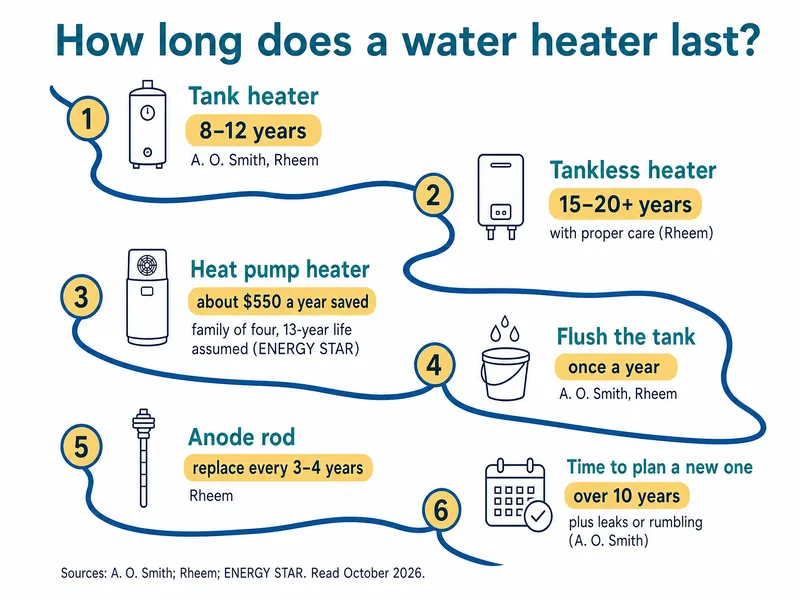
How long does a water heater last? A tank model lasts about 8 to 12 years, say makers A. O. Smith and Rheem, while Rheem puts tankless units at 15 to 20 or more years with proper care.
Answered by the Three Rivers Home Water desk · Last updated
In this answer
The short version
- Tank water heaters last "about 8 to 12 years" on average, based on makers' suggested service life (A. O. Smith; Rheem).
- Rheem says tankless units can last 15 to 20+ years with proper care, because they heat on demand instead of holding a full tank hot.
- Both makers say to flush the tank once a year; Rheem adds replacing the anode rod every 3 to 4 years.
- Fort Wayne city water averaged 130 mg/L (about 7.6 gpg) of hardness in 2025, which the U.S. Geological Survey scale calls hard; Rheem lists hard water among the things that speed up wear.
- A. O. Smith's rule of thumb: over 10 years old and leaking at the base or acting erratically usually means replacement.
- ENERGY STAR estimates a heat pump water heater saves a family of four about $550 a year against a standard electric model, installed where the space stays 40 to 90°F.
How long does a water heater last?
A standard tank water heater lasts about 8 to 12 years. That range comes from the makers themselves: A. O. Smith says the average life expectancy, "based on the manufacturer's suggested service life," is about 8 to 12 years, and Rheem gives the same 8–12 years for traditional tanks.
The range is wide because no two installations are alike. A. O. Smith names the location and design of the unit, quality of installation, maintenance schedule and water quality as the things that move a heater toward one end or the other. Neither maker gives separate figures for gas and electric tanks.
To find your heater's age, look at the rating plate on the side of the tank. It lists the model and serial number. Brands encode the build date in different ways, so ask the maker to date the unit from the serial number.
Water heater life in numbers
- 8–12 yearsAverage life of a tank water heaterSource: A. O. Smith
- 15–20+ yearsTankless life "with proper care"Source: Rheem
- 3–4 yearsHow often Rheem says to replace the anode rodSource: Rheem
- 130 mg/LFort Wayne average hardness, 2025 dataSource: City Utilities 2026 water quality report
- $550 a yearENERGY STAR heat pump savings estimate, family of fourSource: ENERGY STAR
What shortens a water heater's life?
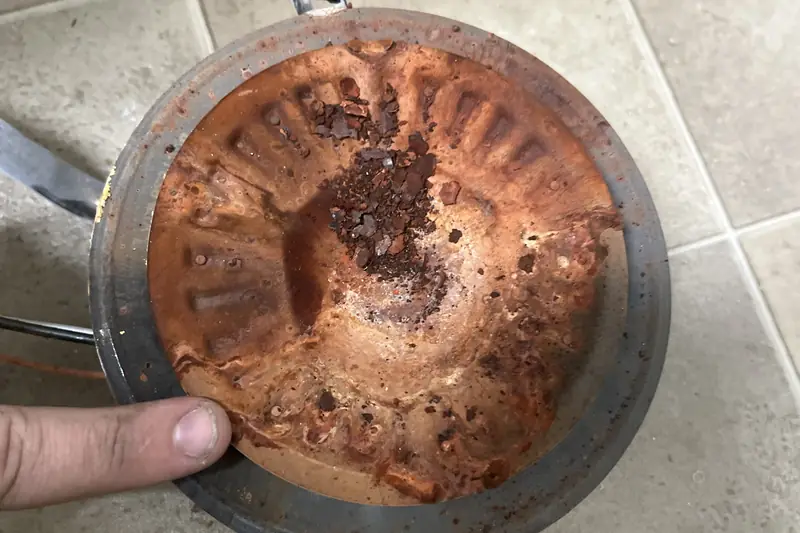
Hard water, heavy demand and skipped maintenance shorten it most. Rheem names all three, and adds that the sacrificial anode rod protects the tank from corrosion until it is used up, after which "the tank itself starts to rust."
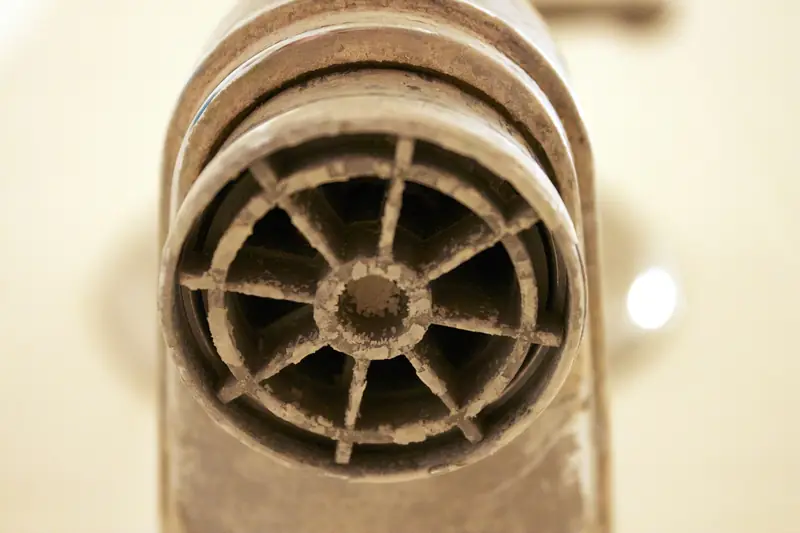
Hardness matters because of scale. Purdue Extension's WQ-5 explains that when water is heated, calcium and magnesium salts fall out of solution and form scale in water heaters. City Utilities' 2026 water quality report (2025 data) lists an average of 130 mg/L (about 7.6 grains per gallon), ranging from 94 to 174 mg/L. The USGS hardness scale puts 121–180 mg/L in its "hard" band. Reports print these as ppm, which is the same as mg/L. For the full picture, read is Fort Wayne water hard?
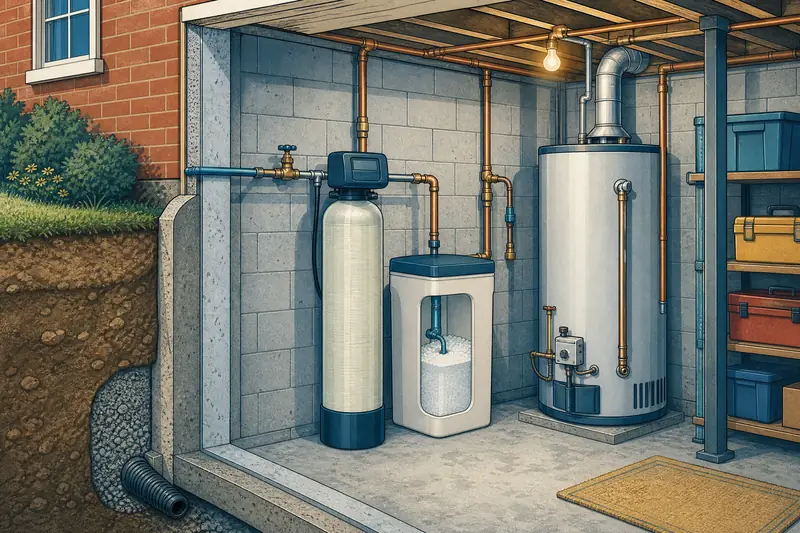
Well water in Allen County is usually harder. Purdue says "virtually all" Indiana groundwater is over 180 ppm, the level at which it recommends a softener. If your heater sits on a private well, the tank sees more scale per gallon, and annual flushing matters more. Whether a softener makes sense for your house is covered in do I need a water softener in Fort Wayne?
What are signs a water heater is failing?
Leaks at the base, rusty hot water, and rumbling or popping from the tank are the main signs. Rheem lists all three, and says an age of 10 to 15 years or more combined with recurring problems "is a strong signal" on its own.
Each sign points at something different:
- Water pooling at the base. A leak from the tank itself usually means corrosion has gone through the steel. Leaks at fittings or the relief valve line can be other parts.
- Rumbling or popping. A. O. Smith says strange noises "typically mean you have sediment buildup at the bottom of the tank." If they continue after a repair, it warns of a failing element or a cracked tank.
- Rusty or odd-smelling hot water. If only the hot side smells like rotten eggs, Purdue's WQ-11 explains that a magnesium anode can release hydrogen that combines with sulfur in the water, which mostly matters on wells. See why does my well water smell like rotten eggs?
- Not enough hot water. A. O. Smith links this to a failing thermostat or sediment, and says flushing can fix it.
Water running from the temperature and pressure relief valve's pipe is a different warning. The 2018 International Residential Code, which Indiana adopted for this section without changes, requires that valve to open at no more than 210°F and no more than 150 psi (ICC, IRC chapter 28). Never cap or plug that pipe.
| Situation | Maker guidance | Source |
|---|---|---|
| Under 6–8 years old, no tank corrosion, repair well under half the cost of a new unit | Repair usually makes sense | Rheem |
| Repair would cost more than 50% of a new unit | Replacement "is almost always the better investment" | Rheem |
| Several repairs in a short time | Points to wider internal wear; consider replacing | Rheem |
| Over 10 years old and leaking at the base or erratic | "Probably time to replace" | A. O. Smith |
| Over 10 years old with several symptoms | Replacement "is usually the better path" | A. O. Smith |
| Leaks at a fitting or no hot water on a young unit | May be repairable; check the warranty first | A. O. Smith |
Should you repair or replace an old water heater?
Replace it when it is past 10 years and showing symptoms, or when a repair costs more than half the price of a new unit. That is Rheem's 50% rule of thumb, and it adds that units over 10 years old "are more likely to experience additional failures soon after one is fixed."
Repair makes sense on a younger tank with one worn part, such as an element, a thermostat or a gas valve. A. O. Smith tells owners to factor in the warranty before deciding, since parts or the whole tank may still be covered.
If you replace it, plan the job before the old one fails. Indiana's version of the residential code drops the drain-pan requirement only when the heater sits on a water-resistant floor sloped to a floor drain in the same room (675 IAC 14-4.4-162). Gas venting, gas lines and the relief valve discharge all have code rules, and a gas heater swap is work for a licensed plumber. Whether Indiana lets a homeowner do any of it is covered in the DIY plumbing rules question.
How long does a tankless water heater last?
Rheem says tankless water heaters "can last 15–20+ years with proper care," roughly twice a tank. It explains that tankless units heat water only on demand and so wear more slowly than a tank that holds hot water all day.
Proper care still includes dealing with scale. Hard water passes through a tankless unit's heat exchanger every time a tap opens, so follow the maker's descaling schedule in the manual for your model. On harder well water, that schedule matters more.
Is a heat pump water heater worth it?
For many electric-heater homes, yes, by ENERGY STAR's own estimate. It says a certified heat pump water heater can save a household of four about $550 a year compared with a standard electric water heater, and more than $5,610 over its lifetime (ENERGY STAR).
Those figures rest on ENERGY STAR's assumptions: electricity at $0.146 per kWh, a $1,503 higher purchase cost and a 13-year life. Your rate and household size will change the result, so treat it as an estimate.
Placement matters in northern Indiana. ENERGY STAR says to install these units in interior spaces that stay between 40 and 90°F year-round, with 1,000 cubic feet of air around them. Fort Wayne International Airport averages 123.6 nights a year at or below 32°F (NOAA NCEI 1991–2020 normals), so an unheated garage is a poor spot; a basement usually is not. For the rest of the cold-weather picture, see keeping pipes from freezing and the winter pipes and heaters questions.
How this answer was put together
This answer is based on A. O. Smith's "when to repair or replace" page and Rheem's water heater lifespan article (both read October 2026), ENERGY STAR's heat pump water heater pages, Purdue Extension WQ-5 and WQ-11, the USGS hardness scale, City Utilities' 2026 water quality report (2025 data), the 2018 International Residential Code chapter 28 with Indiana's 2020 amendments, and NOAA NCEI 1991–2020 climate normals for Fort Wayne International Airport. It leaves out installed prices, brand rankings and repair cost figures, which were not found in a primary source. No heaters were tested for this page.
Follow-up questions
How do I tell how old my water heater is?
Read the rating plate on the tank for the model and serial number. Brands encode the build date differently, so the maker's website or customer line is the reliable way to decode it. A. O. Smith's average life of 8 to 12 years counts from installation.
Does a water softener make a water heater last longer?
Softening reduces the hardness that forms scale when water is heated, which Purdue Extension describes. Rheem lists hard water among the causes of faster wear. No maker figure for added years was found, so this site doesn't give one.
How often should a water heater be flushed in Fort Wayne?
Both A. O. Smith and Rheem say at least once a year. City water averaged 130 mg/L of hardness in 2025, and most well water is harder, so sediment builds up either way.
Is it normal for a water heater to make popping noises?
A. O. Smith says noises typically mean sediment at the bottom of the tank. Flushing often helps. If noises continue after a repair, it suggests a failing element or a cracked tank.
Can a heat pump water heater go in a Fort Wayne garage?
ENERGY STAR says the space should stay between 40 and 90°F all year. Fort Wayne's January average low is 18.4°F (NCEI 1991–2020), so an unheated garage usually falls outside that range.
What does the relief valve pipe on a water heater do?
It carries water away if the tank overheats or overpressurizes. The residential code says the pipe must end no more than 6 inches above the floor or drain, with no valve and no threaded end. Water coming out of it is a reason to call a licensed plumber.
Does a gas water heater last longer than an electric one?
Neither A. O. Smith nor Rheem separates the two; both give tanks 8 to 12 years. Maintenance and water quality make more difference in their guidance than the fuel.
Next questions about hot water and winter

Have another question? See every Fort Wayne home water answer.