Is a Salt-Free Water Conditioner Worth It?
Is a salt-free water conditioner worth it? Sometimes, on clean city water when you only want less scale: it leaves the hardness in, and Nebraska Extension says few conclusive studies confirm how well these devices work in homes.
Answered by the Three Rivers Home Water desk · Last updated
About the store links on this page: SoftPro Water Systems and Quality Water Treatment, the two stores linked on this page, have the same owners as Three Rivers Home Water. Answers here lean on Fort Wayne City Utilities' published reports and rules, Indiana and federal agency guidance and makers' certification listings, read in October 2026. What a store says about its own products is quoted as the store's claim. How store links work
In this answer
The short version
- Nebraska Extension's NebGuide G2275 (December 2025) calls salt-free units "descalant devices as opposed to hardness removing devices."
- Template-assisted crystallization (TAC) converts dissolved hardness into tiny crystals that don't stick, it says; it does not remove it.
- EPA WaterSense's May 2026 softener guide says to look for the IAPMO/ANSI Z601 standard for scale reduction devices.
- Fort Wayne city water averaged 130 mg/L (about 7.6 gpg) in 2025, well inside the 75-grain limit SoftPro lists for its FORTRESS unit.
- That listing voids the warranty above 2.0 ppm of chlorine without pretreatment; the city's highest 2025 chlorine reading was 2.10 ppm.
- G2275 says salt-free units are generally not designed to remove iron or manganese, which rules most of them out for raw well water.
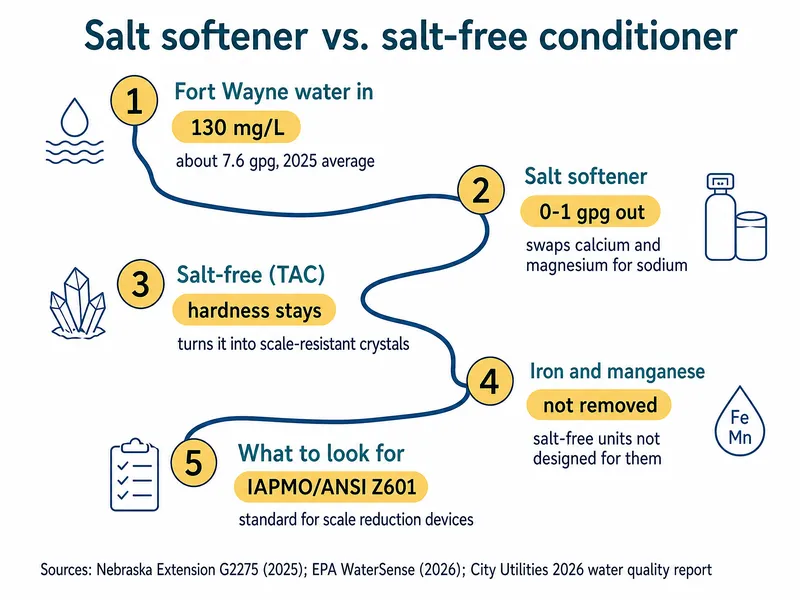
A salt softener and a salt-free conditioner answer different questions. The softener takes calcium and magnesium out of the water. The conditioner leaves them in and tries to stop them forming scale.
What does a salt-free water conditioner do?
A salt-free water conditioner changes the form of the hardness so less of it sticks as scale. G2275 says these point-of-entry devices "do not remove the hardness from the water, but instead change the form of the hardness to minimize scale build up."
The most common type in home units is template-assisted crystallization. In G2275's description, TAC "uses surface-treated resin beads to convert (not remove) dissolved hardness ions to microscopic scale-resistant crystals." Once released, the crystals are insoluble particles; in some cases "a fine dust may form on dishes but it can be wiped away."
SoftPro's FORTRESS listing (sold by SoftPro Water Systems, same owners as this site) names TAC as its technology and says it "doesn't remove existing scale" already in old pipes. Magnetic and electronic gadgets are a different category: G2275 says magnetic treatment "should be regarded as unproven technology without a strong scientific basis."
Salt-free conditioner numbers
- 130 mg/LFort Wayne 2025 average hardness (about 7.6 gpg)Source: City Utilities 2026 report
- 0–1 gpgHardness after an ion exchange softener ("soft" range)Source: Nebraska Extension G2275
- 2.10 ppmHighest chlorine reading on city water in 2025Source: City Utilities 2026 report
- Z601IAPMO/ANSI standard EPA says salt-free units should meetSource: EPA WaterSense softener guide
Is a salt-free conditioner a water softener?
No: a salt-free conditioner is not a water softener, even when a store titles it one. EPA's guide says they work "instead of removing the hardness ions," and G2275 says ion exchange softening is what brings water to the "soft" range of 0–1 gpg.
On Fort Wayne city water, that means water through a TAC unit still tests about 7.6 gpg on an average day (the city reported 94–174 mg/L across 2025, or about 5.5–10.2 gpg). A hardness test strip after the unit will read the same as before it. The difference is meant to show up as less scale, not a lower number.
It also means none of the effects that come from removing hardness. Soap still behaves as it does in hard water. No sodium is added, because nothing is exchanged. G2275 adds that, beyond what vendors say, no studies confirm which of these technologies help with poor soap and detergent performance.
When is a salt-free conditioner worth it?
A salt-free conditioner is worth considering when you want some scale control on clean city water and can't or won't use salt. EPA's guide names the cases: people "with certain medical conditions," and places where softeners are prohibited. It also avoids the brine discharge and the 20–70 gallons per regeneration that EPA says a typical softener uses.
The honest caveat is the evidence. G2275 says some research supports these devices as anti-scaling treatment at industrial scale, "but few conclusive studies confirm the efficiency of these devices for residential use." Until a household standard is common, it says, "consumers cannot tell for certain which products best reduce scale buildup in the home." That is why EPA points buyers to IAPMO/ANSI Z601.
Check what any listing actually certifies. The FORTRESS listing names IAPMO R&T certification to NSF/ANSI/CAN 61, a standard for materials that touch drinking water; it does not name Z601. On the USGS hardness scale the city's 130 mg/L average sits in the hard band, not the very hard one above 180. City water here also falls below the 180 ppm point where Purdue recommends softening, which makes any hardness treatment optional; do I need a water softener in Fort Wayne? covers that.
| Question | Salt softener (ion exchange) | Salt-free conditioner (TAC) | Source |
|---|---|---|---|
| Hardness after treatment | 0–1 gpg ("soft") | Unchanged, about 7.6 gpg average | Nebraska G2275; city 2026 report |
| Salt and brine | Yes; 20–70 gallons per regeneration | None | EPA WaterSense guide |
| Sodium added | About 8 mg/L per gpg removed | None | Nebraska G1491 |
| Iron and manganese | Some dissolved iron, within the maker's rating | Generally not designed for them | Nebraska G1491, G2275 |
| Standard to look for | NSF/ANSI 44 | IAPMO/ANSI Z601 | EPA WaterSense guide |
When does a salt softener make more sense?
A salt softener makes more sense when hardness is high, the water carries iron, or when you want the effects of truly soft water. Purdue Extension's WQ-5 says water over 180 ppm "should be conditioned with a water softener," and that "virtually all" Indiana groundwater is in that range.
Iron is the usual deal-breaker on Allen County wells. G2275 says salt-free alternatives are generally not designed to remove iron and manganese and need pretreatment or an ion exchange softener instead. Purdue puts typical Indiana groundwater iron at 0.1–3.0 ppm, with staining above 0.3 ppm. If your well test shows iron, start with what well water treatment do I need?, and size any softener with what size water softener do I need?.
A softener is also the choice if the goal is soap and spotting rather than scale alone, since only removing hardness changes how water behaves with detergent.
What does a salt-free conditioner need upstream?
A salt-free conditioner needs clean water in. G2275 says TAC systems "typically require relatively clean water as the input, and may require pretreatment if the water contains high iron and manganese concentrations or other sediment."
Chlorine is the other limit to read for. SoftPro's FORTRESS listing excludes media damage from chlorine or oxidizers and voids the warranty when chlorine is above 2.0 ppm without pretreatment. City Utilities' 2026 water quality report lists a 2025 chlorine range of 1.54–2.10 ppm, so the top of that range edges past the listing's limit. Ask the seller whether a carbon prefilter is expected on Fort Wayne water; should I filter chlorine from Fort Wayne water? explains carbon filters.
The FORTRESS listing gives a 75-grain hardness limit, 40–100°F water and 90 psi maximum pressure, and flow ratings of up to 6, 10 and 16 gallons a minute for its Home, Pro and Commercial sizes.
How long does a salt-free conditioner last?
The media in a salt-free conditioner wears out and has to be replaced on the maker's schedule. SoftPro's FORTRESS listing expects Home media to be replaced within 2 years and gives Pro and Commercial media up to 5 years, with a 1-year limited warranty on the unit. No extension or government source gives a general lifespan for TAC media, so go by the manual of the unit you buy.
On price, the FORTRESS listing ran $229–$1,259 by size, and SoftPro's Elite salt-free conditioner (sold by SoftPro Water Systems, same owners as this site) and Quality Water Treatment's Elite no-salt conditioner (sold by Quality Water Treatment, same owners as this site) were each listed at $1,299 (the stores' listed prices in October 2026). Those store pages describe the units as reducing scale without salt; neither removes hardness minerals.
How this answer was put together
This answer is based on Nebraska Extension NebGuides G2275 (December 2025) and G1491; EPA WaterSense's softener selection guide (May 2026); Purdue Extension WQ-5; City Utilities' 2026 report on 2025 water; and SoftPro's FORTRESS product listing for its limits, media life and warranty. All were read in October 2026. Left out: the stores' claims about minerals and health, and any percentage of scale prevention, because no third-party performance test of these models was found. Electronic and magnetic descalers are not covered beyond Nebraska Extension's verdict.
Follow-up questions
Will a salt-free conditioner remove scale already in my pipes?
Don't count on it. SoftPro's own FORTRESS listing says it doesn't remove existing scale buildup in old pipes or appliances.
Does a salt-free conditioner add sodium?
No. Nothing is exchanged, so no sodium or potassium is added. Hardness stays in the water instead.
Will a hardness test strip show a difference after a salt-free unit?
It shouldn't. TAC converts hardness rather than removing it, so the grains per gallon reading stays about the same.
Can I use a salt-free conditioner on a well?
Only after a lab test and usually with pretreatment. Nebraska Extension says these units are generally not designed for iron and manganese and need relatively clean water in.
Is a magnetic or electronic descaler the same thing?
No. Nebraska Extension treats magnetic devices as unproven, and the site does not link them.
Does a salt-free conditioner need a drain or electricity?
They need no salt or brine. Nebraska Extension says these no-salt technologies generally use electricity, though at a lower rate than most home appliances; check the unit's manual for power, drain and bypass needs.
Will it make water feel soft?
Not the way a softener does. The calcium and magnesium are still there, so soap and detergent behave as they do with hard water.
Next questions
Have another question? See every Fort Wayne home water answer.