Do I Need a Sump Pump Backup?
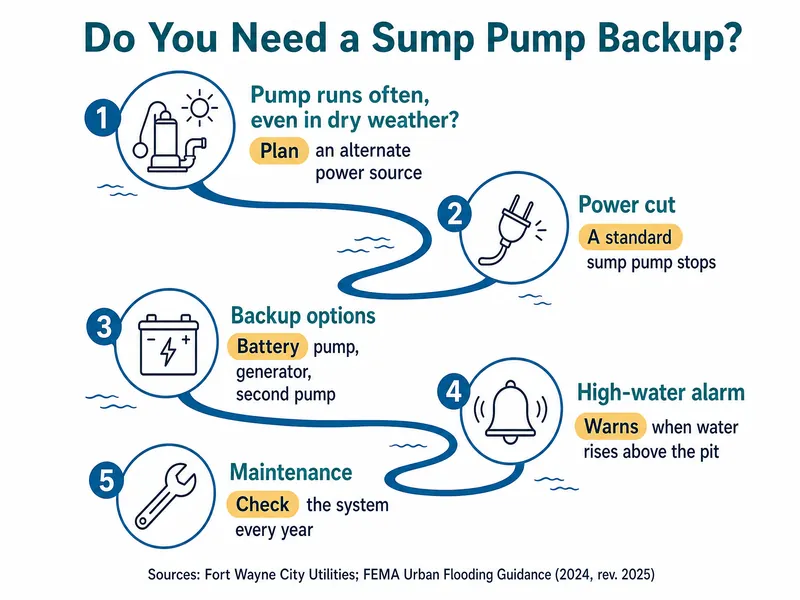
Do I need a sump pump backup? If your pump runs often, your basement is finished, or storms cut your power, yes: FEMA notes an ordinary sump pump stops when the electricity does.
Answered by the Three Rivers Home Water desk · Last updated
In this answer
The short version
- FEMA's urban flooding guidance says sump pumps won't work "when electricity is off" and that you would need battery storage or a generator to keep one running in an outage.
- Fort Wayne City Utilities advises: if your sump pump "runs frequently even when it's not raining, consider an alternate power source."
- FEMA's homeowner checklist asks three sump questions: is there battery backup, is there a high-water alarm, and is the pump maintained every year.
- The NFIP flood policy excludes water that overflows from a sump or sump pump unless a flood in the area is the direct cause (FEMA dwelling policy, 2021).
- This site found no primary-source run time for battery backups: run time depends on the battery, the pump and how often it cycles, so read the maker's own chart.
Do you need a sump pump backup?
You need a sump pump backup if losing the pump for a few hours would put water on your basement floor. That is most homes where the pump cycles in wet weather, and nearly every home with a finished basement, a furnace or a water heater on that floor.
Two official sources point the same way. FEMA's Urban Flooding guidance (November 2024, revised May 2025) says sump pumps "are not designed to handle large amounts of water, nor will they work when electricity is off," and that "you would need to add battery storage or a generator" to keep one going during an outage. Fort Wayne City Utilities' heavy-precipitation page puts the test simply: if the pump runs often even in dry weather, plan an alternate power source.
Ask yourself three questions:
- Does the pump run during ordinary rain, or even on dry days?
- Has the power gone out during a storm at this house before?
- What sits on the basement floor: storage boxes, or carpet, drywall, a furnace and a water heater?
Two "yes" answers and anything valuable downstairs make a backup worth planning.
What kinds of sump pump backup are there?
There are four common setups, and they solve different problems. A battery or generator covers a power cut; a second pump covers a failed or overwhelmed primary pump; an alarm only tells you something is wrong.
| Option | Covers a power cut | Covers a failed primary pump | Notes |
|---|---|---|---|
| Battery backup pump | Yes, until the battery runs down | Yes | Separate pump and float in the same pit; needs battery care |
| Generator (portable or standby) | Yes, while fueled | No | Runs the existing pump; FEMA links its generator safety advice |
| Second electric pump | No | Yes | Helps when inflow beats one pump; same power source |
| Water-powered backup | Yes | Yes | Uses city water pressure; this site found no FEMA guidance on it |
| High-water alarm | Alerts only | Alerts only | FEMA's checklist suggests one; choose one with a battery |
A battery backup pump is a second, smaller pump with its own float, wired to a charger and a deep-cycle battery. When the main pump stops or the water climbs past its float, the backup takes over.
A generator keeps the main pump itself running. FEMA's guide links its generator safety sheet; a portable generator never runs inside the house or an attached garage.
A water-powered backup uses pressure from your drinking-water line to pull water out of the pit. Because it ties into the drinking-water plumbing, ask the installer how it will be protected against backflow under the plumbing code.
How long does a battery backup sump pump run?
It depends on the battery's capacity, how much current the backup pump draws, how high it has to lift the water and how often the pit refills. A pump that cycles once an hour can last far longer on one charge than a pump running almost nonstop in a spring storm.
No federal or state agency publishes a standard run-time figure, and this site does not repeat sellers' numbers. To size one honestly:
- Ask for the maker's run-time chart for that pump with that battery, at your discharge height.
- Time your primary pump in a heavy rain: how many seconds it runs and how many minutes between cycles.
- Plan for a long outage, not an average one, and know whether you can add a second battery.
Batteries also age. Check the charger's status light every month and follow the maker's replacement interval for the battery.
How do you test a sump pump?
Test it the way rain would: fill the pit and watch. FEMA's checklist asks whether the pump "is maintained annually," and a spring test before the wet season is a sensible habit.
- Check the power. Make sure the pump is plugged in to a working outlet, ideally one it doesn't share with other appliances.
- Fill the pit slowly with a bucket of water until the float rises. The pump should start, empty the pit and shut off cleanly.
- Check the discharge. Go outside while it runs: water should leave the pipe freely and flow away from the house, not pool by the foundation.
- Watch the pit after shut-off. If water runs back down the pipe into the pit, the check valve may be failing.
- Test the backup. Unplug the main pump and fill the pit again. The backup should start on its own float, and any alarm should sound.
- Clear debris from the pit and the pump's intake screen.
If the pump hums but doesn't move water, or the float sticks, call a licensed plumbing contractor before the next storm.
Does insurance cover a failed sump pump?
Often not without an add-on. FEMA says most homeowners policies don't cover flood and "may not cover sewer backup and surface flooding." Water from a failed or overwhelmed sump pump usually sits in that same gap.
The federal flood policy is narrow here too. The NFIP dwelling policy excludes water that "discharges or overflows from a sump, sump pump, or related equipment" unless there is a flood in the area and the flood is the proximate cause. FEMA's basement coverage explainer says NFIP basement coverage is "limited": it lists sump pumps, furnaces and water heaters as covered items, but not finished walls, floors or most contents.
So ask your insurer two things: is there a sewer or drain backup endorsement, and does it name sump pump overflow? Get the answer in writing.
Sump pump backup facts
- 2power sources FEMA names for an outage: battery storage or a generatorSource: FEMA Urban Flooding guidance (2024/2025)
- 1 yearhow often FEMA's checklist expects the sump pump to be maintainedSource: FEMA Urban Flooding guidance
- 0sump connections allowed to the sanitary sewer in Fort WayneSource: City Utilities wastewater rules (2026)
What size sump pump backup do you need?
Size the backup against the water you actually get, not the box label. The figure that matters is how many gallons the pump moves at your real lift: the height from the pit to the point where the discharge pipe leaves the house, plus the run of pipe outside.
Pump makers publish performance tables that show flow at different heights. Ask for that table for the backup model, and compare it with what your primary pump does at the same height. A backup that moves much less than your main pump can still save the floor in a power cut, but it may not keep up in the worst storm on its own.
Wherever the water goes, it can't go to the sanitary sewer. The Fort Wayne wastewater rules (October 2026) bar sump pumps from it "directly or indirectly"; see can my sump pump drain into the sewer. If the water in your basement comes up a floor drain instead of into the pit, a backup pump won't help: read do I need a backwater valve. For all the causes, start at why does my basement flood when it rains.

How this answer was put together
Based on FEMA's Urban Flooding: Guidance for Homeowners and Renters (November 2024, revised May 2025), the NFIP Dwelling Form Standard Flood Insurance Policy (F-122, 2021), FEMA's explainer on basement flood coverage (updated October 2025), Fort Wayne City Utilities' heavy-precipitation page and its Wastewater Rules and Regulations as amended October 20, 2026, all read in October 2026. Left out on purpose: battery run times, pump flow ratings and prices, because no government or extension source publishes them and sellers' figures can't be checked; brand names; and any claim about water-powered backups beyond what they are.
Follow-up questions
Does a battery backup sump pump need its own pit?
Usually not. Most battery backups sit in the same pit as the main pump, with their own float set a little higher so they start only when the water passes the main pump's level. Ask the installer to make sure the two floats can't snag each other.
Can I run my sump pump on a generator?
Yes, if the generator is sized for the pump's starting load and set up safely. FEMA's guide links its generator-safety sheet; never run a portable generator indoors or in an attached garage. An electrician can tell you whether you need a transfer switch.
Should a sump pump have an alarm?
FEMA's checklist asks whether there is an alarm to warn you that the water has risen above the top of the sump. A battery-powered alarm keeps working in an outage, which is when you most need it.
How often should a sump pump run?
There is no single right number. A pump that runs during rain is normal; City Utilities flags a pump that "runs frequently even when it's not raining" as the case for an alternate power source.
Does City Utilities help pay for a backup sump pump?
This site found no Fort Wayne program that pays for backup sump pumps, backwater valves or downspout work. The utility's optional service-line protection plan covers buried water and sewer lines, not pumps.
Do I need a permit to add a backup sump pump?
That depends on the work, such as new wiring or a new discharge line. Check with the building department before you start. Indiana's plumbing license law lets an owner-occupant of a home with 8 or fewer units work on their own plumbing, but codes still apply.
Next questions


Have another question? See every Fort Wayne home water answer.