Can My Sump Pump Drain Into the Sewer?
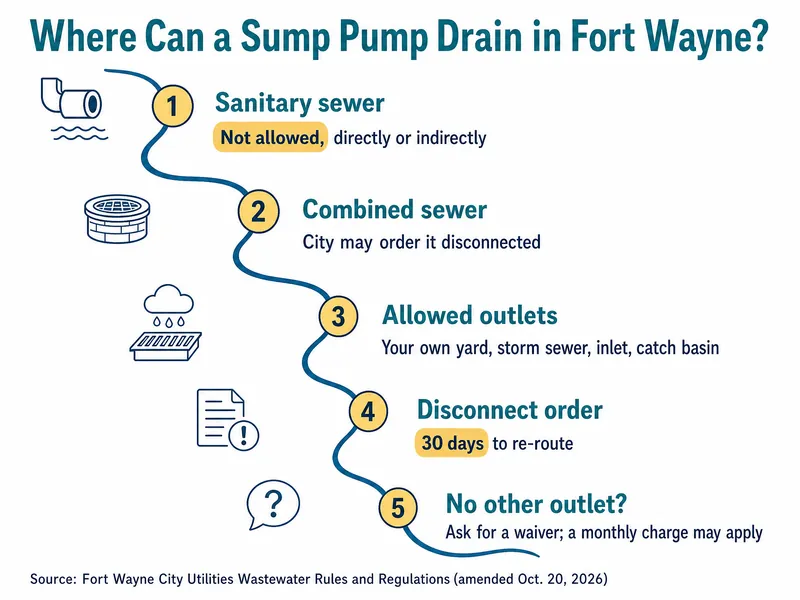
Can my sump pump drain into the sewer in Fort Wayne? Not into the sanitary sewer: City Utilities' 2026 rules ban it "directly or indirectly," and the utility can order a combined-sewer hookup removed too.
Answered by the Three Rivers Home Water desk · Last updated

In this answer
The short version
- Section 14 of the City Utilities wastewater rules (amended October 20, 2026) says no person may connect a sump pump, roof downspout, yard drain or geothermal system "either directly or indirectly, to a sanitary sewer."
- The same rules let the utility order those drains off a combined sewer too, "in its discretion."
- After a disconnection order the owner has 30 days to re-route the water to the ground of the property, a storm sewer or another stormwater facility.
- Where there is truly no other outlet, the owner may ask for a waiver, which can be limited to months such as November to March and may carry a monthly charge under City Code section 51.074.
- About one-third of Fort Wayne is on combined sewers, where rain and sewage share a pipe (City Utilities).
Can a sump pump drain into the sewer in Fort Wayne?
No, not into the sanitary sewer, and possibly not into a combined sewer either. The Water Pollution Control Utility General Rules and Regulations that City Utilities amended on October 20, 2026 cover this in section 14, "Special Discharges." The general rule is that clear-water drains, a list that names sump pumps, downspouts, roof drains, surface drains and subsoil drains, go to a storm sewer or other stormwater outlet "whenever possible," and "in no event shall such discharge be directed to a sanitary sewer."
"Indirectly" matters. A hose from the sump into a laundry tub, a floor drain or a basement toilet still ends up in the sanitary line, so it counts. So does a buried pipe from the sump that joins the house sewer outside.
Combined sewers are the gray area. The rules let the utility require disconnection from a combined sewer "if the Utility determines, in its discretion, that disconnection is appropriate or necessary." In practice that means an existing combined hookup isn't automatically illegal, but it isn't protected either.
Why does the city ban sump pumps in the sewer?
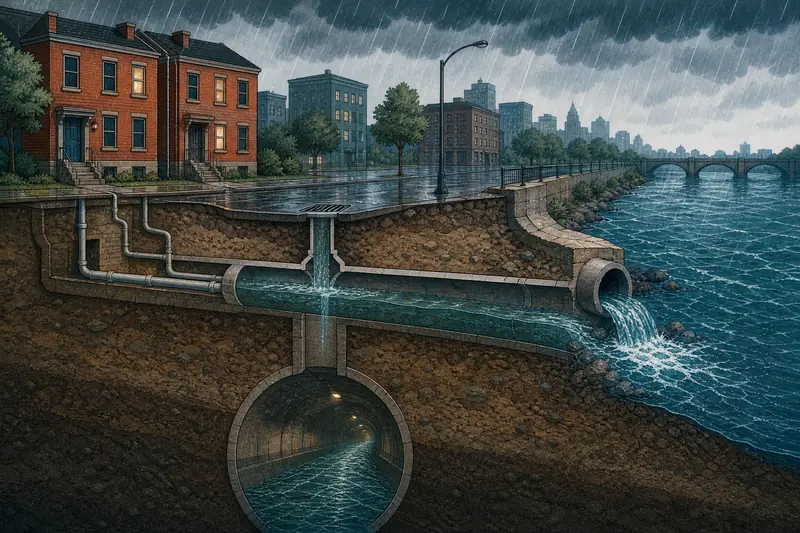
Because rainwater takes up room the sewage needs. A sanitary sewer is sized for what drains out of homes, not for groundwater and roof runoff. When hundreds of sump pumps and downspouts feed it in a storm, the pipes fill, and the extra flow either spills out of the system or backs up through the lowest drains on the street.
In the combined area the stakes are rivers. City Utilities says about a third of Fort Wayne is served by combined sewers, with 44 overflow outfalls to the three rivers and their tributaries. Every gallon of clear water kept out of those pipes is room for sewage on the way to the treatment plant. The city built a 24,519-foot tunnel to store that overflow; see what is a combined sewer overflow.
There's a self-interest angle too. Your basement floor drain connects to the same house sewer. Pumping groundwater into it during a storm adds to the load at exactly the moment you need it to drain.
Where can a sump pump drain?
The rules name the acceptable places: "the ground of the property served, a storm sewer, or other stormwater facility (such as an inlet, catch basin, or waterbody)." For most homes that means the yard. City Utilities' heavy-rain checklist adds a practical point: make sure the pump works, and if it runs often even in dry weather, consider an alternate power source.
| Outlet | Allowed? | What the rules say |
|---|---|---|
| Sanitary sewer, directly or through a floor drain, tub or toilet | No | "In no event shall such discharge be directed to a sanitary sewer" |
| Combined sewer | Only until the utility orders otherwise | Disconnection may be required "in its discretion" |
| Your own yard | Yes | "The ground of the property served" |
| Storm sewer, street inlet or catch basin | Yes | Named as stormwater facilities; ask City Utilities before tying in |
| A neighbor's yard or the sidewalk | Not listed | The waiver test turns on avoiding "a nuisance" |
A yard outlet works best when the water lands somewhere it can soak in or run off, not beside the foundation where it soaks straight back to the drain tile. Connecting a pipe to a public storm sewer or inlet is work on public infrastructure; the same rules require a written permit from Development Services before anyone opens or connects to a public sewer, so ask City Utilities first.
What about downspouts?
Downspouts follow the same rule as sump pumps. Section 14 lists roof downspouts alongside sump pumps, yard drains and geothermal systems: none may connect to a sanitary sewer, and the utility can order any of them off a combined sewer.
FEMA's Urban Flooding guidance for homeowners (2024, revised 2025) makes the same point from the homeowner's side. Its checklist asks whether downspouts are "disconnected from the sewer drains and directed away from the building," and it suggests sending roof water to lawns, plantings, rain gardens or rain barrels so it soaks in.
Some older houses have downspouts that disappear into a pipe at the foundation. If you don't know where that pipe goes, a camera inspection of the lateral will show whether it joins the house sewer.
What happens if the city finds a sump connection?
The utility can order you to disconnect it, and you then have 30 days. The rules give City Utilities "the authority to conduct inspections to identify improper connections" and to issue an order to disconnect. Once ordered, the owner has 30 days to finish the work and re-route the water to the yard or a stormwater outlet.
If there's genuinely nowhere else for the water to go "without creating a nuisance," the owner may apply for a waiver. The utility can grant or refuse it and may limit it to part of the year, the rules' own example being November to March. Either way, the owner "may be subject to an additional monthly charge" under section 51.074 of the Fort Wayne Code for as long as the connection stays.
For any question about a specific order, City Utilities takes calls through 311. Its 2026 rules also say the building sewer is the owner's: "City Utilities shall have no responsibility" for installing or repairing it, so re-routing work is yours to arrange.
Sump and downspout rules
- 30 daysto disconnect after an orderSource: City Utilities wastewater rules (2026)
- 44combined sewer overflow outfalls in Fort WayneSource: City Utilities
- 1/3of the city served by combined sewersSource: City Utilities
- Nov–Marthe rules' example of a time-limited waiverSource: City Utilities wastewater rules (2026)
How far from the house should a sump pump drain?
Far enough that the water doesn't run back toward the foundation, and never onto a neighbor's property. Fort Wayne's rules set no distance in feet; they ask that discharge go to the property's own ground or a stormwater outlet without creating a nuisance.
A few practical checks:
- Watch the outlet in a heavy rain. If water pools within a few steps of the wall or flows back toward it, extend the line or change the grade.
- Keep the outlet off sidewalks and driveways, where winter discharge can freeze.
- In winter, check that the outside line can drain and hasn't frozen shut; a blocked outlet can send water back into the pit.
- Don't aim it at a window well or a basement stairwell.
If the pump can't keep up at all, the outlet may not be the problem. Read what causes a wet basement after rain and do I need a sump pump backup, or browse every basements and sewers question.

How this answer was put together
Built from the Fort Wayne City Utilities Water Pollution Control Utility General Rules and Regulations in the October 20, 2026 revision (section 3 on building sewers and section 14 on special discharges), the utility's combined sewer and CSO notification pages, and FEMA's urban flooding advice for households (first issued November 2024, updated May 2025), read in October 2026. Left out: the dollar amount of the section 51.074 monthly charge (not on the pages read), any distance rule in feet (none found in the city's rules), and building-department permit details, which this site could not confirm.
Follow-up questions
Can I drain my sump pump into the basement floor drain?
No. In Fort Wayne a floor drain leads to the sanitary or combined sewer, and the 2026 rules bar sump pumps from the sanitary sewer "directly or indirectly." A hose into a floor drain, laundry tub or toilet is an indirect connection.
Can I drain my sump pump into the street?
The rules list storm sewers, inlets and catch basins as acceptable stormwater outlets, but they don't mention running water across a sidewalk or curb. Ask City Utilities through 311 before tying into a street inlet; a written permit from Development Services is needed to connect to a public sewer.
Does the sump pump rule apply to homes on combined sewers?
Partly. Connecting to a sanitary sewer is banned outright; for combined sewers the utility may require disconnection "in its discretion." If you're on a combined line, assume an order is possible.
Can a sump pump drain into a rain barrel?
The rules don't name rain barrels. Groundwater from a sump is often heavy and constant in wet weather, so a barrel fills quickly and still needs an overflow to the yard.
Do the rules cover air conditioner and dehumidifier drains?
Air conditioning drains are on the rules' list of clear-water drains that should go to a storm outlet whenever possible and never to a sanitary sewer. Check where any condensate line ends up.
Will selling my house trigger a sump pump inspection?
This site found no Fort Wayne rule tying inspections to a sale. The utility can inspect for improper connections at any time under its 2026 rules.
Next questions
Have another question? See Fort Wayne home water questions, answered.