How Does Fort Wayne Lead Line Replacement Work?
How does Fort Wayne lead line replacement work? City Utilities replaces your private lead line with its own neighborhood work, for no more than $2,600 in project areas and free for lower incomes.
Answered by the Three Rivers Home Water desk · Last updated
In this answer
The short version
- Through the City Utilities program, homeowners in project areas pay no more than $2,600; outside project areas the base cost is $3,500, according to the city's lead removal page.
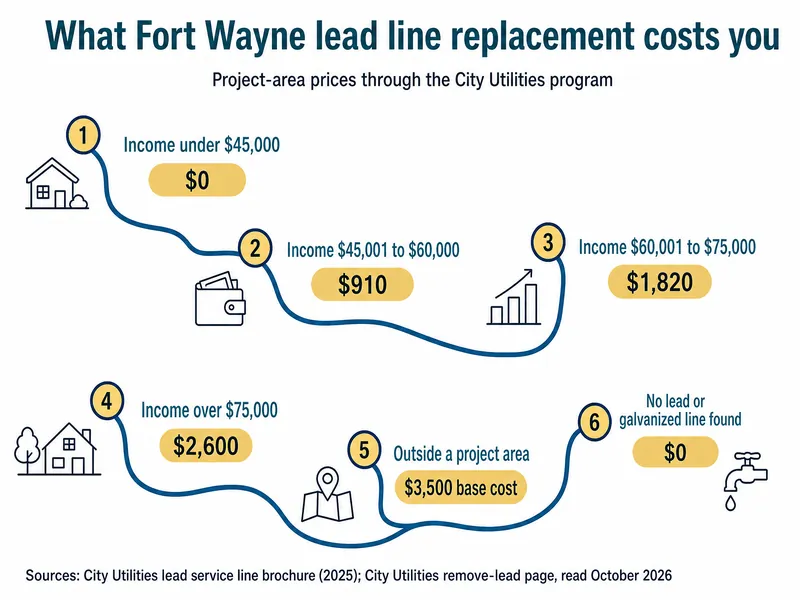
- In project areas, households earning under $45,000 pay nothing, $45,001 to $60,000 pay $910, and $60,001 to $75,000 pay $1,820 (2025 brochure).
- Replacement is free in parts of Hamilton, Renaissance Pointe, the East Side, Harvester and Oxford, paid for by a federal grant.
- There is no charge if the crew finds no lead or galvanized line, and no reimbursement for private work done outside the program.
- The program had replaced more than 3,100 lead lines by the time of the city's 2026 water quality report.
- EPA's Lead and Copper Rule Improvements take effect November 1, 2027, lowering the lead action level to 10 µg/L and requiring lead lines to be replaced within 10 years.
What does Fort Wayne lead line replacement cost?
Through the city program, the most a homeowner in a project area pays is $2,600, and many pay less. City Utilities' 2025 brochure says a private contractor can charge as much as $6,000 for the same job; the city lowers the price by bundling a whole neighborhood and paying the contractor up front, then adds income-based help on top.
The project-area tiers in the brochure are:
- Household income under $45,000: free.
- $45,001 to $60,000: $910.
- $60,001 to $75,000: $1,820.
- $75,001 or more: $2,600.
Outside a project area the base cost is $3,500. If the crew opens the ground and finds neither lead nor galvanized pipe, there is no charge, according to the city's lead removal page. One catch matters before you call a contractor yourself: the city does not reimburse private work done outside the program.
You can also spread the cost. The brochure says your share can be added to your monthly water bill with no credit check, and it lists monthly amounts of $10.80, $21.60 and $30.86 for the three paying tiers. Financing and income-based help are only for small residential properties.
| Situation | Your cost | Monthly on the water bill |
|---|---|---|
| Project area, income under $45,000 | Free | None |
| Project area, income $45,001 to $60,000 | $910 | $10.80 |
| Project area, income $60,001 to $75,000 | $1,820 | $21.60 |
| Project area, income $75,001 or more | $2,600 | $30.86 |
| Outside a project area | $3,500 base cost | Financing offered |
| Grant areas in Hamilton, Renaissance Pointe, East Side, Harvester, Oxford | Free | None |
| No lead or galvanized line found | No charge | None |
Which Fort Wayne neighborhoods get free replacement?
Parts of five neighborhoods get free replacement regardless of income: Hamilton, Renaissance Pointe, the East Side, Harvester and Oxford, per the city's lead removal page. The city page credits a federal grant; the brochure says the same infrastructure-law grant pays for the income-based help described above.
"Parts of" is the key phrase: the free zones follow project boundaries, not neighborhood signs. Check your address on the service line map first, then ask the city whether your street is inside a current project. If you are not sure whether you have a lead line at all, does my house have a lead service line walks through the map and the scratch-and-magnet check.
Landlords get their own discounts. The brochure lists a $500 reduction when the tenant's income is under $45,000 or the home is subsidized housing, and $1,300 off each additional property in a project area ($1,000 outside one).
Fort Wayne's lead line program in numbers
- $2,600most a project-area homeowner paysSource: City Utilities brochure 2025
- $3,500base cost outside project areasSource: City Utilities brochure 2025
- $6,000what a private contractor can charge, per the citySource: City Utilities brochure 2025
- 3,100+private lead lines the program has replaced so farSource: City Utilities 2026 report
How do you sign up?
You sign up by telling City Utilities you want more information; nothing is binding until you sign a contract. When a project reaches your neighborhood, the city mails a brochure with a prepaid postcard. You can return the postcard, scan its QR code to answer a two-question survey, or phone the program line printed on it, and the brochure says none of those commits you.
If you answer yes, the city sends more details and a contract to opt in. Outside a mailing, start from the city's lead removal page, which links a property owner survey and the program contacts. This site is run separately from City Utilities, so the city is the only place to enroll.
Don't wait for a better deal. The brochure says the discounted pricing is offered only while the city is replacing its own pipes in your neighborhood; once that work moves on, the bundled price moves with it. In 2024 alone, nearly 2,400 homeowners signed up, the city's 2025 report said.
What happens during a lead line replacement?
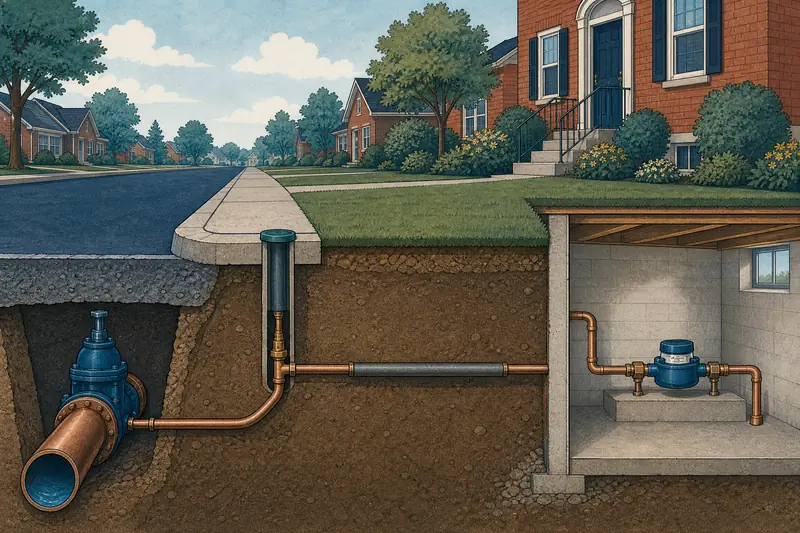
The city replaces its part and yours in the same project. The brochure says City Utilities is replacing the utility-owned service lines in each project neighborhood and adds the private section, from the curb box to your meter, to the same contract to get better pricing. You own that private section, so the opt-in contract is what lets the crew work on it.
The brochure and city page don't describe the dig itself, so ask the project contact the practical questions before you sign: when the work is scheduled, how long the water will be off, whether the crew needs basement access to reach the meter, and how the lawn and sidewalk are restored. Keep a copy of the signed contract and any letter that confirms the new pipe material.
What should you do after the new line goes in?
Flush the pipes. City Utilities' lead removal page tells residents after a partial replacement to take the aerators off and run each tap on cold water for 5 minutes. Work on an old line can release lead particles, which is why the federal rule requires filters after such disturbances, and EPA notes that particles caught in an aerator can get into your water.
Then keep using a filter certified to reduce lead for drinking and cooking until a test shows low levels; which filters reduce lead explains how to check a filter's listing. A lab test a few weeks after the work, from one of the labs the state health department certifies, tells you where your tap stands, since lead can also come from old faucets and solder inside the house.
What does the federal lead rule change?
From November 1, 2027, EPA's Lead and Copper Rule Improvements lower the lead action level from 15 µg/L to 10 µg/L and require most water systems to replace lead and galvanized-requiring-replacement lines within 10 years, per EPA's October 2024 summary of the rule. Until then, the 15 µg/L action level applies.
EPA's November 2024 briefing slides add the details that touch homeowners: systems must replace an average of 10% of those lines a year, first checked on December 31, 2030; they must notify every customer with a lead, galvanized or unknown line each year; and they must provide filters certified to reduce lead after a lead line is replaced or disturbed. EPA's rule page, last updated December 29, 2025, showed no delay to those dates.
Fort Wayne's 2025 tap results were 4.26 ppb and 2.61 ppb at the 90th percentile for the two sampling rounds, under both the current and future action levels, though 3 of 106 homes topped 15 ppb in the first half of the year. The lead rows are explained in how to read the Fort Wayne water quality report.
How this answer was put together
This answer is based on City Utilities' lead service line brochure (2025), its lead removal web page, its 2026 and 2025 water quality reports, two EPA documents on the new federal lead rule (an October 2024 summary and November 14, 2024 briefing slides) and EPA's rule page, last updated December 29, 2025. Everything was read in October 2026. Not included: contractor prices other than the city's own $6,000 figure, any timeline for finishing all Fort Wayne lines (none has been published) and counts of lines still in the ground.
Follow-up questions
Can I hire my own plumber and get reimbursed?
No. The city's lead removal page says private work done outside the program is not reimbursed. Indiana does let owner-occupants do their own plumbing, but a service line connects to the city's system, so talk to City Utilities before any digging.
Does the program replace galvanized lines too?
The city's pricing covers lead and galvanized lines, and there is no charge if neither is found. Under the federal rule, galvanized pipe that sat downstream of lead also counts as needing replacement.
What if you rent your home?
The owner signs up and signs the contract, since the line belongs to the property. The brochure offers landlords extra reductions, including $500 off when the tenant earns under $45,000.
Does the cost include work inside the house?
The program covers the private service line from the curb box to the water meter. Lead solder, old faucets and pipe past the meter are not part of it, which is why a tap test after the work is useful.
What happens if you say no to the program?
Your private line stays as it is, and the discounted price may not come back once the city's neighborhood work moves on, the brochure warns. Federal rules will still require the utility to keep notifying you each year if the line is lead.
Does financing raise the water bill?
Yes, by the monthly amount for your tier until the balance is paid. The brochure lists $10.80, $21.60 or $30.86 a month for the three paying project-area tiers and says no credit check is needed.
Is a new service line copper or plastic?
The city's materials reviewed for this page don't name the replacement material. Ask the project contact before you sign, and keep the confirmation with your house records.
Next questions on lead pipes
Have another question? See every Fort Wayne home water answer.