Does My Lawn Sprinkler Need a Backflow Test?
Does my lawn sprinkler need a backflow test? Yes: in Fort Wayne an in-ground sprinkler's backflow device must be tested every year by a state-certified tester, who files the results within 10 days.
Answered by the Three Rivers Home Water desk · Last updated
In this answer
The short version
- Fort Wayne City Utilities treats lawn irrigation as a "high hazard" that must have an approved backflow device "installed and tested annually" (City Utilities).
- The rule applies even to a system you no longer use, unless it is physically disconnected.
- Only a state-certified backflow tester can test the device and submit results, and Fort Wayne's City Code Chapter 52 gives the tester 10 calendar days to file them (2026 backflow newsletter).
- Each test entry carries a $9.95 fee, waived for the first test on a newly installed device.
- State rule 327 IAC 8-10-6 requires an air gap, reduced pressure backflow preventer or pressure vacuum breaker on in-ground irrigation built after July 19, 1985 with heads under 6 inches above grade.
- City Utilities can shut off water for non-compliance, after multiple notices.
Does a lawn sprinkler need a backflow test in Fort Wayne?
Yes. A lawn sprinkler connected to Fort Wayne's water system needs its backflow device tested once a year. City Utilities' backflow prevention page says irrigation systems "are considered high hazards" and "must have an approved backflow prevention device installed and tested annually," and that the owner is responsible for keeping it maintained.
Two state and city rules sit behind that. Indiana's cross-connection rule, 327 IAC 8-10, requires every device to be tested or inspected at installation and at intervals "not exceeding one (1) year." Fort Wayne City Code Chapter 52 adds local enforcement, including the 10-day reporting deadline described below.
The requirement does not lapse when you stop watering. City Utilities says the backflow rules "are still in effect and enforced unless the system is physically disconnected," which means cut and capped from the house plumbing, not just switched off at the controller. The utility's FAQ adds that a device is "past due the following calendar day after the test due date."
Backflow testing in numbers
- 1 yearLongest allowed gap between testsSource: 327 IAC 8-10-8
- 10 daysTime for the tester to submit results in Fort WayneSource: City Utilities 2026 backflow newsletter
- $9.95Fee per test entrySource: City Utilities 2026 backflow newsletter
- 6 inSprinkler heads below this height above grade trigger the state device ruleSource: 327 IAC 8-10-6
- 12 inMinimum height of a pressure vacuum breaker above downstream pipingSource: 327 IAC 8-10-7
What is backflow?
Backflow is water running the wrong way, from your property back into the public water main. City Utilities' backflow brochure describes two causes: backpressure, where equipment on your side pushes water harder than the main does, and backsiphonage, where pressure in the main drops and pulls water backward "in much the same way as you do when you drink through a straw."
Pressure drops are not rare events. The brochure lists fighting a fire, flushing fire hydrants and water main breaks as the moments backflow is most likely. If a sprinkler line is connected at that moment, whatever sits in the buried pipes and around the heads can be drawn toward the main.
That is why irrigation counts as high hazard. The brochure says sprinkler systems are classed that way "because of the bacterial and chemical contaminants found on lawns." A backflow device is the one-way gate that stops it. Hoses create the same risk on a smaller scale, and the brochure recommends a hose bibb vacuum breaker, an inexpensive screw-on fitting, for any hose used with sprayers or left in a bucket.
Which backflow devices do sprinklers use?
Fort Wayne sprinklers usually use a pressure vacuum breaker or a double check valve assembly. City Utilities' brochure says it "recommends an approved Double Check Valve Assembly (DCVA) or an approved Pressure Vacuum Breaker (PVB) as a minimum level of protection." The state rule for in-ground systems, 327 IAC 8-10-6, allows an air gap, a reduced pressure (RP) backflow preventer or a pressure vacuum breaker.
| Device | Protects against | Installation rules | What the annual test checks |
|---|---|---|---|
| Pressure vacuum breaker (PVB) | Backsiphonage only | Between two shutoff valves, 12 in above the highest downstream piping; accessible without a ladder | Air inlet opens fully when pressure drops to atmospheric |
| Double check valve assembly (DCVA) | Backpressure and backsiphonage, low hazard | Accessible from floor level; not exposed to flooding, heat or freezing | Both check valves drip-tight |
| Reduced pressure (RP) assembly | Backpressure and backsiphonage, high hazard | Above ground, relief port 12 in above the floor; not below grade | Check valves drip-tight; relief valve holds the middle chamber at least 2 psi below the inlet |
| Atmospheric vacuum breaker (AVB) | Backsiphonage only | No shutoff downstream; not under pressure more than 12 hours in 24 | Inspected yearly; not designed to be tested |
| Air gap | Everything | A physical gap above the overflow rim | Inspected yearly |
The details come from 327 IAC 8-10-7 and 8-10-8. A pressure vacuum breaker must stand above the sprinkler piping, so it usually sits outdoors on a riser; a double check valve has no height rule but must stay reachable and protected from flooding and freezing. An irrigation brochure from the American Water Works Association's Pacific Northwest Section, published by Washington's health department, notes that an atmospheric vacuum breaker "is not designed to be tested," which is why some utilities require testable assemblies.
Who can do a backflow test?
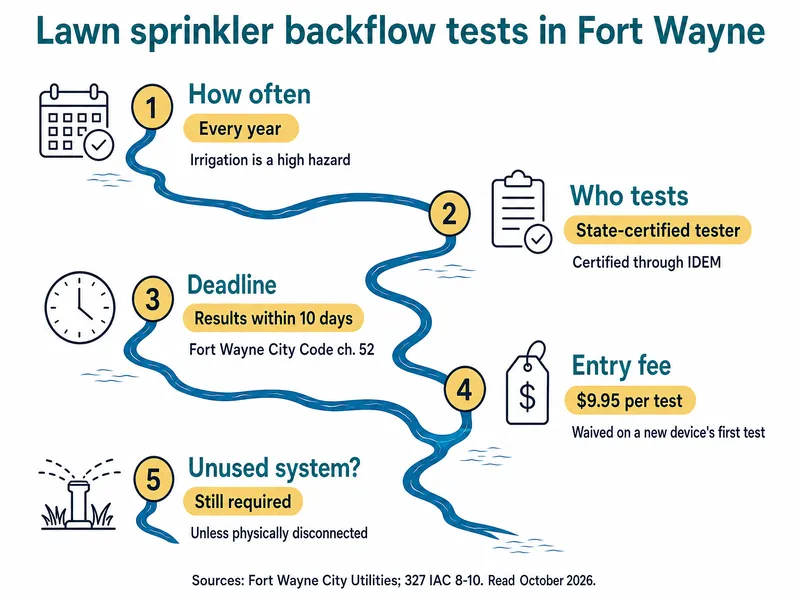
Only a state-certified backflow tester, certified through the Indiana Department of Environmental Management, can test your device and report the result. City Utilities' FAQ says testing "must be performed by a State Certified Backflow Tester," and its brochure says installing the device is work for licensed plumbers and contractors.
You can't file the result yourself. City Utilities' FAQ says only a certified tester can submit results online at the city's reporting site, run by Aqua Backflow, and "a water utility customer may not submit the results on the tester's behalf." Under Chapter 52 the tester has 10 calendar days to enter the test, and the 2026 newsletter lists a $9.95 fee per test entry, waived for the first test on a new device (not a replacement).
To check that a tester is active, search the tester's name on Indiana's mylicense.in.gov, which City Utilities points testers to; IDEM now asks testers to confirm every two years that they are still testing. City Utilities also posts a tester business listing on its website. IDEM requires an inspection tag on the device after each test, so look for a fresh one when the tester leaves. Fort Wayne's newsletter encourages booking next year's test as soon as this year's is done.
What happens if you skip the backflow test?
If you skip the test, you will get notices, and if you keep ignoring them City Utilities can turn off your water. Its FAQ says the utility "may terminate water service for a customer who is found to be in non-compliance," and that "you will receive multiple notices prior to the ultimate disconnection."
The 2026 newsletter says final notices before disconnection rose over the past year, so this is enforced. Getting service back for testing takes a scheduled visit: the tester, not you, calls City Utilities Field Operations to arrange an on-and-off appointment at least one business day ahead, weekdays only. A field representative turns the water on, waits up to 15 minutes while the test runs, and turns it back off if the device fails.
Water rule 17 in City Utilities' water rules also says failing to keep up annual testing "may result in discontinuance of service." This site is not City Utilities; for questions about your account, the utility's own backflow page has the program contacts.
How do you winterize a sprinkler backflow device?
Drain it before the first hard freeze, and blow out the sprinkler lines only from a connection downstream of the device. State rule 327 IAC 8-10-7 requires double checks, pressure vacuum breakers and atmospheric vacuum breakers to be installed where they won't be subject to freezing, and in practice an outdoor riser in Fort Wayne needs draining each fall: the city's airport averages 123.6 nights a year at or below 32°F, in NOAA's 1991–2020 normals.
The usual order is to close the shutoff valve that feeds the irrigation line, drain the device and the line, and follow the device maker's instructions for leaving its valves and test cocks. Many owners have the irrigation installer or tester do this at the fall visit.
Compressed air is the step to be careful with. The AWWA Pacific Northwest brochure says a pressure vacuum breaker "does not provide adequate protection" if compressed air is used to winterize the system, recommends a double check as the minimum in that case, and says compressed-air connections belong "only downstream" of a double check. Ask whoever blows out your lines where they connect. In spring, open the supply slowly and look for leaks at the device before the season's first run. For the rest of the house in cold weather, see keeping pipes from freezing in a Fort Wayne winter
How this answer was put together
Based on Fort Wayne City Utilities' backflow prevention page and FAQ, its 2026 cross-connection newsletter for testers, its backflow brochure (revised 2015), its 2022 water rules, the text of 327 IAC 8-10 as hosted by City Utilities (readopted 2013), and the AWWA Pacific Northwest Section's lawn irrigation brochure hosted by the Washington State Department of Health, all read in October 2026. Left out: tester prices, which were not published, any list of testers or companies, and device makers' winterizing steps, which vary by model.
Follow-up questions
Do I need a backflow test if my sprinkler system is on a well?
The City Utilities rules cover connections to the city's public water system. A sprinkler that runs only from a private well and has no connection to city water is outside that program, but a well and city water connected at the same house is itself a cross-connection the brochure warns about.
Can a plumber test my backflow device?
Only if that person also holds the state backflow tester certification. Installing the device is plumbers' and contractors' work; testing it requires the IDEM tester certification, which you can confirm on mylicense.in.gov.
When is my backflow test due each year?
City Utilities tracks a due date for each device, and the device is past due the day after it. Booking the next year's test as soon as this year's passes, as the city's newsletter suggests, keeps you clear of notices.
What if my backflow device fails the test?
It has to be repaired or replaced and then pass a test, which the tester reports. During a non-compliance shutoff, the city's field representative turns the water back off if the device fails, to protect the public supply.
Does an unused sprinkler system still need testing?
Yes, unless it is physically disconnected from the plumbing. City Utilities says the requirement stays in effect and enforced until then.
Does a garden hose need a backflow device?
The city's brochure recommends a hose bibb vacuum breaker, an inexpensive screw-on fitting, for hoses used with sprayers or dropped into buckets. It does not require annual testing like an in-ground sprinkler device.
Who pays the $9.95 entry fee?
The newsletter describes testers entering and paying for each test entry. Whether a tester passes that on in the bill is between you and the tester, so ask when booking.
Other cold-season answers

Have another question? See all Fort Wayne home water questions.