How Do I Keep Pipes From Freezing?
How do I keep pipes from freezing in Fort Wayne? Keep the heat at 55°F or higher, let cold water drip at faucets on exposed pipes, and protect lines in crawlspaces and outside walls before January's 18°F average lows.
Answered by the Three Rivers Home Water desk · Last updated
In this answer
The short version
- Fort Wayne's January low averages 18.4°F, with 27.5 January nights at or below freezing, in NOAA NCEI's 1991–2020 normals for the airport.
- Fort Wayne sees 6.2 nights a year at 0°F or colder on average, and the record low is −24°F, set January 12, 1918 (National Weather Service).
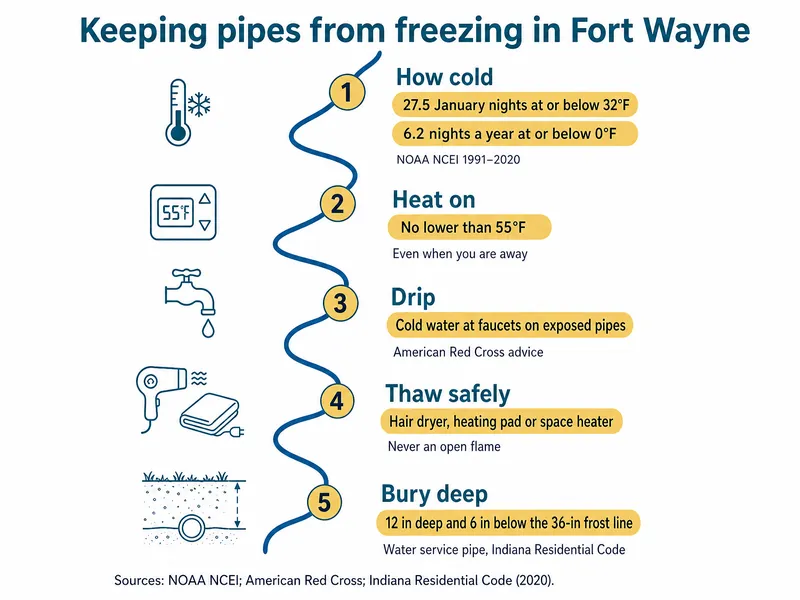
- The American Red Cross says to leave the heat no lower than 55°F when you're away and to drip cold water from faucets served by exposed pipes.
- Thaw with a hair dryer, heating pad or space heater; the Red Cross says never use an open flame.
- In Fort Wayne the meter is the customer's responsibility, and replacement fees start at $130 (City Utilities).
- Indiana's residential code puts Allen County's frost depth at 36 inches and requires water service pipe at least 12 inches deep and 6 inches below the frost line.
How cold does it get for pipes in Fort Wayne?
Cold enough that pipes in unheated spaces are at risk on most winter nights. NOAA's National Centers for Environmental Information put the average January low at Fort Wayne International Airport at 18.4°F and the average high at 32.6°F, using 1991–2020 climate normals.
Freezing nights are routine rather than rare. Those same normals count 27.5 nights in an average January with a low at or below 32°F, and 123.6 such nights across a year. Truly dangerous cold is less frequent but reliable: an average of 6.2 nights a year at or below 0°F, 3.3 of them in January.
The extremes are the ones that catch houses out. The National Weather Service lists Fort Wayne's coldest official reading as −24°F on January 12, 1918, and its coldest day as January 20, 1985, with a low of −22°F and a high of −11°F. A house that copes with an ordinary January can still freeze a pipe in a week like that.
Fort Wayne cold in numbers
- 18.4°FAverage January low, 1991–2020Source: NOAA NCEI
- 123.6Nights a year at or below 32°FSource: NOAA NCEI
- 6.2Nights a year at 0°F or colderSource: NOAA NCEI
- −24°FRecord low, January 12, 1918Source: National Weather Service
- $130Starting fee to replace a damaged meterSource: Fort Wayne City Utilities
Which pipes freeze first?
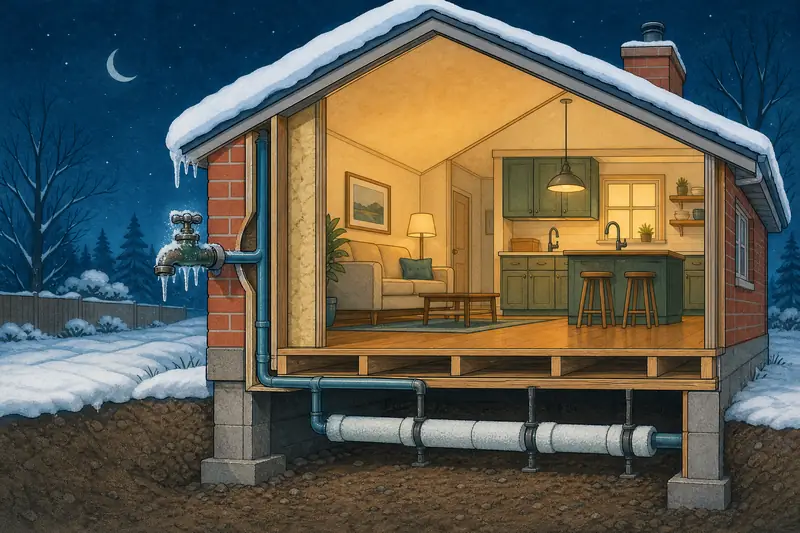
The pipes that freeze first are the ones outside the heated part of the house: crawlspace lines, pipes in outside walls, lines in garages and attics, and the short run to an outdoor faucet. The Indiana Residential Code reflects this. Its water-line rule (675 IAC 14-4.4-157) bars water lines outside the building's thermal envelope, in attics or crawlspaces unless they are protected from freezing, and concealed in exterior walls above grade.
Older houses don't always meet that rule, because many were plumbed before it existed. Look for these weak spots:
- Crawlspace runs under kitchens and bathrooms, especially near vents.
- Sink lines on outside walls, where the cabinet keeps room heat away from the pipe.
- Outdoor faucets that still have a hose attached or water in the line.
- Garage or porch pipes, including laundry lines in an unheated attached garage.
- The water meter, if it sits low in a cold basement corner or near a drafty rim joist.
Lawn sprinkler lines and their backflow device are a separate freeze risk with their own rules; the sprinkler backflow answer covers draining them.
| Pipe location | Before cold weather | On the coldest nights |
|---|---|---|
| Crawlspace lines | Insulate the pipes with foam sleeves | Keep the house heat steady; check for drafts |
| Sink lines on outside walls | Seal gaps where cold air reaches the pipe | Open the cabinet doors; drip the cold tap |
| Outdoor faucet | Disconnect hoses and drain the line from inside | Leave the inside shutoff closed |
| Garage or porch pipes | Insulate exposed runs | Keep the garage door shut |
| Water meter (basement) | Keep the area heated and free of drafts | Check it if water stops; the meter is the owner's responsibility |
| Yard service line | Must be buried 12 in deep and 6 in below the 36-in frost line (code) | If the freeze is outside, call a plumber |
How do you keep pipes from freezing on the coldest nights?
Keep the heat on and steady, keep warm air near the pipes, and keep water moving. The American Red Cross gives the core advice: if you will be away in cold weather, "leave the heat on in your home, set to a temperature no lower than 55° F," and when it is very cold, "let the cold water drip from the faucet served by exposed pipes."
A short checklist for a cold snap:
- Hold the thermostat steady. The Red Cross advises the same setting day and night, rather than a deep overnight setback.
- Drip the right taps. Choose the cold tap on any faucet whose pipes run through an outside wall or crawlspace.
- Open sink cabinets on outside walls so room air can reach the pipes.
- Close the garage door if water lines run through the garage.
- Know your main shutoff. If a pipe bursts, shutting the water off fast limits the damage.
Do the slower work in fall. Insulate exposed pipes with foam sleeves, seal gaps around pipes where cold air gets in, and disconnect and drain garden hoses. If you leave the house for a winter trip, ask someone to check it daily, since a furnace that quits while you're gone can freeze a house that was set correctly.
How do you thaw a frozen pipe safely?
Thaw a frozen pipe slowly with gentle electric heat, never a flame. The Red Cross lists an electric heating pad, an electric hair dryer or a portable space heater as safe ways to warm the frozen section, and keeping the space heater clear of anything that can burn is common sense.
What not to use matters as much. The Red Cross says: "Do not use a blowtorch, kerosene or propane heater, charcoal stove, or other open flame device." Open flames start house fires, and a pipe can burst as it thaws, so watch it the whole time.
Signs of a frozen pipe are a faucet that gives only a trickle or nothing at all, often on just one fixture. If you can't find the frozen section, can't reach it, or can't thaw it, the Red Cross says to call a licensed plumber. Once water flows, check every fixture: one frozen run often means another nearby. If you find a burst pipe, shut off the main valve first. FEMA says homeowners insurance usually covers losses caused by broken water pipes, but may not cover sewer backup or surface flooding; ask your insurer how your policy treats each.
What if the water meter or service line freezes?
If the meter or the line into the house freezes, it is mostly your problem to solve, not the city's. City Utilities' cold-weather page is direct: "The meter is your responsibility and you are liable for any damage to the meter. Fees for meter replacement start at $130 if the meter is damaged."
The line from the curb stop to the house belongs to the owner as well. City Utilities' 2022 water rules say the utility owns the service up to and including the curb stop, the customer owns the rest for services 2 inches and smaller, and "the Utility shall not be required to attempt to thaw Service Pipes." If you believe the freeze is in the yard line, the cold-weather page says to call a plumber; the plumber may ask City Utilities for help, "however, it is your responsibility to attempt to resolve the issue first."
One check saves a wasted call. If your neighbors have no water either, the problem is likely in the city's main, and City Utilities takes those reports through 311. Who handles which part of a sewer line is a separate question, answered in who fixes a sewer backup in Fort Wayne?
How deep must water lines be buried?
In Allen County a new water service line must be at least 12 inches deep and at least 6 inches below the frost line, which the state code sets at 36 inches. That makes 42 inches the practical minimum for the pipe. Both figures come from the 2020 Indiana Residential Code: Table R301.2(1) lists Allen County's frost depth at 36 inches, and the water-service rule sets the 12-inch and 6-inch minimums.
That rule covers new work and repairs. A shallow old service line, or one under a driveway where plowed snow leaves the ground bare, can still freeze in a cold snap like January 1985. If yours has frozen before, ask a licensed plumber about lowering or insulating it, and check with the building department before any digging; whether you can do the work yourself is covered in can I do my own plumbing in Indiana?
Water heaters live through the same winters; for their side of the house, see how long does a water heater last?, and for the full set of cold-season answers, the winter pipes and heaters topic page.
How this answer was put together
Built from NOAA NCEI's 1991–2020 climate normals for Fort Wayne International Airport (station USW00014827), the National Weather Service's Fort Wayne climate page, the American Red Cross page on preventing and thawing frozen pipes, Fort Wayne City Utilities' cold-weather page and 2022 water rules, the state's 2020 residential code rule (675 IAC 14-4.4), and FEMA's urban flooding guide for homeowners (2024, revised 2025), all read in October 2026. Left out: heat-tape and pipe-insulation product advice, insurance details beyond FEMA's general statement, and local permit rules, which could not be verified.
Follow-up questions
At what outdoor temperature do pipes in Fort Wayne start to freeze?
There is no single number, because it depends on where the pipe runs and how long the cold lasts. Pipes in crawlspaces and outside walls are at risk on the 27.5 January nights that average at or below 32°F, and far more so on the 6.2 nights a year at or below 0°F.
Should I drip hot or cold water?
Cold. The Red Cross advice is to let cold water drip from faucets served by exposed pipes. Dripping hot water wastes energy in the water heater without protecting the cold line.
Can I turn the heat down while away for the holidays?
Not below 55°F, says the Red Cross. Shutting off the water at the main and draining the lines adds protection for a long absence, and having someone check the house daily catches a failed furnace early.
Does the city thaw frozen water lines?
No. City Utilities' rules say it is not required to attempt to thaw service pipes, including the customer-owned line. When the whole street has lost water, the main may be the cause, so call 311.
Who pays if my water meter freezes and cracks?
Usually you do. City Utilities says the meter is the customer's responsibility, and replacement fees start at $130. Keeping the meter area heated and out of drafts is the cheapest fix.
Do frost-free outdoor faucets still freeze?
They can if a hose is left attached and holds water against the valve. Disconnecting hoses before the first hard freeze each fall is the simple precaution.
How deep is the frost line in Allen County?
The 2020 Indiana Residential Code lists 36 inches for Allen County. Water service pipe must be at least 6 inches below that and at least 12 inches deep overall.
Winter questions
Have another question? See Fort Wayne home water questions, answered.