Should I Filter Chlorine From Fort Wayne Water?
Should you filter chlorine from Fort Wayne water? Only if the taste or smell bothers you: 2025 levels peaked at 2.10 ppm, about half the legal limit, and a carbon filter is a comfort choice.
Answered by the Three Rivers Home Water desk · Last updated
About the store links on this page: SoftPro Water Systems and Quality Water Treatment, the two stores linked on this page, have the same owners as Three Rivers Home Water. Answers here lean on Fort Wayne City Utilities' published reports and rules, Indiana and federal agency guidance and makers' certification listings, read in October 2026. What a store says about its own products is quoted as the store's claim. How store links work
In this answer
The short version
- City Utilities' 2026 water quality report lists chlorine's highest 2025 level at 2.10 ppm (range 1.54 to 2.10) against a limit of 4 ppm.
- Chlorine dioxide peaked at 228 ppb against a limit of 800 ppb, and its byproduct chlorite at 0.77 ppm against 1 ppm.
- Fort Wayne disinfects with free chlorine plus chlorine dioxide; no City Utilities source mentions chloramine.
- Water must leave the Three Rivers plant with at least 0.5 ppm chlorine, per the city's water quality page.
- The whole-house carbon filters this site checked carry only materials marks (NSF/ANSI 61 and 372), not a certified chlorine-reduction claim.
- For drinking water alone, a point-of-use carbon filter listed under NSF/ANSI 42 for chlorine taste and odor is the smaller, cheaper step.
How much chlorine is in Fort Wayne water?
Fort Wayne's chlorine ran between 1.54 and 2.10 ppm in 2025, the city's annual report published in 2026 shows. The legal ceiling, called the maximum residual disinfectant level, is 4 ppm, so the highest reading was about half of it. The table labels 2.10 the "highest level detected"; it is not an average.
The city also uses chlorine dioxide, which peaked at 228 ppb (range 57 to 228) against a limit of 800 ppb. Chlorine dioxide leaves chlorite behind, and that measured 0.77 ppm at most against a limit of 1 ppm. (Reports print these as ppm, parts per million or mg/L, and ppb, parts per billion or µg/L.)
There is also a floor. City Utilities' water quality page says water leaving the plant must hold at least 0.5 ppm chlorine, so the disinfectant is still working as it travels through the city's mains to your tap.
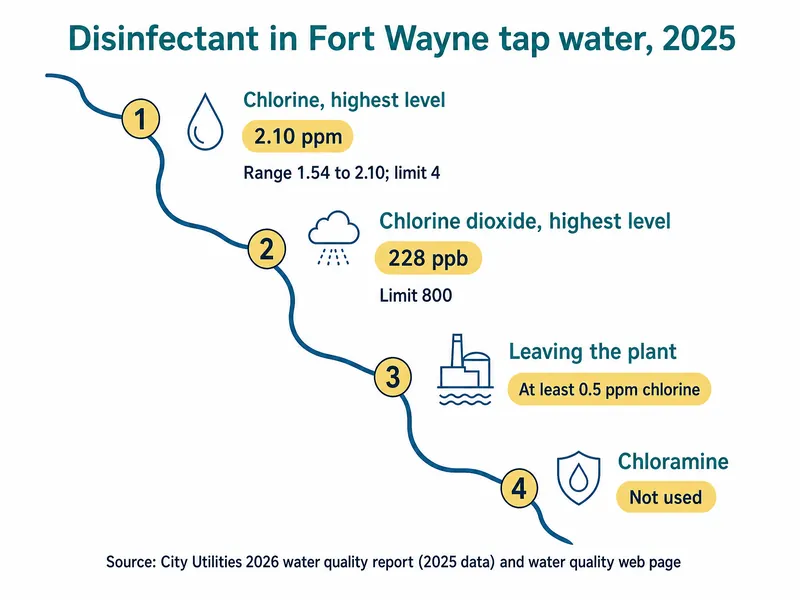
Fort Wayne disinfectant levels, 2025
- 2.10 ppmhighest chlorine level (limit 4 ppm)Source: City Utilities 2026 report
- 228 ppbhighest chlorine dioxide level (limit 800 ppb)Source: City Utilities 2026 report
- 0.5 ppmminimum chlorine in water leaving the plantSource: City Utilities water quality page
- 22.5 ppbhighest running average of total trihalomethanes (limit 80)Source: City Utilities 2026 report
Does Fort Wayne use chloramine?
No. City Utilities describes its disinfectant as chlorine, which "includes free chlorine and chlorine dioxide," on its water quality page, and neither that page nor the 2026 report mentions chloramine or monochloramine. Many other cities use chloramine, a chlorine-ammonia compound, and filter listings are often written with those cities in mind.
That matters when you read a product page. Both stores on this site describe their whole-house catalytic carbon filters as being for chlorine and chloramine. In Fort Wayne the chlorine part is what applies; the chloramine part is for other systems. If you are on New Haven water, its 2025 report (2024 data) lists the same pair, chlorine and chlorine dioxide. Where Fort Wayne tap water comes from explains the treatment steps in order.
Should you filter chlorine at one tap or the whole house?
Filter one tap if what bothers you is the taste of drinking water; filter the whole house only if the smell in showers, baths or laundry bothers you too. Both are comfort choices: the 2025 levels were within federal limits, and this site makes no health claim either way.
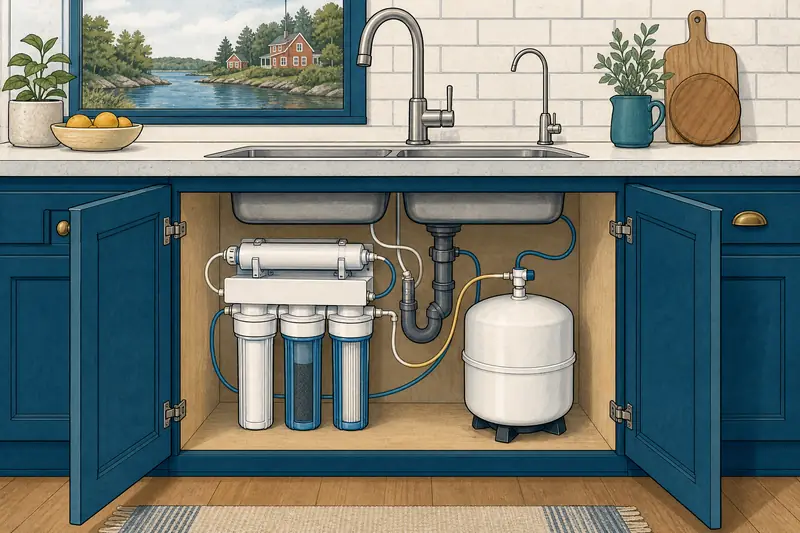
The one-tap route is smaller and cheaper. Pitcher, faucet and under-sink carbon filters can carry an NSF/ANSI 42 claim for chlorine taste and odor; IAPMO R&T, for example, lists the carbon stage of Waterdrop's G3 under-sink systems under NSF/ANSI 42 for that claim. Check the exact model in the certifier's directory, such as IAPMO R&T or NSF.
| Option | Where it works | Certified for chlorine? | Typical use |
|---|---|---|---|
| Pitcher or faucet carbon filter | One tap or jug | Many models list NSF/ANSI 42 chlorine taste and odor | Drinking and cooking water |
| Under-sink carbon or RO system | One faucet | Check the model's NSF/ANSI 42 claim | Drinking water, ice |
| Whole-house catalytic carbon tank | Every tap, shower and appliance | No claim found; materials marks only | Smell in showers and laundry |
What does a whole-house carbon filter do?
A whole-house carbon filter is a tank of carbon media on your main water line, after the meter, that takes chlorine taste and smell out of the water before it reaches any tap. SoftPro Water Systems lists its Chlorine+ catalytic carbon filter (sold by SoftPro Water Systems, same owners as this site) for city water at $1,097, and Quality Water Treatment lists its SoftPro Chlorine+ filter (sold by Quality Water Treatment, same owners as this site) at $917 to $1,097 (the stores' listed prices in October 2026). Both describe them as catalytic carbon filters for chlorine and chloramine.
Be clear about what that rests on. The listings make wider claims, but the only certification marks this site found on them, NSF/ANSI 61 and 372, cover the parts and materials, not what the media removes. The chlorine reduction is the stores' own description, which is the honest way to weigh it.

What does a carbon filter not do?
A whole-house carbon filter does not soften water, and it is not certified to reduce lead, PFAS or bacteria. Hardness averaged 130 mg/L (about 7.6 gpg) in 2025 and passes straight through carbon; is Fort Wayne water hard covers that. For lead, only a filter listed under NSF/ANSI 53 or 58 with a lead claim counts, as which filters reduce lead explains.
It also removes the disinfectant that City Utilities keeps in the water on purpose. Once chlorine is gone, the water sitting in your house pipes and water heater no longer carries that residual, so a whole-house unit is best kept for city water and changed on schedule. Don't use one on a private well without asking the maker; what well water treatment do you need starts with a lab test instead.
The disinfection byproducts that chlorine creates were well under their limits in 2025: total trihalomethanes peaked at a 22.5 ppb running average (limit 80) and HAA5 at 18.4 ppb (limit 60). No whole-house filter this site checked is certified to reduce them.
How do you maintain a chlorine filter?
Replace the carbon or the cartridge on the maker's schedule, and check that chlorine is not getting through. Carbon media wears out; the interval depends on how much water your household uses, and the owner's manual sets it.
A simple check is a free-chlorine test, the DPD kind sold for pools and spas: test a tap before the filter and one after it. When the reading after the filter starts to match the one before, the media is spent. Fit a bypass valve when the tank is installed so the house keeps water during service, and have a licensed plumber or the installer set it up, and ask the building department about permits before any work begins.
Point-of-use filters are simpler: change the cartridge by the date or gallon count on the package, since a spent cartridge stops doing its job. All softener and filter questions lists the related pages.
How this answer was put together
This answer is based on City Utilities' 2026 water quality report (2025 data), its water quality web page, New Haven's 2025 water quality report (2024 data), the SoftPro Water Systems and Quality Water Treatment product listings and the IAPMO R&T certifier directory, all read in October 2026. It leaves out health claims for or against chlorine, the stores' purity and PFAS claims (no certification found), and any media lifespan in gallons.
Follow-up questions
Is the chlorine smell stronger at some times of year?
City Utilities' report does not give monthly chlorine levels, only the 2025 range of 1.54 to 2.10 ppm. If the taste or smell changes noticeably, City Utilities posts a daily taste-and-odor indicator on its taste and odor page.
Does a refrigerator filter take out chlorine taste?
Many refrigerator filters are certified under NSF/ANSI 42 for chlorine taste and odor. Look up the exact cartridge in the certifier's directory to confirm the claim.
Will a carbon filter change Fort Wayne's fluoride?
A standard catalytic carbon filter is not sold for fluoride. The bone-char version both stores list targets fluoride and chlorine, but this site found no certification for either claim.
Does chlorine dioxide taste different from chlorine?
City Utilities does not describe a separate taste. Both are counted together as the city's disinfectant, and a carbon filter is sold to reduce chlorine taste and smell in general.
Can a softener and a carbon filter share one installation?
Yes, the stores sell softener bundles with a carbon add-on, and the order of tanks is set by the maker. A softener does not remove chlorine by itself.
Is chlorine in Fort Wayne water a health problem?
The 2025 levels were within the federal limit of 4 ppm, and City Utilities reports full compliance. This site makes no health claim either way; filtering chlorine is about taste and smell.
Does a whole-house filter need power or a drain?
That depends on the model; some tanks backwash and need both, others don't. The owner's manual and the installer will say, so ask before you choose a spot.
More questions about filters

Have another question? See the full list of Fort Wayne home water questions.