Is There PFAS in Fort Wayne Water?
Is there PFAS in Fort Wayne water? Not the six PFAS EPA regulated in 2024: City Utilities has never detected them, though two unregulated PFAS turned up at 1.7 and 5.7 parts per trillion.
Answered by the Three Rivers Home Water desk · Last updated
In this answer
The short version
- City Utilities' 2026 water quality report says none of the six PFAS covered by EPA's 2024 rule has been detected in Fort Wayne drinking water in any year of testing.
- Federal UCMR5 sampling (June 2023 to March 2024) found PFHxA at an average of 1.7 ppt and PFPeA at 5.7 ppt; neither has a federal limit.
- EPA's 2024 limits are 4.0 ppt for PFOA and PFOS and 10 ppt for PFHxS, PFNA and HFPO-DA, with water systems due to comply by 2029.
- On May 18, 2026, EPA proposed letting systems ask for two more years, to 2031, and dropping the PFHxS, PFNA, HFPO-DA and mixture limits, while keeping PFOA and PFOS.
- Huntertown's wells showed no PFAS in January 2024 UCMR5 sampling; this site found no PFAS data for private wells in Allen County.
- EPA says a filter certified to NSF/ANSI 53 or 58 for PFOA and PFOS can reduce PFAS, but if PFAS are below federal limits a filter "may not be useful".
What PFAS did Fort Wayne test for?
Fort Wayne has tested for the six PFAS in EPA's 2024 drinking water rule: PFOA, PFOS, PFNA, PFHxS, PFBS and HFPO-DA (sold as GenX). City Utilities' 2026 water quality report (2025 data) says it has not detected any of the six in drinking water samples "in all our years of testing."
After the 2024 rule, City Utilities also began sampling the St. Joseph River, the city's raw water source. Those river samples have not shown any of the six either, the report says. If you want the background on the river and the Three Rivers Filtration Plant, see where Fort Wayne tap water comes from.
The city also took part in EPA's fifth Unregulated Contaminant Monitoring Rule round, called UCMR5. That federal program had water systems test for 29 PFAS plus lithium, so EPA could see where unregulated chemicals show up.
Reports print these results in ppb (parts per billion, the same as µg/L) and ppm (parts per million, mg/L). PFAS figures are so small that most people quote them in ppt, parts per trillion: 1 ppb equals 1,000 ppt.
Which PFAS were found in Fort Wayne water?
Two unregulated PFAS were found in Fort Wayne water during UCMR5: PFHxA and PFPeA. The report's table lists PFHxA at an average of 0.0017 ppb (1.7 ppt, range 0 to 4.1 ppt) and PFPeA at an average of 0.0057 ppb (5.7 ppt, range 4.5 to 8.0 ppt), from samples taken between June 2023 and March 2024.
Neither compound has a federal drinking water limit, and neither is one of the six in the 2024 rule. The report lists them as unregulated, which means there is no legal ceiling to compare them with. Putting them next to the 4.0 ppt limit for PFOA would compare two different chemicals.
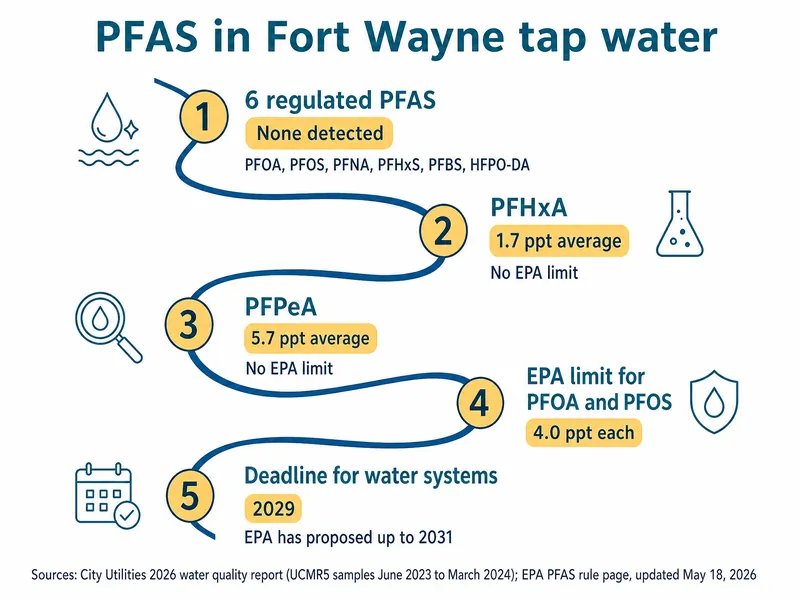
Fort Wayne PFAS results at a glance
- 0 of 6regulated PFAS detected in Fort Wayne drinking waterSource: City Utilities 2026 report
- 1.7 pptPFHxA average, UCMR5 (no federal limit)Source: City Utilities 2026 report
- 5.7 pptPFPeA average, UCMR5 (no federal limit)Source: City Utilities 2026 report
- 4.0 pptEPA limit for PFOA and for PFOSSource: EPA
What are the EPA PFAS limits?
EPA's PFAS limits, set in April 2024, are 4.0 ppt each for PFOA and PFOS, 10 ppt each for PFHxS, PFNA and HFPO-DA, and a "hazard index" of 1 for mixtures of PFHxS, PFNA, HFPO-DA and PFBS, according to EPA's PFAS rule page. The health goal for PFOA and PFOS is zero.
The hazard index is a way to add up several PFAS at once: each chemical's level is divided by its own health-based number and the fractions are summed. A sum above 1 would break the rule even if no single chemical crossed its own line.
| PFAS | EPA 2024 limit | Fort Wayne result |
|---|---|---|
| PFOA | 4.0 ppt | Not detected |
| PFOS | 4.0 ppt | Not detected |
| PFHxS | 10 ppt (proposed for rescission) | Not detected |
| PFNA | 10 ppt (proposed for rescission) | Not detected |
| HFPO-DA (GenX) | 10 ppt (proposed for rescission) | Not detected |
| PFBS | Part of the hazard index only | Not detected |
| PFHxA | No federal limit | 1.7 ppt average (UCMR5) |
| PFPeA | No federal limit | 5.7 ppt average (UCMR5) |
Do Fort Wayne wells have PFAS?
Fort Wayne itself has no wells: City Utilities draws from the St. Joseph River, and its last small well system near Leo was switched to river water in 2023. Nearby Huntertown does run on wells, and its 2023 water report says UCMR5 sampling in January 2024 found none of the 29 PFAS tested.
Private wells are a gap. They are not regulated by IDEM or EPA, and the Indiana Department of Health well-testing list covers bacteria, nitrate, fluoride, arsenic, lead and copper, not PFAS. This site found no published PFAS results for private wells in Allen County. If you own a well, start with how often to test a well in Allen County and ask a state-certified lab whether it runs a PFAS method before you pay for one.
If you get your water from another town system, such as New Haven, Woodburn or Grabill, read that system's own report: the Fort Wayne results apply only to water from the Three Rivers plant.
Which filters reduce PFAS?
Activated carbon, reverse osmosis and ion exchange resin can all reduce PFAS, EPA's home filter handout says, but only a filter certified for it should be trusted. EPA tells buyers to look for certification to NSF/ANSI 53 or NSF/ANSI 58 for PFAS reduction, and to check the certifier's product directory if in doubt.
As of April 2024, those certifications cover PFOA and PFOS specifically, and EPA notes they do not yet show that a filter brings PFAS down to the new 4.0 ppt limits. The handout also says that if PFAS have been measured below federal limits, "a filter may not be useful to you." On Fort Wayne city water, where none of the regulated six have been detected, a PFAS filter is a personal choice rather than a fix for a measured problem.
If you buy one anyway, look the exact model up in a certifier's listing: NSF, IAPMO R&T and WQA all publish theirs. The listing names each reduction claim. Reverse osmosis and lead-certified filters are covered on their own pages here, and the claims on a box often go further than the listing does.

When will PFAS limits apply?
Water systems have until 2029 to meet the PFAS limits, under the 2024 rule; they also had to start reporting PFAS levels to the public in 2027. On May 18, 2026, EPA announced two proposals: one keeps the PFOA and PFOS limits but lets systems request two more years, to 2031; the other would rescind the limits for PFHxS, PFNA, HFPO-DA and the hazard index (EPA PFAS rule page).
Those are proposals, not final rules, so check EPA's page for the current status. For Fort Wayne the dates matter less than they do in many cities: the two chemicals that would stay regulated, PFOA and PFOS, have not been detected in the city's water. Each new annual report will show whether that holds; how to read the Fort Wayne water quality report explains where the PFAS rows sit.
How this answer was put together
This answer is based on the drinking water report City Utilities published in 2026 (covering 2025, with UCMR5 rows for June 2023 to March 2024), EPA's PFAS drinking water rule page (last updated May 18, 2026), EPA's April 2024 home-filter handout on PFAS, the Huntertown 2023 annual water report, and the Indiana Department of Health well-water lab page, all read in October 2026. It leaves out national PFAS maps, news reports and advocacy group rankings, gives no health-risk estimates, and names no PFAS level for private wells because none was found for Allen County.
Follow-up questions
Does boiling Fort Wayne water remove PFAS?
No. Boiling drives off water, not PFAS, so it can leave the chemicals slightly more concentrated in what remains. Since none of the six regulated PFAS have been found in city water, boiling is not needed for PFAS in the first place.
Is Fort Wayne bottled water safer for PFAS than tap water?
This site has no data that would show it. City Utilities' tap results are published every year; bottled water is regulated separately and its PFAS results are not in the city report. Compare published numbers rather than labels.
What do PFHxA and PFPeA come from?
They belong to the same family of fluorinated chemicals as PFOA and PFOS, used since the 1940s in nonstick, stain-resistant and water-repellent products and firefighting foam, according to EPA. The city report does not say where the traces in the St. Joseph River came from.
Will City Utilities keep testing for PFAS?
Yes. Under the 2024 rule, water systems must monitor for the regulated PFAS and report the results to the public starting in 2027. City Utilities' report also says it now tests the St. Joseph River itself.
Does a water softener remove PFAS?
A standard salt softener is sold to reduce hardness, not PFAS. EPA mentions ion exchange resins as one PFAS treatment, but only a filter certified to NSF/ANSI 53 or 58 for PFOA and PFOS has shown it in testing. See do you need a water softener in Fort Wayne for what softeners are for.
Does New Haven water have the same PFAS results?
New Haven buys surface water and publishes its own report, so read that one for its results. This page covers only water from Fort Wayne's Three Rivers Filtration Plant.
Where can a well owner get a PFAS test?
The state lab list for private wells does not include PFAS. Ask a laboratory on the Indiana Department of Health certified-lab list whether it offers an EPA PFAS method for drinking water, and what detection limit it reports.
More questions about Fort Wayne tap water


Have another question? See Fort Wayne home water questions, answered.