What Well Water Treatment Do I Need?
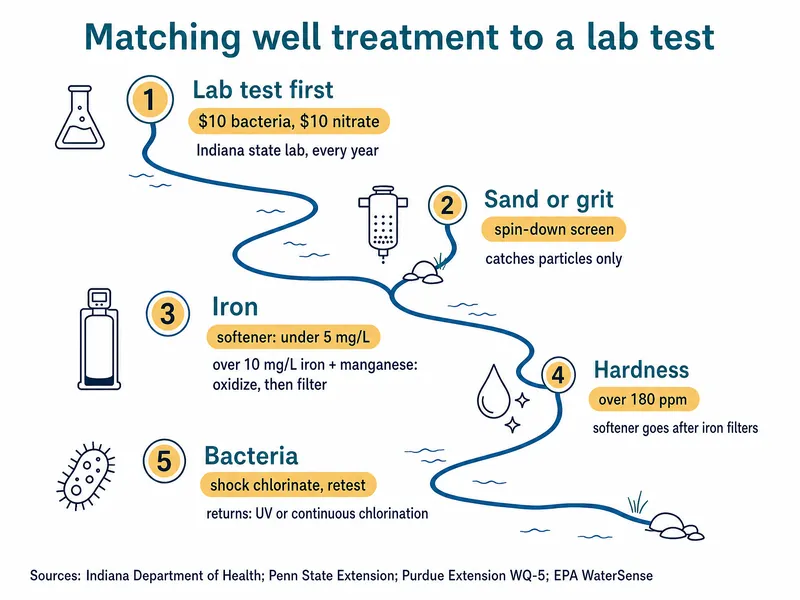
What well water treatment do I need? Whatever your lab test shows, and nothing it doesn't: test for bacteria and nitrate first, add hardness and iron, then match one treatment stage to each problem.
Answered by the Three Rivers Home Water desk · Last updated
About the store links on this page: SoftPro Water Systems and Quality Water Treatment, the two stores linked on this page, have the same owners as Three Rivers Home Water. Answers here lean on Fort Wayne City Utilities' published reports and rules, Indiana and federal agency guidance and makers' certification listings, read in October 2026. What a store says about its own products is quoted as the store's claim. How store links work
In this answer
The short version
- Neither IDEM nor EPA oversees a private Indiana well, so the owner decides when to test; the state health department's advice is at least yearly.
- The state lab charges $10 each for bacteria and nitrate and $20 for arsenic, lead and copper, plus shipping.
- Purdue Extension's WQ-5 puts typical Indiana groundwater iron at 0.1–3.0 ppm, staining above 0.3 ppm, and hardness "virtually all" over 180 ppm.
- Penn State Extension recommends a softener for iron only below 5 mg/L of dissolved iron, and oxidation plus filtration once iron and manganese pass 10 mg/L.
- After a positive coliform test, Penn State says to shock chlorinate and retest in 10–14 days; if bacteria return, continuous disinfection such as UV or chlorination.
- A softener treats hardness and some dissolved iron, not bacteria, arsenic or nitrate.
No Allen County well-testing program was found; the county health department's water page says owners are responsible for keeping their wells safe and points to state testing guidance. So the plan for your well starts with your own lab result.
What well water treatment do you need first?
The first well water treatment step is a lab test, not equipment. The Indiana Department of Health's well water page says private wells are "unregulated by both the Indiana Department of Environmental Management and the Environmental Protection Agency," and its lab recommends bacteria and nitrate every year and fluoride, arsenic, lead and copper at least every five years.
EPA's private well page adds total dissolved solids and pH to the yearly list and says to test right away after flooding, well repairs, or a change in taste, odor or color. For treatment planning, ask the lab to include hardness, iron, manganese and, if you smell rotten eggs, hydrogen sulfide. How often should I test my well in Allen County? covers labs and sampling.
Then treat only what the test finds. Nebraska Extension's G2275 makes the same point: every treatment method has limits, and many water problems need a combination of processes.
Well treatment numbers
- $10State lab fee each for bacteria and nitrate testsSource: Indiana Department of Health lab
- 0.1–3.0 ppmTypical iron in Indiana groundwater; stains above 0.3Source: Purdue Extension WQ-5
- 5 mg/LDissolved iron limit for treating iron with a softenerSource: Penn State Extension
- 10–14 daysWait before retesting after shock chlorinationSource: Penn State Extension
How do you treat iron in well water?
You treat iron in well water by matching the method to how much iron there is and what form it's in. Penn State Extension's iron and manganese page lays out the ranges:
- Softener: generally only when pH is above 6.7, hardness is 3–20 gpg and dissolved iron is under 5 mg/L. Oxidized iron "will foul the softener resin."
- Oxidizing filters (manganese greensand or birm): generally for combined iron and manganese of 3–10 mg/L.
- Oxidation followed by filtration: "the most effective treatment" once combined iron and manganese exceed 10 mg/L, usually with chlorine as the oxidant.
- Aeration units also oxidize iron, but need a backwashing filter after them, and Penn State says the water should be disinfected so bacteria don't colonize the aerator.
Purdue's WQ-11 adds that an iron removal filter can take out low to moderate hydrogen sulfide, up to around 10 mg/L, along with iron and manganese. SoftPro's Iron Master listing (sold by SoftPro Water Systems, same owners as this site) describes an air-injection filter for iron, manganese and hydrogen sulfide that the store says handles "up to 30 ppm of iron," sized so the pump delivers at least 5, 7 or 10 gallons a minute for backwash. The store's listed price in October 2026 was $1,517–$1,897. Why does my well water smell like rotten eggs? covers sulfur on its own.
Does well water need a softener?
Most Indiana well water does, once iron is handled. Purdue's WQ-5 says groundwater hardness in Indiana generally runs 20–400 ppm, that "virtually all" of it is over 180 ppm, and that water above 180 ppm "should be conditioned with a water softener."
Size it from your test, adding 5 gpg of hardness for each ppm of clear-water iron as A. O. Smith's softener manual directs; what size water softener do I need? shows the arithmetic. SoftPro's ECO well softener (sold by SoftPro Water Systems, same owners as this site) is listed at $947–$2,977 in 32,000–64,000 grain sizes (the store's listed price in October 2026), with an optional iron filter bundle.
Purdue's WQ-5 is just as clear on the limit: softeners "are designed only to remove hardness, not other chemicals." The Fort Wayne softener question compares city and well water.
How do you treat bacteria in well water?
You treat bacteria in a well by disinfecting the well, retesting, and adding continuous disinfection only if the bacteria come back. Penn State Extension's shock chlorination guide recommends shock chlorination after a positive coliform result, after new construction and after well or pump work.
It warns that shock chlorination is meant for "one-time contamination incidents." Retest for coliform 10–14 days afterward and again two to three months later. If bacteria return, "a continuous disinfection treatment system will be necessary," such as ultraviolet light or chlorination. In a Penn State study, shock chlorination plus a sanitary well cap kept bacteria out for a year in only 15% of wells.
Until the water tests clean, the Indiana Department of Health says bottled or filtered water can be a short-term solution, and that "boiling water and sanitization of a well may provide a solution" in some cases. Penn State also notes that high chlorine doses can damage some treatment equipment, so check your manuals about bypassing softeners and filters while you shock the well.
| Stage | Treats | Doesn't treat | Source |
|---|---|---|---|
| Spin-down sediment screen | Sand and grit | Dissolved iron, hardness, bacteria | Store listings (60-mesh screen) |
| Iron filter (oxidizing or air injection) | Iron, manganese, some hydrogen sulfide | Hardness, nitrate | Penn State Extension; Purdue WQ-11 |
| Water softener | Hardness; dissolved iron under about 5 mg/L | Bacteria, arsenic, nitrate | Purdue WQ-5; Penn State Extension |
| Shock chlorination | One-time bacterial contamination | Recurring bacteria, minerals | Penn State Extension |
| UV or continuous chlorination | Recurring bacteria | Minerals, nitrate | Penn State Extension |
In what order do well water treatment stages go?
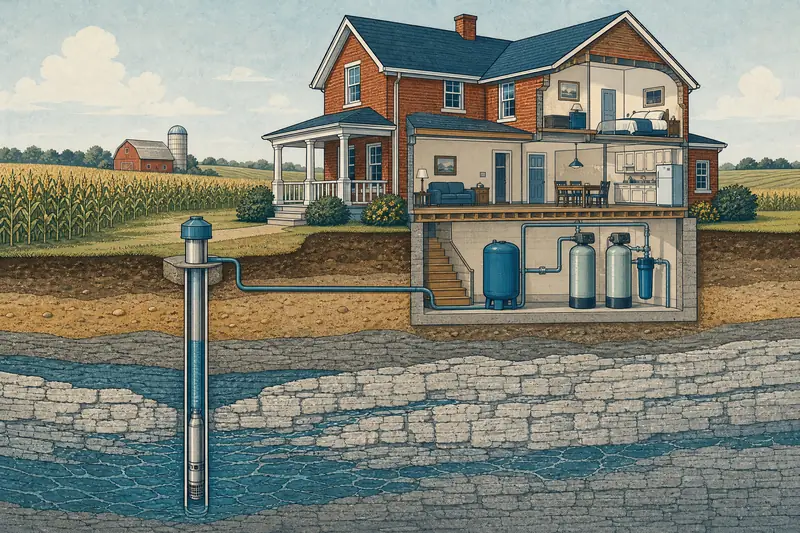
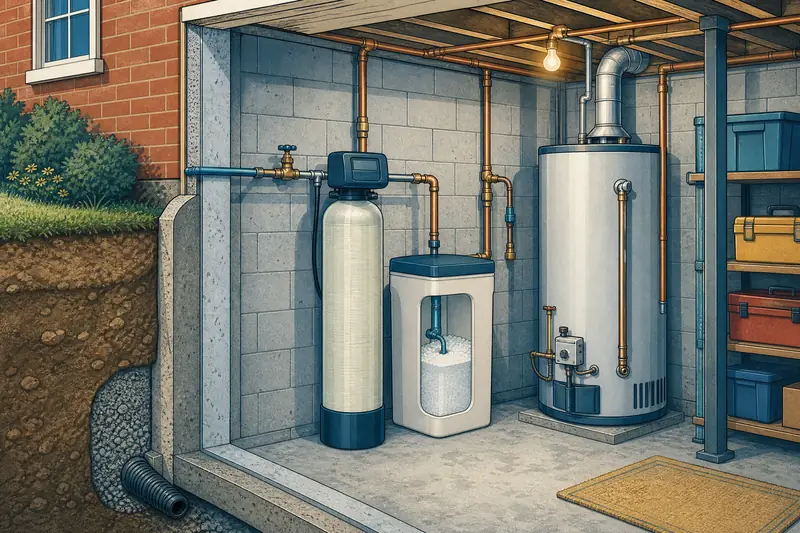
Well water treatment stages run from coarse to fine: sediment first, then iron and sulfur, then the softener, with drinking-water treatment at one tap last. The order follows from what each stage can't tolerate.
- Sediment goes first because it clogs everything after it. SoftPro's spin-down separator (sold by SoftPro Water Systems, same owners as this site) and Quality Water Treatment's spin-down separator (sold by Quality Water Treatment, same owners as this site) are 60-mesh screens that catch sand and grit only; the stores listed them at $95–$117 and $95–$165 in October 2026.
- Iron filters go before the softener. A. O. Smith's softener manual says ferric (rusty) iron "should be filtered out before the water reaches the softener," and Penn State says oxidized iron fouls resin.
- The softener goes after other whole-house filters. EPA WaterSense's May 2026 softener guide recommends installing it "after water leaves the filter, so that any chemicals or sediment is filtered before softening."
- Arsenic, nitrate or lead found by the test usually call for separate treatment, often at the kitchen tap; is there arsenic in Allen County well water? and is reverse osmosis worth it? cover those.
Where the disinfection stage sits depends on the equipment; ask the installer to show where the maker's manual places it.
What does well water treatment cost to run?
Well water treatment running costs are testing, salt, backwash water and media or lamp replacement, and testing is the one you can count on. At state lab prices, yearly bacteria and nitrate tests cost $20 plus shipping, and the every-five-year fluoride, arsenic, lead and copper tests add $30.
Salt depends on your hardness. For a family of four on an example well with 20 gpg compensated hardness, the softener removes about 45,920 grains a week (4 × 82 gallons, EPA WaterSense's average daily home use, × 20 gpg × 7). At 3,350–4,000 grains per pound of salt, that is about 11.5–13.7 lb a week, or roughly 600–710 lb a year. NDSU Extension's softening publication prices salt at about $5–$10 per 40-pound bag, so 15–18 bags is roughly $75–$180 a year. EPA's guide says a typical softener uses 20–70 gallons per regeneration.
Iron filters and spin-downs use water to backwash or flush; the amount depends on the unit, so ask for the figure from the manual.
How this answer was put together
This answer is based on the Indiana Department of Health's well water and lab pages, EPA's private well page and its May 2026 WaterSense softener guide, Purdue Extension WQ-5 and WQ-11, Penn State Extension's iron and manganese and shock chlorination pages, Nebraska Extension G2275, NDSU Extension's softening publication, the A. O. Smith AOW-S400/S500 manual and the Allen County Department of Health's water page. All were read in October 2026. Product claims (the Iron Master's 30 ppm, the 60-mesh screens) are the stores' own descriptions, not tested by this site. Left out: UV pretreatment limits and an Allen County well survey, because no primary source for either was found; arsenic and nitrate treatment are covered on their own pages.
Follow-up questions
Can one system treat everything in my well?
No single unit does. Nebraska Extension says every treatment method has limits, so most wells need a short train of stages matched to the test.
Will a softener remove the orange stains?
Only if the iron is dissolved and under about 5 mg/L, with pH above 6.7, per Penn State Extension. Rusty particles need a filter before the softener.
Does a spin-down filter remove iron?
No. It is a screen that catches sand and grit; dissolved iron passes straight through.
Should I shock chlorinate before installing new treatment?
Penn State recommends shock chlorination after well or pump work and after a positive coliform test. Check your softener and filter manuals about bypassing them while the chlorine is in the lines.
Does well treatment need a permit in Allen County?
This site could not confirm county rules for treatment equipment. Check with the building department before the work starts.
Who records my well's construction?
Indiana requires drillers to file a well record with the Department of Natural Resources within 30 days of finishing a well, and casing must reach at least 25 feet under 312 IAC 13.
Do I still test after treatment is installed?
Yes. The Indiana Department of Health's yearly bacteria and nitrate schedule still applies, and a test after installation shows whether each stage is working.
Next questions
Have another question? See Fort Wayne home water questions, answered.