Topic · 7 questions
Fort Wayne Tap Water Questions
What should you know about Fort Wayne tap water? It is treated St. Joseph River water that met every federal limit in 2025, averaged 130 mg/L of hardness, and can pick up lead only from private service lines.
Answered by the Three Rivers Home Water desk · Last updated

The short version
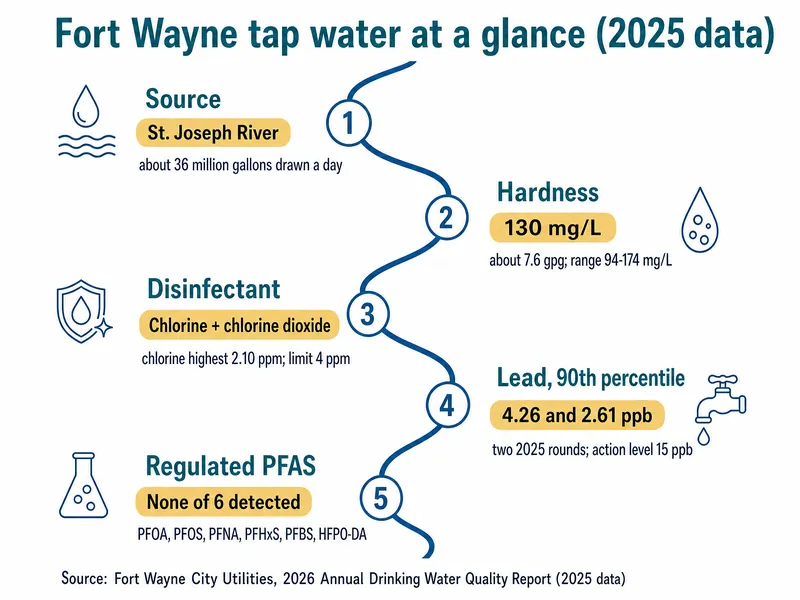
- City Utilities pulls roughly 36 million gallons a day out of the St. Joseph River and treats it at the Three Rivers Filtration Plant, per its 2026 water quality report.
- Hardness averaged 130 mg/L (about 7.6 gpg) in 2025, which the USGS scale calls hard.
- The disinfectant is free chlorine plus chlorine dioxide; chlorine's highest 2025 level was 2.10 ppm against a 4 ppm limit.
- Lead's 90th percentile was 4.26 ppb and 2.61 ppb in the two 2025 rounds, under the 15 ppb action level, with 3 of 106 homes over it in the first round.
- More than 3,100 lead service lines have been replaced through the city's program.
- None of the six PFAS regulated in 2024 has been detected in city drinking water, the report says.
This page gathers every tap water question on Three Rivers Home Water. It is written for homes on Fort Wayne City Utilities water; this site is run separately from the utility, and the utility's own drinking water pages have the final word.
Fort Wayne tap water, 2025 data
- 130 mg/LHardness, yearly mean (roughly 7.6 gpg)Source: City Utilities 2026 water quality report
- 2.10 ppmPeak chlorine reading; the cap is 4 ppmSource: City Utilities 2026 water quality report
- 3,100+Lead lines swapped out under the city program so farSource: City Utilities 2026 water quality report
- about 270,000People served by the city systemSource: EPA SDWIS
Where does Fort Wayne tap water come from?
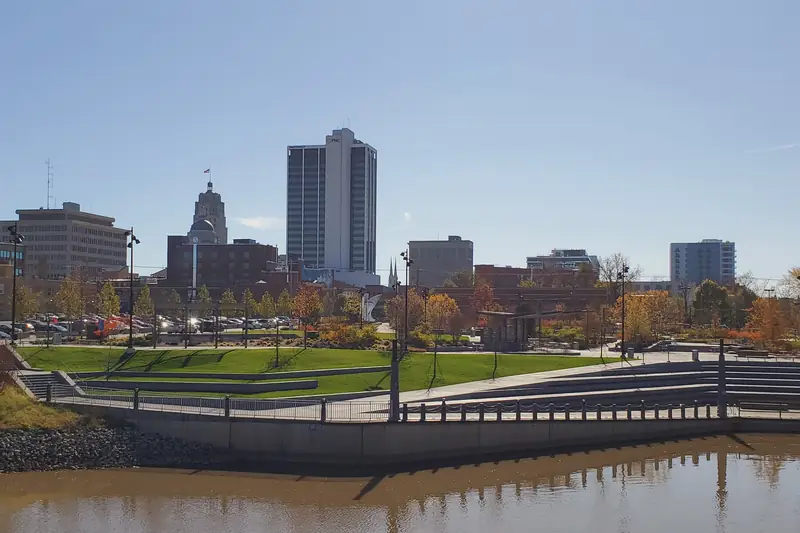
Fort Wayne tap water is drawn from the St. Joseph River and treated at the Three Rivers Filtration Plant, which the city's plant page says opened in 1933 and is rated for 72 million gallons a day. Treatment runs through settling, lime softening, powdered activated carbon, chlorine and chlorine dioxide, and UV light. New Haven buys treated surface water, while Huntertown and several small towns use wells.
How hard is Fort Wayne tap water?
Fort Wayne tap water came in at 130 mg/L of hardness on average in 2025 (about 7.6 gpg), spanning 94 to 174 mg/L, after the plant softens it with lime. That is "hard" on the USGS scale but under the 180 ppm line above which Purdue Extension says water should be softened, so a home softener on city water is a comfort and scale choice. The softeners and filters questions pick up from there.
What do the lead questions cover?
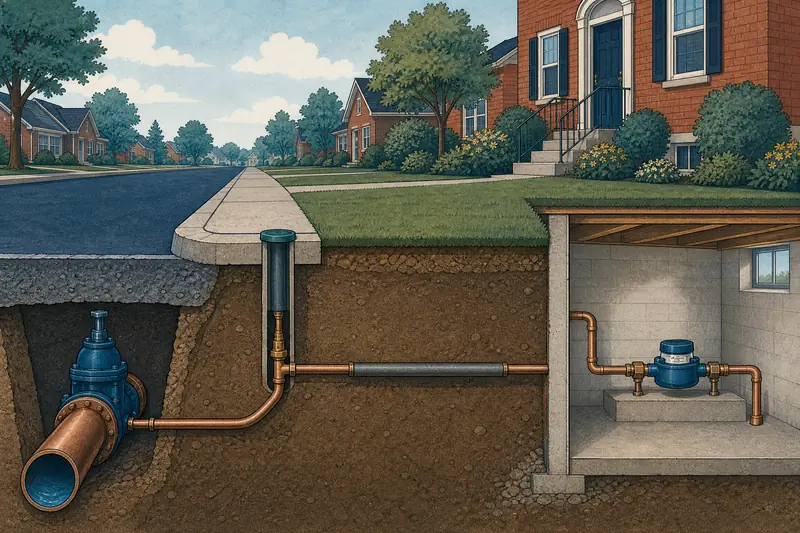
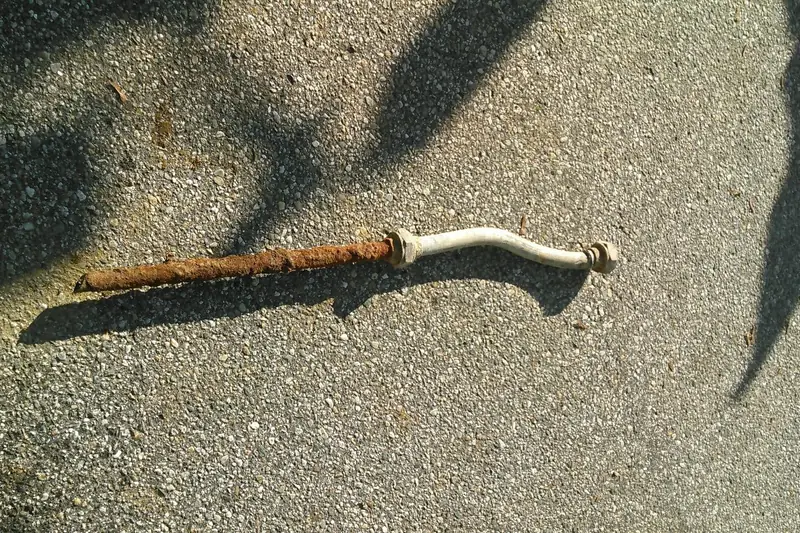
The lead questions cover how to tell whether your private service line is lead and how the city's replacement program works and what it costs. City Utilities says the plant's water and its mains are lead-free, but older homes may have a lead line between the curb stop and the house, which is the owner's. Its lead line page caps the homeowner share at $2,600 in project areas, with a $3,500 base cost elsewhere.
EPA's Lead and Copper Rule Improvements lower the action level from 15 µg/L to 10 µg/L on November 1, 2027 and require lead lines to be replaced within 10 years. Until then, the 2025 sampling rounds both met today's 15 ppb level.
What does the yearly water report show?
The yearly report shows that Fort Wayne water met every federal standard it is tested against in 2025, with "Compliance Achieved: Yes" on every regulated row of its page 4 table. Nitrate peaked at 4.774 ppm against a 10 ppm limit, TTHM's highest running average was 22.5 ppb against 80, and no regulated PFAS was found. The table's units are parts per million and parts per billion, the same as mg/L and µg/L.
Two unregulated PFAS, PFHxA and PFPeA, showed up at 1.7 and 5.7 parts per trillion on average in EPA's 2023–2024 survey; neither has a federal limit. EPA's 2024 limits for PFOA and PFOS are 4.0 ppt, according to its PFAS rule page.
 How do I read the Fort Wayne water quality report?Tap water
 Is there PFAS in Fort Wayne water?Tap water
| Question | Short answer | Source and data year |
|---|---|---|
| Source | St. Joseph River, about 36 million gallons a day | City Utilities 2026 report, 2025 |
| Hardness | 130 mg/L average, 94–174 range | City Utilities 2026 report, 2025 |
| Disinfectant | Free chlorine plus chlorine dioxide | City Utilities water quality page |
| Lead | 90th percentile 4.26 and 2.61 ppb; action level 15 | City Utilities 2026 report, 2025 |
| Regulated PFAS | None of six detected | City Utilities 2026 report, 2025 |
| Taste | Earthy tastes come from river algae and fungi; typically safe | City Utilities taste and odor page |
Why does the taste change?
Fort Wayne tap water can taste different week to week because the river changes. City Utilities' taste and odor page says algae, bacteria and tiny fungi on sunlit source water release "harmless but smelly chemicals" that can make water taste earthy or musty, and that such water is typically safe to drink. The plant uses powdered activated carbon against it, measures taste at least weekly and posts a daily indicator.
If the taste you dislike is chlorine, a carbon filter certified for chlorine is the usual fix, and the softeners and filters questions compare the options.
How this answer was put together
This topic page condenses its seven question pages. Behind them: the city's June 2026 drinking water report on 2025 testing; the utility's water quality, taste-and-odor, plant and lead line web pages; EPA's SDWIS records, PFAS page and lead rule page; the USGS hardness page; and Purdue's WQ-5 bulletin. Everything was checked in October 2026. Each figure here matches the one on its question page. Private wells are covered in their own topic, not here.
Follow-up questions
Is Fort Wayne tap water safe to drink?
The city's 2026 report says every regulated contaminant met its federal limit in 2025. The main household-level risk it describes is lead from private service lines and plumbing, which is why it gives flushing advice.
Does Fort Wayne tap water have fluoride?
Yes. The city aims for 1.0 mg/L; its top 2025 reading was 0.85 ppm, well under EPA's 4 ppm ceiling.
Is Fort Wayne water the same as Allen County water?
Only for homes on City Utilities. New Haven, Huntertown, Woodburn, Monroeville, Grabill, Maysville and Leo's Pioneer Water each publish their own reports, and many rural homes use private wells.
Should I buy bottled water in Fort Wayne?
The yearly report does not call for it. If you have a lead service line, the report advises flushing and using a filter certified for lead by an ANSI-accredited certifier.
How do I report a water problem to the city?
City Utilities takes calls through 311. For problems inside your home's plumbing, a licensed plumber is the usual next step.
Does Fort Wayne use chloramine?
No city source mentions it. Fort Wayne disinfects with free chlorine and chlorine dioxide, which matters when reading filter claims written for chloramine systems.
Have another question? See Fort Wayne home water questions, answered.