What Size Water Softener Do I Need?
What size water softener do I need? Multiply people by daily gallons by hardness in grains per gallon, add 5 gpg for each ppm of ferrous iron, and pick a unit that lasts about a week between regenerations.
Answered by the Three Rivers Home Water desk · Last updated
About the store links on this page: SoftPro Water Systems and Quality Water Treatment, the two stores linked on this page, have the same owners as Three Rivers Home Water. Answers here lean on Fort Wayne City Utilities' published reports and rules, Indiana and federal agency guidance and makers' certification listings, read in October 2026. What a store says about its own products is quoted as the store's claim. How store links work
In this answer
The short version
- The daily load is people × gallons per person × hardness in gpg; EPA WaterSense puts average home use at 82 gallons per person a day.
- Fort Wayne city water averaged 130 mg/L (about 7.6 gpg) in 2025, so a family of four loads a softener with about 2,490 grains a day, or 17,450 a week.
- For wells, A. O. Smith's softener manual says to add 5 gpg for every 1 ppm of ferrous iron before you do the math.
- A softener's grain rating depends on salt dose: Pentair's 2.0 cubic foot 5600SXT is rated 23,900 grains at 6 lb of salt and 62,200 at 18 lb.
- EPA WaterSense says not to oversize, and to choose demand-initiated regeneration and NSF/ANSI 44 efficiency ratings.
- Penn State Extension's own sizing example lands on regeneration about every 6–7 days.
Reports print hardness in mg/L or ppm (the same thing), while softeners are sized in grains per gallon (gpg). Divide mg/L by 17.1 to get gpg, the factor Purdue Extension's WQ-5 uses.
How do you work out water softener size?
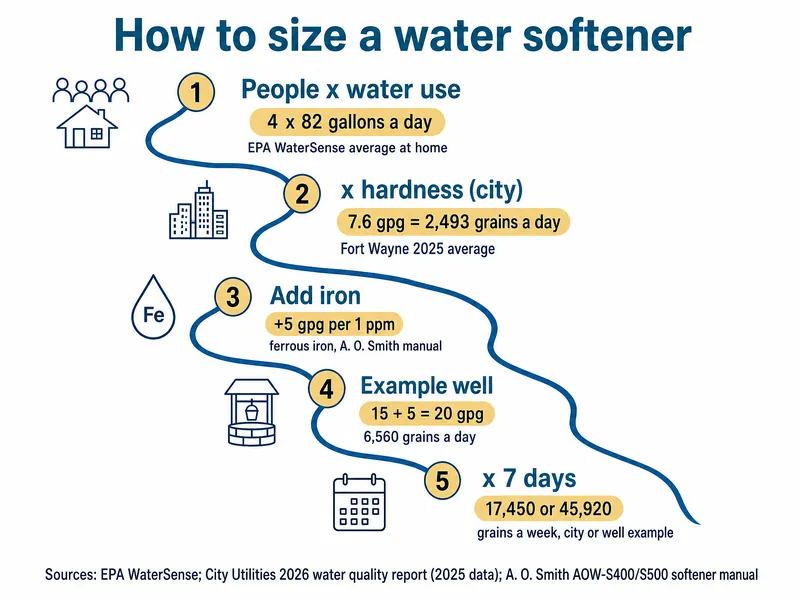
You work out water softener size from three numbers: how many people live in the house, how many gallons each uses a day, and the hardness in gpg. Multiply them and you get the grains of hardness the softener has to remove each day. Multiply by 7 for a week.
For the gallons, this page uses EPA WaterSense's figure that each American uses an average of 82 gallons a day at home, which EPA attributes to a USGS 2015 estimate. Penn State Extension's water softening page uses 75 gallons per person in its own example. Your water bill is better than either: EPA's May 2026 softener guide says to review recent bills and to leave out water that doesn't need softening, such as irrigation.
The guide also says plainly that oversizing "will lead to inefficient use of water." A softener only needs enough capacity to run several days between regenerations; buying the biggest tank on the shelf just means more resin, more salt per cycle and longer gaps that you don't need.
Numbers behind softener sizing
- 82 galAverage daily use at home per personSource: EPA WaterSense
- 130 mg/LFort Wayne 2025 average hardness (about 7.6 gpg)Source: City Utilities 2026 report
- +5 gpgAdded to hardness for each 1 ppm of ferrous ironSource: A. O. Smith AOW-S400/S500 manual
- 3,350Grains per pound of salt, EPA's efficiency floorSource: EPA WaterSense softener guide
What size water softener for Fort Wayne city water?
On Fort Wayne city water, a family of four needs a softener that removes about 17,450 grains a week at the average hardness. City Utilities' 2026 water quality report gives a 2025 average of 130 mg/L (about 7.6 gpg) and a range of 94–174 mg/L (about 5.5–10.2 gpg).
Here is the arithmetic:
- Average: 4 people × 82 gallons × 7.6 gpg = 2,493 grains a day; × 7 = 17,450 grains a week.
- Highest 2025 reading: 4 × 82 × 10.2 gpg = 3,346 grains a day; × 7 = 23,420 grains a week.
- Two people at the average: 2 × 82 × 7.6 = 1,246 grains a day, or about 8,725 a week.
Set the control for the higher end of the range rather than the 7.6 average if you want soft water on the hardest days, because hardness shifts with the river through the year. Remember too that city water is already lime-softened at the plant and sits under Purdue's 180 ppm softening line, so on city water you are buying comfort and less scale, not fixing a problem; whether a Fort Wayne home needs one at all is its own question.
What size water softener for a well?
For a well, the size comes from your own lab result, and it usually lands well above the city numbers. Purdue's WQ-5 says Indiana groundwater generally runs 20–400 ppm hardness and that "virtually all" of it is over 180 ppm, so get a test before you shop; how often should I test my well in Allen County? covers where.
Take an example well result of 257 mg/L hardness and 1 ppm of clear-water (ferrous) iron:
- Hardness: 257 ÷ 17.1 = 15 gpg.
- Iron: 1 ppm × 5 = 5 gpg, so compensated hardness is 15 + 5 = 20 gpg.
- Load: 4 people × 82 gallons × 20 gpg = 6,560 grains a day; × 7 = 45,920 grains a week.
That family needs about 2.6 times the weekly capacity of the same family on city water. The example numbers are illustrative; use your own test.
How does iron change softener size?
Iron raises the size because the resin spends capacity on it. The A. O. Smith AOW-S400/S500 manual (page 5) tells owners to increase the hardness setting "by 5 grains per gallon (86 mg/L) for every 1 ppm (1mg/L) of ferrous iron." Its own example is 20 gpg plus 3 ppm of iron, for a compensated hardness of 35 gpg.
That rule only covers dissolved, clear-water iron. The same manual says ferrous iron is the "only type of iron that can be treated with a water softener," and that ferric (already rusty) iron should be filtered out before it reaches the resin. Penn State Extension's iron and manganese page generally recommends softeners for iron only when pH is above 6.7, hardness is 3–20 gpg and dissolved iron is under 5 mg/L.
Iron also lowers efficiency. The Water Quality Association's Getting Smart with Softeners says efficiency ratings assume under 2 ppm of iron, and that hardness can leak through with more than 2 ppm of iron or more than 30 gpg of hardness. Above those levels, plan on an iron filter first; what well water treatment do I need? lays out the order. No primary source was found for a manganese adjustment, so this page doesn't give one.
What does flow rate mean for softener size?
Flow rate is the second sizing test: the tank has to pass your peak flow without a big pressure drop, whatever its grain capacity. Pentair's 5600SXT operation manual rates its 1.0, 1.5 and 2.0 cubic foot systems for 10.0, 10.8 and 12.0 gallons a minute at a 15, 14 and 14 psi drop.
On a well, the pump sets the limit. SoftPro's Elite well softener listing (sold by SoftPro Water Systems, same owners as this site) is sized by pump output in gallons per minute as well as grains, and offers a bundle with an iron filter. The store's listed price in October 2026 runs $1,327–$3,367 depending on size and bundle. Quality Water Treatment sells the ECO well softener (sold by Quality Water Treatment, same owners as this site) in 32,000–64,000 grain sizes, listed at $947–$2,977 in October 2026.
| System | Resin | Low salt setting | Middle setting | High setting | Rated flow |
|---|---|---|---|---|---|
| VT-11-01 | 1.0 cu ft | 11,900 grains @ 3 lb | 31,100 @ 9 lb | 35,400 @ 15 lb | 10.0 gpm |
| VT-17-01 | 1.5 cu ft | 17,900 @ 4.5 lb | 46,600 @ 13.5 lb | 53,100 @ 22.5 lb | 10.8 gpm |
| VT-23-01 | 2.0 cu ft | 23,900 @ 6 lb | 62,200 @ 18 lb | 70,700 @ 30 lb | 12.0 gpm |
The table is the reason a "64,000-grain" label needs care. Nominal ratings are usually reached only at a heavy salt dose; at the lowest salt setting in the table, every size works out to roughly 4,000 grains per pound of salt.
How often should a softener regenerate?
A softener sized well regenerates about once a week. Penn State's example (4 people, 75 gallons, 10 gpg, a 20,000 grain sample unit) works out to "about 6-7 day regeneration." NDSU Extension's softening publication warns that recharging too early "wastes salt and water" and recharging too late lets performance fall off.
Using the Pentair figures with the city family (2,493 grains a day):
- 1.5 cu ft at 4.5 lb: 17,900 ÷ 2,493 = about 7 days.
- 2.0 cu ft at 6 lb: 23,900 ÷ 2,493 = about 9.6 days.
For the example well (6,560 grains a day), 2.0 cu ft at 18 lb gives 62,200 ÷ 6,560 = about 9.5 days, and 1.5 cu ft at 13.5 lb gives about 7 days.
Salt follows the same math. At EPA's efficiency floor of 3,350 grains per pound, the city family's 17,450 grains a week takes about 5.2 lb of salt; at the WQA's 4,000 grain target, about 4.4 lb. The example well needs about 11.5–13.7 lb a week. EPA's guide recommends demand-initiated regeneration, which counts gallons and recharges only when needed.
For city water, SoftPro's Elite city softener (sold by SoftPro Water Systems, same owners as this site) comes in 32,000–64,000 grain sizes at $1,367–$2,827, and Quality Water Treatment's ECO city softener (sold by Quality Water Treatment, same owners as this site) at $967–$2,677 (the stores' listed prices in October 2026). For the city example above, the 32,000 size at a lean salt setting already covers a week.
How this answer was put together
This answer is based on EPA WaterSense's statistics page and its May 2026 softener guide (832-F-26-007); the city's 2026 drinking water report on 2025 testing; Purdue Extension WQ-5; Penn State Extension's water softening and iron pages; NDSU Extension's ion exchange publication; WQA's Getting Smart with Softeners; the A. O. Smith AOW-S400/S500 manual; and Pentair's 5600SXT manual. All were read in October 2026, and every calculation is shown on the page. The well example numbers are illustrative, not a real test. Left out: a manganese adjustment and "buy 1.5 times your weekly need" rules, because no maker manual or extension source for them was found.
Follow-up questions
Is a 32,000 grain softener big enough for Fort Wayne city water?
For most households, yes. A family of four at the 2025 average needs about 17,450 grains a week, so a unit with 32,000 nominal grains still lasts a week at a lower, more efficient salt setting.
What hardness should I program on city water?
Many owners program the top of the range rather than the average. City Utilities reported 94–174 mg/L in 2025, which is about 5.5–10.2 gpg, so 10 gpg keeps water soft on the hardest days.
Does an outdoor faucet count in softener sizing?
Leave it out if you can. EPA's guide suggests installing the softener after the line branches to outdoor faucets or irrigation, so lawn water never uses up grains.
How do I convert mg/L to grains per gallon?
Divide by 17.1. So 130 mg/L is about 7.6 gpg and 257 mg/L is about 15 gpg.
Does potassium chloride change the softener size?
It changes the salt, not the grain load. WQA says regeneration with potassium chloride needs a 13–15% higher concentration, so expect to use more of it per cycle.
Can a softener be too big?
Yes. EPA says oversizing leads to inefficient use of water, and a bigger resin bed uses more salt and water each time it regenerates.
Should I size up for iron?
Use the compensated hardness instead: add 5 gpg per ppm of ferrous iron, per A. O. Smith's manual, and keep iron under the level your softener's manual allows.
Next questions
Have another question? See all Fort Wayne home water questions.