Why Does My Well Water Smell Like Rotten Eggs?
Why does my well water smell like rotten eggs? Usually hydrogen sulfide gas, which Purdue Extension says is noticeable in much of northeastern Indiana's groundwater, or a water heater reaction if only the hot side smells.
Answered by the Three Rivers Home Water desk · Last updated
About the store links on this page: SoftPro Water Systems and Quality Water Treatment, the two stores linked on this page, have the same owners as Three Rivers Home Water. Answers here lean on Fort Wayne City Utilities' published reports and rules, Indiana and federal agency guidance and makers' certification listings, read in October 2026. What a store says about its own products is quoted as the store's claim. How store links work
In this answer
The short version
- Hydrogen sulfide gas causes the rotten-egg smell, and Purdue Extension's WQ-11 says much of the groundwater in northeastern Indiana has noticeable levels.
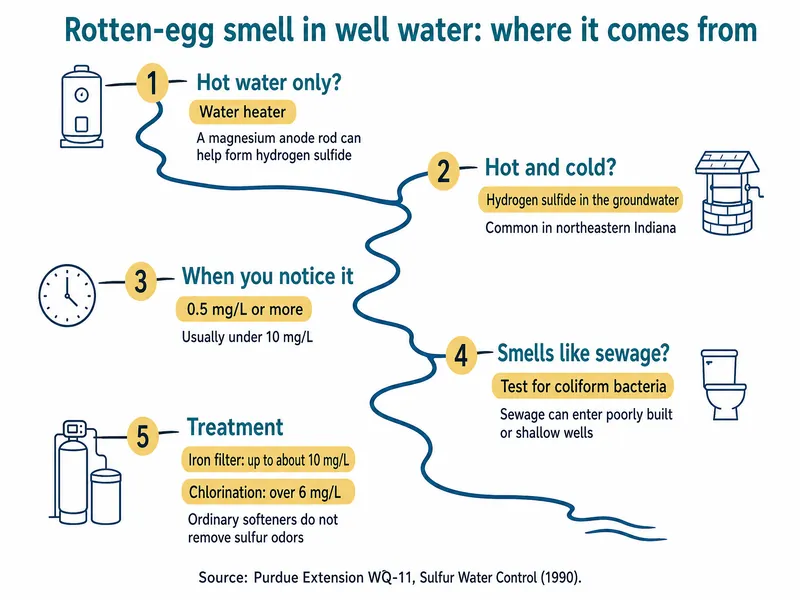
- Most people notice it at 0.5 mg/L or more; Purdue says levels usually run under 10 mg/L.
- If only the hot water smells, a magnesium anode rod in the water heater can be helping form the gas, per the same bulletin.
- Purdue says hydrogen sulfide alone "causes no known health effects," but a sewage-like odor can mean contamination: test for coliform bacteria (IDOH lab, $10).
- Purdue gives iron removal filters for up to about 10 mg/L and chlorination for levels over 6 mg/L; "ordinary household water softeners do not remove sulfur odors."
- Shock chlorination is a one-time disinfection for bacteria, with a coliform retest about 10 to 14 days later (Penn State Extension).
Why does well water smell like rotten eggs?
Well water smells like rotten eggs because of hydrogen sulfide, a gas dissolved in the groundwater. Purdue Extension's bulletin WQ-11, Sulfur Water Control, says "much of the ground water in northwestern and northeastern Indiana has noticeable hydrogen sulfide levels," which takes in Allen County's rural wells.
The gas can come from two places. Some is simply in the aquifer, and Purdue notes it is more common in groundwater than surface water because the gas escapes quickly from open water. Some is made in place: certain harmless bacteria use the oxygen in sulfate and leave hydrogen sulfide behind. The Indiana Department of Health lists sulfate and sulfide among the natural problems in Indiana wells (IDOH).
Your nose is a sensitive meter. Purdue says levels of 0.35 mg/L and less may go unnoticed, while 0.5 mg/L or more is usually noticed even in cold water. Concentrations are generally under 10 mg/L, though 50 to 75 mg/L turn up occasionally. Reports print these in mg/L or ppm, which mean the same thing.
Sulfur water in numbers
- 0.5 mg/LHydrogen sulfide level most people noticeSource: Purdue Extension WQ-11
- Under 10 mg/LUsual range in well waterSource: Purdue Extension WQ-11
- Over 6 mg/LLevel where Purdue points to chlorinationSource: Purdue Extension WQ-11
- $10State lab coliform bacteria testSource: Indiana Department of Health
- 10–14 daysRetest after shock chlorinationSource: Penn State Extension
Is it the well or the water heater?
Run a cold tap, then a hot tap: if only the hot water smells, the water heater is the likely source. Purdue explains two reasons. Heated water releases hydrogen sulfide faster than cold water, and sulfate in the water can turn into hydrogen sulfide inside the tank.
The second reason involves the anode rod. Many tanks hold a magnesium rod that protects the steel from corrosion. As the rod gives up magnesium, Purdue says, some hydrogen is released, and it can combine with sulfur in the water to form hydrogen sulfide.
If the smell is in hot and cold alike, it is coming from the well water itself. If it only shows up in one bathroom, check that fixture's drain trap before blaming the water: a dry trap can let sewer gas into the room. For the heater's own life and anode upkeep, see how long does a water heater last?, and ask the heater's maker which replacement anode it approves before swapping one.
| What you notice | Likely source | Next step |
|---|---|---|
| Hot water only | Water heater: heat releases the gas, and a magnesium anode can help form it | Ask the heater maker or a licensed plumber about the anode |
| Hot and cold water | Hydrogen sulfide in the groundwater | Test sulfide at the well, plus iron and manganese |
| Sewage-like odor, or a shallow or poorly built well | Possible sewage pollution | Coliform bacteria test before anything else |
| Black stains, tarnished silverware | Hydrogen sulfide corroding iron, copper and brass | Treat the sulfur; check iron and manganese |
| One room only | Often a drain, not the water | Run water into unused drains to refill traps |
Is rotten-egg smell in well water harmful?
Hydrogen sulfide on its own is a nuisance rather than a health risk: Purdue says it "causes no known health effects," though high levels change the taste. The real question is whether something else is causing the smell.
Purdue's warning is about sewage. Its odor is similar, and sewage pollution can reach "poorly constructed wells or in shallow wells close to sewer lines or septic tanks." Sewage carries disease-causing organisms, and plain hydrogen sulfide does not. That is why a new or sewage-like smell calls for a coliform bacteria test, which the Indiana Department of Health lab runs for private well owners for $10 plus shipping.
The gas still does damage around the house. Purdue lists corrosion of iron, steel, copper and brass, "black water" from iron sulfide, blackened silverware, and laundry that is hard to get clean. Iron and manganese often travel with it and stain sinks and clothes. The full testing schedule is on how often should I test my well?
How is hydrogen sulfide removed from well water?
Hydrogen sulfide is removed by oxidizing it into solid sulfur and filtering that out, and the right method depends on how much gas is present and what else is in the water. Purdue says the choice turns on the sulfur level, the iron and manganese level, and whether bacteria also need treating. Test first, at the well, since the gas escapes from a sample quickly.
Purdue's bulletin describes four approaches:
- Iron removal filter. Handles "low to moderate amounts (up to around 10 mg/l)" while also removing iron and manganese. The type Purdue describes is recharged with potassium permanganate.
- Continuous chlorination. For "medium to high levels (over 6 mg/l)." A chemical feed pump adds chlorine, a filter or settling tank catches the sulfur, iron and manganese, and a carbon filter can take out the leftover chlorine.
- Aeration. Air is added to the water in a non-pressurized tank; it may not get the gas to non-detectable levels, but sometimes reduces it to acceptable amounts.
- Activated carbon. Absorbs some hydrogen sulfide but has "very limited capacity," so it suits a drinking tap more than a whole house.
A softener is not on the list. Purdue says "ordinary household water softeners do not remove sulfur odors," and that sulfur and iron can foul the softener resin. Drilling a new well is no sure fix either: Purdue says a new well "may or may not" reach sulfur-free water, and deeper wells tend to have more minerals and sulfur.
Air-injection iron filters are one way to do the oxidizing. SoftPro Water Systems lists the Iron Master (sold by SoftPro Water Systems, same owners as this site) as removing iron, manganese and hydrogen sulfide, and says it handles up to 30 ppm of iron (the store's own claim, sized by pump flow). Quality Water Treatment lists the same Iron Master (sold by Quality Water Treatment, same owners as this site). Neither is a fix for bacteria: get a coliform result first, and compare your sulfide, iron and manganese numbers against the product's stated limits. What well water treatment do I need? sets out the order to treat things in.
What is shock chlorination?
Shock chlorination is a one-time dose of strong chlorine put down the well and through the plumbing to kill bacteria, then flushed out. Penn State Extension's shock chlorination page lists three times to do it: after a new well is built, after work on the well or a new submersible pump, and after a positive coliform test.
Afterward, Penn State says to retest for total coliform "approximately 10 to 14 days later," and if that is clean, test again two to three months later. If bacteria come back, it says "a continuous disinfection treatment system will be necessary," because a single shock does not fix a well that keeps letting contamination in.
It warns that strong chlorine can damage or exhaust some treatment equipment, so ask the equipment's maker or installer whether to bypass softeners and filters first. Purdue's WQ-11 does not list shock chlorination as a sulfur treatment; it lists the continuous methods above. Penn State's page points to step-by-step instructions from Pennsylvania's environment department rather than giving bleach amounts, and a licensed well driller or plumber can do the job.
What else causes well water smells?
Other smells point to other causes, and Purdue warns that foul or unusual odors "should make you question" the water's quality and safety. A sewage odor calls for the bacteria test above. The Indiana Department of Health also notes that naturally occurring methane "exist[s] throughout Indiana," so ask the lab about a methane test if gas sputters from the taps.
A musty or earthy taste in a well is less common than in river-fed city water, which is covered in why does my tap water taste earthy? A metallic taste with orange stains usually means iron; Purdue's WQ-5 says iron typically runs 0.1 to 3.0 ppm in Indiana groundwater and stains above 0.3 ppm. A chlorine smell on a well means someone added chlorine, often after a shock or through a feed pump. All the well questions are collected on the wells topic page.
How this answer was put together
This answer is based on Purdue Extension bulletins WQ-11 (1990) and WQ-5 (1990), two Indiana Department of Health pages, one on well water quality and one listing its lab's tests and prices (both read in October 2026), Penn State Extension's shock chlorination page (updated May 2025), and the SoftPro Water Systems and Quality Water Treatment product listings (read October 2026). Product capacities are the stores' own claims and were not tested. Left out: bleach dosages and step-by-step shock instructions, which Penn State refers to other agencies, and prices for treatment systems.
Follow-up questions
Why does my well water smell worse in the morning?
Water that sits in a warm water heater or in pipes overnight has more time to release gas, and Purdue notes heated water lets hydrogen sulfide escape faster. If the first hot draw of the day is worst, the heater is the likely source.
Can I just remove the water heater's anode rod?
Purdue links the magnesium anode to hot-water sulfur smells, but the rod also protects the tank from rusting. Ask the heater's maker which replacement anode it approves, since changes can affect the warranty, and have a licensed plumber do it if you are not sure.
Will a carbon pitcher filter take out the rotten-egg smell?
It may help a little at one tap. Purdue says activated carbon absorbs some hydrogen sulfide but has very limited capacity, and the filters must be replaced often.
Does hydrogen sulfide damage plumbing?
Yes. Purdue says it corrodes iron, steel, copper and brass, forms black iron sulfide, and corrodes exposed metal parts in washing machines. It also tarnishes silverware.
Should the sulfide test be done at the well?
Yes. Purdue says to collect hydrogen sulfide samples at the well site because the gas escapes from water easily. Ask the lab for its bottle and instructions before collecting.
Is it safe to shower in water that smells of sulfur?
Purdue describes hydrogen sulfide at well levels as a nuisance with no known health effects. If the smell is strong, new, or seems like sewage, test for bacteria and ventilate the bathroom while you wait for results.
Will a water softener remove the smell?
No. Purdue says ordinary household softeners do not remove sulfur odors and can become fouled or clogged by it. Treat the sulfur first, then soften if the water is hard.
More on private wells


Have another question? See every Fort Wayne home water answer.