How Often Should I Test My Well?
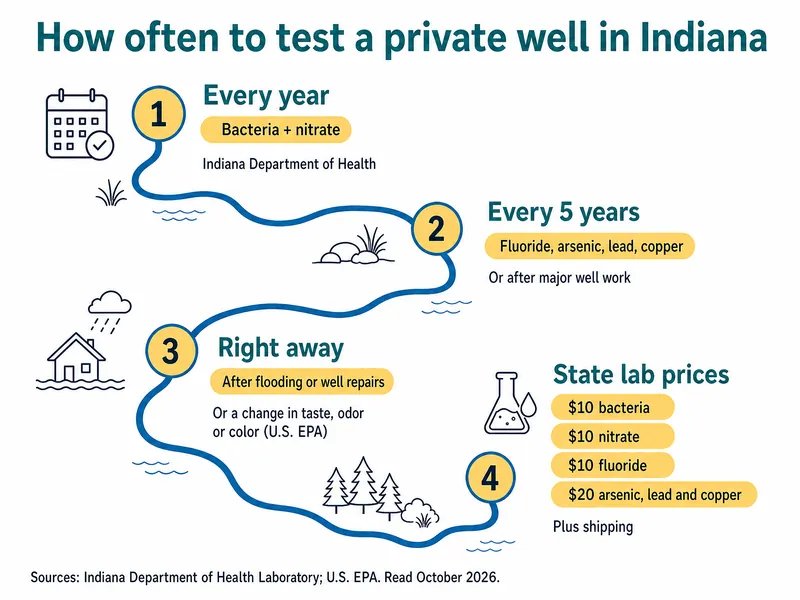
How often should I test my well in Allen County? Every year for bacteria and nitrate, and at least every five years for arsenic, fluoride, lead and copper, says the Indiana Department of Health.
Answered by the Three Rivers Home Water desk · Last updated
In this answer
The short version
- The Indiana Department of Health says to test a private well every year for bacteria and nitrate, and at least every 5 years for fluoride, arsenic, lead and copper.
- Private wells are not regulated by IDEM or the U.S. EPA, so nobody tests yours unless you do (IDOH).
- The state lab charges private well owners $10 for bacteria, $10 for nitrate, $10 for fluoride and $20 for arsenic, lead and copper, plus shipping.
- The EPA adds total dissolved solids and pH to the yearly list, and says to test right away after flooding, well repairs or a change in taste, odor or color.
- The drinking water standard for nitrate is 10 mg/L and for arsenic 10 µg/L (EPA).
- No Allen County well-testing program turned up in the county health department's published pages; the state lab is the low-cost route this page found.
How often should you test a well in Allen County?
Test a well in Allen County at least once a year for bacteria and nitrate. That is the minimum the Indiana Department of Health laboratory gives, and it adds a second, slower schedule: fluoride, arsenic, lead and copper at least every 5 years, or whenever major maintenance is done on the well.
The reason the job falls to you is simple. IDOH states that private well water "is unregulated" by both the Indiana Department of Environmental Management and the EPA (IDOH well water page). The Allen County Department of Health puts it the same way: owners of individual water systems "are responsible for ensuring wells maintained."
Homes on Fort Wayne City Utilities water are in a different position. The utility samples and reports on its water every year; if you are not sure which you have, where Fort Wayne tap water comes from explains the city system. Everything on this page is for private wells.
Well testing by the numbers
- 1 yearBacteria and nitrate testing intervalSource: Indiana Department of Health
- 5 yearsFluoride, arsenic, lead and copper intervalSource: Indiana Department of Health
- $10State lab bacteria test for private well ownersSource: Indiana Department of Health
- 10 mg/LNitrate drinking water standardSource: U.S. EPA
- 10 µg/LArsenic drinking water standardSource: U.S. EPA
What should a well test include?
A well test should include, at minimum, total coliform bacteria and nitrate every year. The state and federal lists differ a little, so it helps to see them side by side.
| Test | How often | Who recommends it | State lab price |
|---|---|---|---|
| Bacteria (total coliform) | Every year | IDOH and EPA | $10 |
| Nitrate | Every year | IDOH and EPA | $10 |
| Total dissolved solids and pH | Every year | EPA | Not on the IDOH price list |
| Fluoride | At least every 5 years | IDOH | $10 |
| Arsenic, lead and copper | At least every 5 years, or after major well work | IDOH | $20 |
| Any of the above | Right away after flooding, repairs or a change in taste, odor or color | EPA | As listed |
Two local reasons make the 5-year tests worth doing. IDOH notes that glacial deposits of arsenic "exist throughout the State of Indiana," and arsenic has no taste or smell; is there arsenic in Allen County well water? covers what the USGS found in glacial-aquifer wells. IDOH also warns about naturally occurring methane in Indiana groundwater.
Hardness and iron are not health tests, but they decide what treatment makes sense. Purdue Extension's WQ-5 says "virtually all" Indiana groundwater is very hard, over 180 ppm, and that iron typically runs 0.1 to 3.0 ppm and stains above 0.3 ppm. A private lab can run these alongside the health tests. Reports print results in ppm or ppb: ppm is the same as mg/L, and ppb the same as µg/L.
Where do you get a well tested in Indiana?
You can send samples to the Indiana Department of Health laboratory in Indianapolis or use a state-certified private lab. The IDOH lab page says kits are ordered through Access Indiana, the sample containers are mailed once the order is in, and samples go back to the lab at 550 W. 16th St. with a chain-of-custody form.
The state prices for "private citizens using well water for drinking" are $10 for bacteria, $10 for nitrate, $10 for fluoride and $20 for arsenic, lead and copper as a group, not counting shipping. That makes a full yearly test $20 and the 5-year add-on about $30.
A private lab may cost more but can run a wider panel, such as hardness, iron, manganese, sulfate and pH, in one visit. Ask any lab whether it is certified for drinking water and which bottles and hold times it needs before you collect anything. This site found no well-testing program run by the Allen County Department of Health.
When should you test your well right away?
Test right away after flooding, after any repair to the well, and any time the water's taste, odor or color changes. The EPA's private well page lists those triggers, and the IDOH lab adds "whenever any major maintenance is done" to its 5-year metals tests.
In practice that covers these moments:
- High water around the wellhead. Flooding is the first trigger on the EPA's list.
- A new pump, a pulled pump or new piping. Penn State Extension lists well work and a new submersible pump among the times to disinfect and retest (Penn State Extension).
- A new smell. A rotten-egg odor is usually hydrogen sulfide, but Purdue warns that a sewage source is possible, which calls for a coliform test; see why does my well water smell like rotten eggs?
- A baby on the way. EPA warns that infants under six months who drink water high in nitrate "can become seriously ill" (EPA).
- Buying or selling a house. Purdue notes that water test records "are often needed for property sales."
How do you take a well water sample?
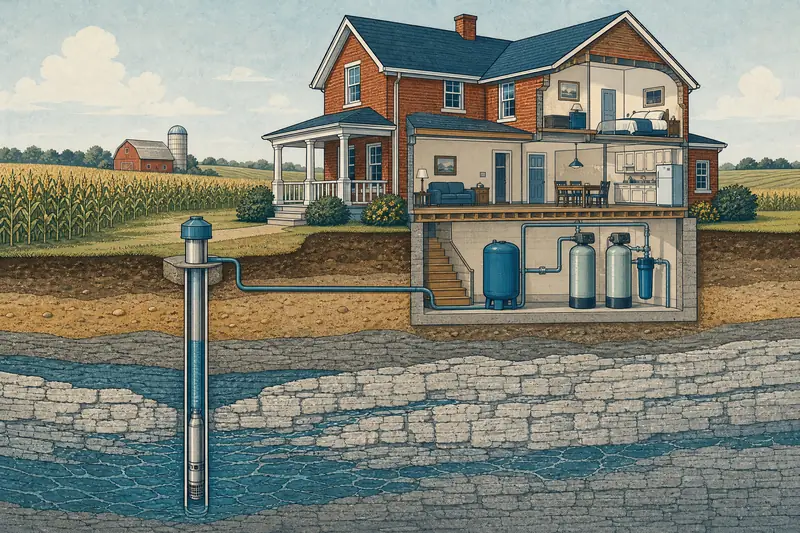
Take it from a cold tap close to the pressure tank, before any softener or filter, using only the lab's sterile bottle. Purdue Extension's WQ-3, How to Take a Water Sample, gives the steps most labs still follow:
- Pick a faucet near the pump that does not leak, and not a swing-type faucet.
- Remove the aerator and disinfect the faucet with bleach or a flame.
- Run the water several minutes to clear the line.
- Fill the bottle midstream without touching the inside of the bottle or cap.
- Refrigerate if needed and get it to the lab quickly; Purdue gives 48 hours as the outer limit.
Lead samples are the exception to running the water first: Purdue notes they usually need water that has stood in the pipes overnight. Where the lab's own instructions differ from these, follow the lab.
Keep every report. Purdue suggests filing the date and results so you can compare years, which is how slow changes, such as nitrate creeping up, get noticed.
What do the well test results mean?
A result means the most when you compare it with the drinking water standard and with your last test. For bacteria, labs usually report total coliform as present or absent, and "present" means something is getting into the water system.
- Coliform present. Penn State lists a positive coliform test as a reason to shock chlorinate, then retest about 10 to 14 days later and again two to three months after that. If bacteria keep returning, it says a continuous disinfection system "will be necessary."
- Nitrate at or above 10 mg/L. That is the EPA standard. Given EPA's warning about infants, don't use the water for formula until a retest and a fix bring it down.
- Arsenic at or above 10 µg/L. Retest to confirm, then compare treatment; a softener is not one of the options.
- Hard water, iron or sulfur odor. These are nuisance problems with their own fixes, covered in what well water treatment do I need?
IDOH's own advice is short: "If any of the above tests come back elevated, we recommend additional testing." A second sample before buying equipment is cheap insurance. Other private-well answers are listed on the wells topic page.
How this answer was put together
What went into it: IDOH's private-well page and its lab's test list with prices (October 2026), the U.S. EPA private well and drinking water standard pages (read October 2026), the Allen County Department of Health water quality page (last updated 2022), Purdue Extension bulletins WQ-3 (1990) and WQ-5 (1990), and Penn State Extension's shock chlorination page (updated 2025). Left out: private lab prices, which vary and were not checked, and any county testing program, since none was found. Three Rivers Home Water is not a lab, a utility or a health agency.
Follow-up questions
Is a well test required when selling a house in Allen County?
This site found no Allen County rule that requires one. Lenders and buyers often ask for a recent bacteria and nitrate result anyway, and Purdue notes that test records are often needed for property sales. Check with the lender or your agent early, since lab turnaround takes days.
Should a new well be tested before you drink from it?
Yes. Penn State lists construction of a new well as a time to disinfect the well and test it for coliform afterward. Indiana drillers must also file a record of each new well with the DNR within 30 days, under 312 IAC 13-2-6, which is worth keeping with your test reports.
Can I test my well with a store-bought strip kit?
Strip kits give a rough reading for things like hardness or pH, but they are not a substitute for a lab bacteria or arsenic test. The IDOH lab's bacteria test costs $10. Use a lab result for any decision about drinking water or treatment.
Does a softener or filter change what the test shows?
Yes, which is why the sample should come from a tap before any treatment. If you want to know whether a filter is working, take a second sample after it and label both bottles clearly.
How long does the state lab take to return results?
The IDOH lab page does not give a turnaround time. Ship early in the week so samples do not sit over a weekend, and email the lab's address on its page with any question about timing.
Do you need to test a well that only feeds a barn or garden?
If nobody drinks it, the yearly health tests matter less. If people or animals drink from it, the same schedule applies. A garden hose on a well can also siphon back into it, so keep hose ends out of buckets and tanks.
What does a 5-year test cost at the state lab?
Fluoride is $10 and the arsenic, lead and copper group is $20, so about $30 plus shipping. Adding that year's bacteria and nitrate tests brings it to about $50 before shipping.
Read next

Have another question? See all Fort Wayne home water questions.