Does My House Have a Lead Service Line?
Does my house have a lead service line? In Fort Wayne, look your address up on City Utilities' service line map, then confirm with a scratch-and-magnet check where the pipe enters your basement.
Answered by the Three Rivers Home Water desk · Last updated
In this answer
The short version
- City Utilities published its service line inventory in October 2024; you can search any address on the city's service line map, which shows the city side and the property side separately.
- The city's 2025 lead line brochure says homes built before 1937 are likely to have lead service lines, and homes built before 1981 may.
- EPA's Protect Your Tap check needs only a key or coin and a magnet: lead is soft to scratch and a magnet won't stick.
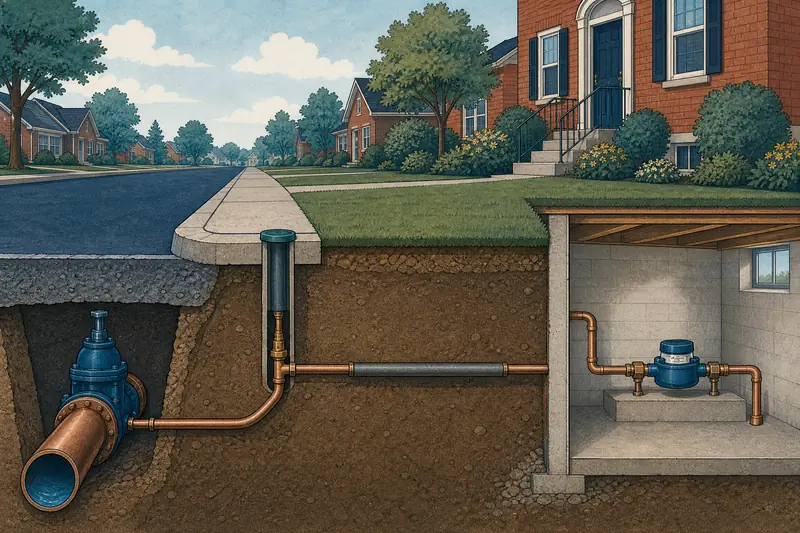
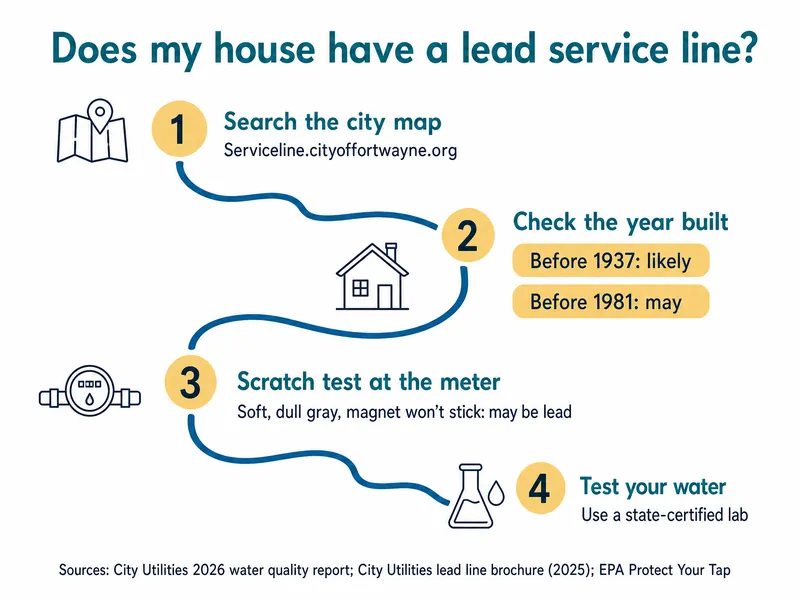
- The homeowner owns the pipe from the curb box to the meter; City Utilities owns the main and the line up to the curb stop.
- Fort Wayne's water leaves the plant lead-free, and 2025 tap sampling met the 15 ppb action level, though 3 of 106 homes tested from January to June were above it.
How do you check a Fort Wayne address for a lead service line?
Start with the city's map. City Utilities' 2026 water quality report points residents to Serviceline.cityoffortwayne.org, a map titled "Fort Wayne: Water Service Lines Materials" that lets you search an address and see the material recorded for the city-owned side and the property-owned side.
Read the map as a starting point, not a final answer. Its own disclaimer says it is built from historical data, predictive modeling and information customers have sent in, and it does not cover the plumbing past your meter. A line marked "unknown" or "galvanized requiring replacement" needs the same follow-up as one marked lead.
City Utilities also links a short property owner survey from its lead removal page. If you check your own pipe, sending in what you found is how the inventory gets corrected, and federal rules now require utilities to keep updating these lists.
How can you tell a lead pipe at the meter?
You can usually tell in two minutes with a key and a magnet, using EPA's Protect Your Tap steps. Find your water meter, which EPA says may be in a basement, crawlspace or garage, or outside between the street and the house. Then find the pipe that comes through the wall or floor and connects to it; there should be a valve on it.
Gently scratch that incoming pipe with the edge of a key or coin, close to where it enters:
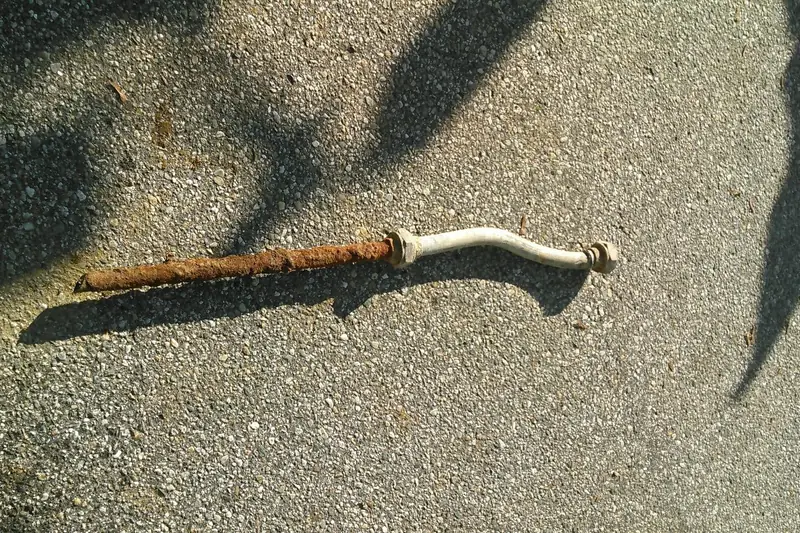
- Copper: the scratch shows orange or pale orange, the color of a penny, and a magnet won't stick.
- Galvanized steel: gray, hard to scratch, and a magnet sticks.
- Lead: gray, soft and easy to scratch, and a magnet does not stick.
- Plastic: white, blue, black or another color; no metal at all.
One detail trips people up: copper pipe inside the house tells you nothing about the buried line, so scratch the very first section where it comes through the wall or floor.
| Material | Scratch test | Magnet | What it means |
|---|---|---|---|
| Lead | Soft and easy to scratch, gray | Does not stick | Likely a lead service line: sign up for replacement |
| Galvanized steel | Hard to scratch, stays gray | Sticks | Can carry lead particles from old lead pipe upstream |
| Copper | Orange or penny-colored | Does not stick | Not lead, but check the map for the city side |
| Plastic | No metal; colored pipe | Does not stick | Not lead |
Which Fort Wayne homes are likely to have lead lines?
Age is the strongest clue. City Utilities' 2025 brochure says homes built before 1937 are "likely" to have lead service lines and homes built before 1981 "may" have them, noting that most homes built before 1937 used lead pipe to connect to city water. Congress banned new lead pipe installation in 1986, EPA notes.
That puts the older neighborhoods closest to downtown at the top of the list. The city's free-replacement areas in parts of Hamilton, Renaissance Pointe, the East Side, Harvester and Oxford are older housing stock, and many 1920s and 1930s streets elsewhere fall in the "likely" band too. A house built after the 1986 ban should not have a lead line, but the map is still the quickest way to rule it out.
Who owns the service line?
You own most of it. The city's lead removal page splits the line at the curb stop: City Utilities owns the main and the pipe up to the curb stop, and the property owner owns the pipe from the curb stop to the house and meter. The brochure calls the same spot the "curb box," the buried shut-off valve, usually near the sidewalk.
That split matters for cost. When the city replaces its side in a neighborhood, your side is still yours to replace, which is why City Utilities runs a program that bundles private-side work and caps what homeowners pay. How Fort Wayne lead line replacement works walks through the prices and income tiers.
Lead service lines in Fort Wayne
- 3,100+lead service lines replaced through the city programSource: City Utilities 2026 report
- 1937homes built before this year are likely to have lead linesSource: City Utilities brochure 2025
- 4.26 ppb90th percentile lead, January to June 2025 (action level 15)Source: City Utilities 2026 report
- 3 of 106homes sampled above 15 ppb, January to June 2025Source: City Utilities 2026 report
Is Fort Wayne tap water lead-free?
The water is lead-free when it leaves the plant, but it can pick up lead on the way through an old pipe. City Utilities' 2026 report says water from the Three Rivers Filtration Plant is lead-free and there are no lead water mains; the risk sits in private service lines and older household plumbing. The plant adds orthophosphate, which coats the inside of pipes to slow lead from dissolving.
Tap sampling in 2025 met the federal rule. From January to June the 90th percentile was 4.26 ppb across 106 homes, but 3 homes were above the 15 ppb action level and the highest result was 23.7 ppb. From July to December the 90th percentile was 2.61 ppb across 101 homes, with none above 15 ppb. (Reports print lead in ppb, parts per billion, the same as µg/L.)
Those homes are chosen because they are at higher risk, so the results describe the system, not your kitchen tap. The only way to know your own level is a test. City Utilities does not offer free lead tests; its report tells residents to use a lab on the Indiana Department of Health certified-lab list, and EPA puts typical costs at $15 to $100. Reading the Fort Wayne water quality report shows where these rows sit in the table.
What should you do if your house has a lead service line?
Sign up for replacement, and cut your exposure until the pipe is gone. The city's report gives the everyday steps: use only cold water for drinking, cooking and baby formula; run the tap 30 seconds to 2 minutes before using water that has sat, or up to 5 minutes if you have a lead line; and remember that boiling does not remove lead.
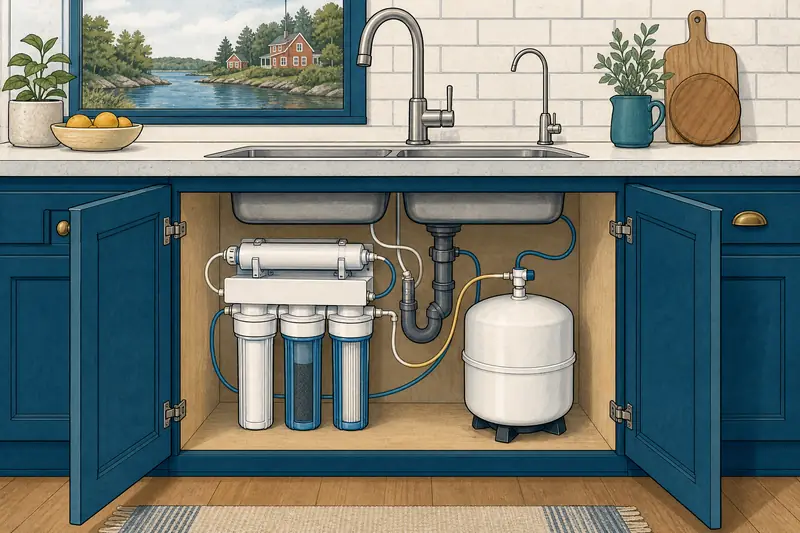
A filter is the other daily safeguard. City Utilities and EPA both say to use one certified to reduce lead, and the label alone is not enough; which filters reduce lead explains how to check the certifier's listing. Clean faucet aerators now and then too, since EPA notes lead particles can collect there.
Then get on the city's list. The program caps what you pay in project areas and replaces lines free for lower incomes, as covered in how Fort Wayne lead line replacement works. This site is run separately from City Utilities; sign-ups go through the city's lead removal page.
How this answer was put together
This answer is based on City Utilities' 2026 water quality report (2025 lead sampling), its 2025 lead service line brochure, its lead removal web page and service line map disclaimer, EPA's Protect Your Tap steps (page updated May 7, 2026), EPA's basic lead-in-drinking-water page (updated June 18, 2026) and EPA's October 2024 overview of the Lead and Copper Rule Improvements, all read in October 2026. It leaves out counts of lead lines still in the ground, which City Utilities has not published, and gives no health advice beyond what EPA and the city print.
Follow-up questions
Can the lead line be on the city side but not mine?
Yes. The map shows the two sides separately, and either can be lead, copper or unknown. If only the city side is lead, City Utilities owns that work; your side still matters if it is galvanized.
Does a galvanized pipe count as a lead line?
Not by itself, but the federal rule treats galvanized pipe that is or was downstream of lead as needing replacement, because lead particles can lodge on its rough inside surface. The city program replaces galvanized lines as well as lead.
My scratch test was unclear. What next?
Mark it unknown, send the city's property owner survey, and test your water at a certified lab. Treat an unknown line the way you would a lead one until you know.
Does a landlord have to tell tenants about a lead line?
This site found no Indiana disclosure rule to quote. The city's brochure notes utilities must list addresses with lead lines publicly, and it offers landlords extra cost reductions for replacing them.
Does selling a house with a lead line require replacing it?
No rule requiring it was found for Fort Wayne. Buyers can search the same public map, so many sellers check it first and join the replacement program.
Is the water from my outdoor spigot affected?
Yes, if it is fed by the same service line. Use cold water from a filtered kitchen tap for drinking and cooking, not the hose.
Will City Utilities tell me if my line is lead?
Under the federal rule, utilities must notify customers with lead, galvanized-requiring-replacement or unknown lines every year. The map is available now, so you don't need to wait for a letter.
More questions about lead and tap water

Have another question? See every Fort Wayne home water answer.