Where Does Fort Wayne Tap Water Come From?
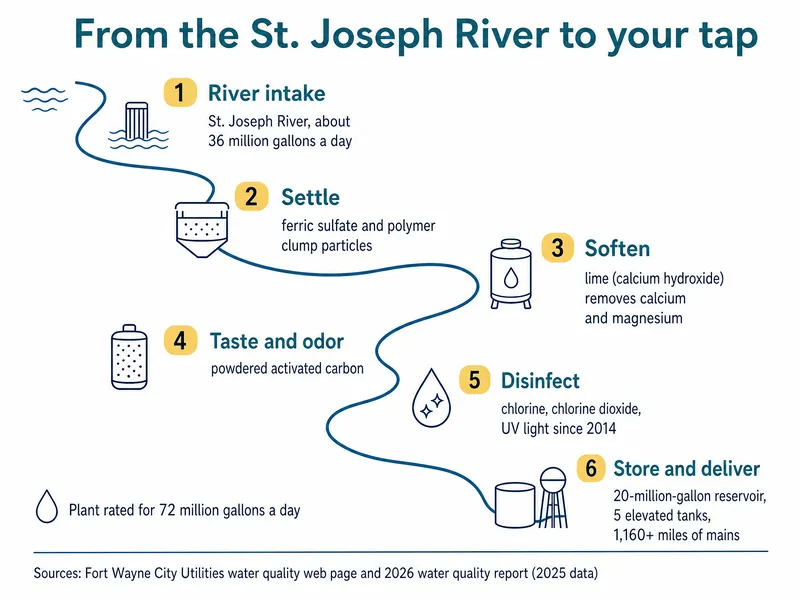
Where does Fort Wayne tap water come from? The St. Joseph River: City Utilities draws about 36 million gallons a day from it and treats it at the Three Rivers Filtration Plant, where the rivers meet.
Answered by the Three Rivers Home Water desk · Last updated
In this answer
The short version
- City Utilities' 2026 water quality report names the St. Joseph River as the only source and says the city draws about 36 million gallons from it a day.
- The Three Rivers Filtration Plant opened in 1933 at 24 million gallons a day and is now rated for 72 million after expansions in 1955 and 1981.
- Treatment runs through ferric sulfate and polymer, lime softening, powdered activated carbon, free chlorine plus chlorine dioxide, and UV light added in 2014 for $21 million.
- EPA's drinking water database lists the system at about 270,000 people and about 110,000 connections.
- New Haven buys treated surface water; Huntertown, Woodburn, Monroeville and Leo's Pioneer Water pump groundwater from wells.
Which river supplies Fort Wayne tap water?
Fort Wayne tap water comes from the St. Joseph River, the river that flows in from the northeast and joins the St. Marys downtown to form the Maumee. City Utilities' report says it draws "an average of about 36 million gallons of water from the river each day", and no city source lists any working groundwater wells.
The plant sits at that confluence, on a 25-acre site east of Spy Run Avenue, but its raw water is the St. Joe's. Upstream, City Utilities can hold back extra water in the Cedarville Reservoir at the St. Joe River dam near Leo-Cedarville, and it has a man-made reservoir near Grabill, the Hurshtown Reservoir, according to its water quality page.
Because the source is a river, what happens in the St. Joseph watershed shows up at the plant. Rain, farm runoff and warm, sunny weather all change the raw water, which is why the treatment is adjusted from day to day and why the taste can shift (more in why tap water can taste earthy).
Fort Wayne water supply in numbers
- 36 million galAverage daily draw from the St. Joseph River, 2025Source: City Utilities 2026 water quality report
- 72 million galDaily design capacity of the Three Rivers Filtration PlantSource: City Utilities plant page
- 269,994People served, per EPA's drinking water recordsSource: EPA SDWIS
- 1,160+ milesWater mains carrying treated water around the citySource: City Utilities water quality page
What happens at the filtration plant?
At the plant, river water is clumped and settled, softened, cleared of taste and odor, filtered and disinfected before it is stored. The city's plant page says the water "travels nearly a mile" through the chemical treatment area, settling tanks and filters once it enters the building.
City Utilities lists the chemicals it uses, in roughly this order:
- Ferric sulfate and polymer make soil and other particles stick together in clumps that settle out. The city says these are "added then completely removed".
- Calcium hydroxide (lime) softens the water by removing calcium and magnesium. That is why the tap averaged 130 mg/L of hardness in 2025, covered in is Fort Wayne water hard.
- Powdered activated carbon is added and removed, "taking taste and odor with it".
- Chlorine and chlorine dioxide kill bacteria.
Ultraviolet light is the last treatment step. The 2026 report says City Utilities spent $21 million adding UV in 2014 to meet EPA requirements; it is aimed at Cryptosporidium, which the report found at up to 0.242 oocysts per liter in the incoming river water in 2025 and at zero in finished water. Orthophosphate is also added to coat the inside of private lead service lines (see does your house have a lead service line).
Which disinfectant does Fort Wayne use?
Fort Wayne disinfects with free chlorine plus chlorine dioxide, not chloramine. The city's water quality page says chlorine "includes free chlorine and chlorine dioxide", and water leaving the plant must hold at least 0.5 ppm "to stop bacteria from developing in the water main system".
The 2026 report's table lists chlorine at a highest level of 2.10 ppm in 2025, with a range of 1.54–2.10 ppm, under the EPA's maximum residual disinfectant level of 4 ppm. Chlorine dioxide's highest reading was 228 ppb against a limit of 800 ppb. Reports print these in ppm (parts per million, the same as mg/L) and ppb (parts per billion, the same as µg/L).
This matters if you shop for a filter, because some product pages talk about chloramine. On Fort Wayne water, the chlorine part of a filter's claim is the part that applies; should you filter chlorine from Fort Wayne water covers that choice.
How much water does Fort Wayne use a day?
Fort Wayne uses about 36 to 37 million gallons of water on an average day, roughly half of what the plant is built for. The 2026 report gives both figures: about 36 million gallons drawn from the river and about 37 million gallons used, against a design capacity of 72 million gallons a day that it says the plant "can produce more" than.
The plant grew in three equal steps: 24 million gallons a day when it opened in 1933, another 24 million in 1955 and 24 million more in 1981. The city's plant page also notes that its three sections can run separately, so one can be serviced while the others keep producing water.
| Water system | Source type | People served | Notes |
|---|---|---|---|
| Fort Wayne City Utilities | Surface water (St. Joseph River) | 269,994 | Three Rivers Filtration Plant |
| New Haven Water Department | Purchased surface water | 15,700 | Report lists chlorine and chlorine dioxide |
| Huntertown Water Works | Groundwater | 14,058 | Three wells, Steuben Morainal Lake Area Aquifer System |
| Pioneer Water LLC (Leo) | Groundwater | 2,076 | Read its own yearly report |
| Woodburn Water Works | Groundwater | 1,609 | Read its own yearly report |
| Monroeville Water Works | Groundwater | 1,400 | Read its own yearly report |
| Grabill Water Works | Purchased surface water | 1,163 | Supplier not named in the records read |
Do New Haven and Huntertown get the same water?
New Haven's water is very likely the same treated river water, but Huntertown's is not. EPA records list New Haven as buying treated surface water, and New Haven's 2025 report (2024 data) shows hardness of 122 mg/L, chlorine and chlorine dioxide, the same figures Fort Wayne reported for 2024, though the report does not name its supplier.
Huntertown is a separate well system. Its latest report online (2023 data) says the town draws from three wells in the Steuben Morainal Lake Area Aquifer System and disinfects with chlorine; it gives no hardness figure. Woodburn, Monroeville and Pioneer Water in Leo also use groundwater, while Grabill and Maysville buy surface water.
One more name causes confusion: Aqua Indiana. In Allen County it provides sewer service, not drinking water, according to a July 2026 City Utilities release. If your house has its own well rather than any of these systems, the questions are different; start at Allen County well water questions.
Where does Fort Wayne tap water go after the plant?
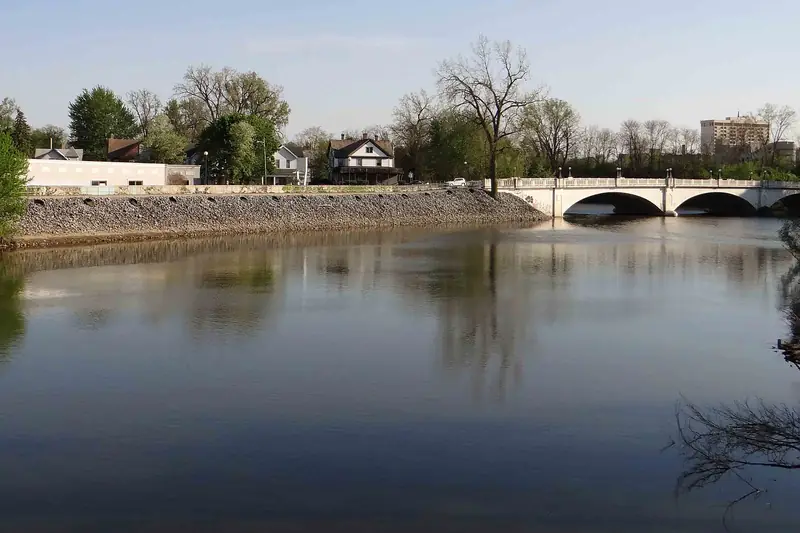
After treatment, the water sits in a 20-million-gallon underground reservoir next to the plant, then is pumped into the mains. City Utilities says it feeds 5 elevated storage tanks that also hold pressure at the edges of the system, and travels through more than 1,160 miles of water mains.
The city's taste-and-odor page notes that when the plant changes treatment, "it may take a few days for the newly treated water to reach your tap". The city owns the main and the service pipe up to and including the curb stop; from the curb stop to your house, the line is the owner's. That split matters for leaks, frozen lines and lead pipes, which are covered in how to keep pipes from freezing and the lead pages.
Three Rivers Home Water is run separately from City Utilities. For service problems such as low pressure across a street, the utility takes calls through 311, and its own drinking water pages are the official word.
How this answer was put together
This answer draws on City Utilities' 2026 Annual Drinking Water Quality Report (2025 data, pages 2, 4 and 6), the utility's water quality, taste-and-odor and Three Rivers Water Filtration Plant web pages, EPA SDWIS system records for Allen County retrieved October 26, 2026, New Haven's 2025 report (2024 data) and Huntertown's report on 2023 data, all read in October 2026. Customer counts printed on some city pages (250,000 customers, 300,000 people) were left out in favor of EPA's population figure, because the city uses "customers" for both people and accounts.
Follow-up questions
Does Fort Wayne still use any wells?
No city source lists a working well. The small Honeysuckle well system near Leo and Spencerville was switched onto Three Rivers water on June 20, 2023, according to City Utilities.
Why is the plant at the three rivers if the water comes from only one?
The city already owned the land, intended as Three Rivers Park, and its central spot made it easy to send water to every part of town, the plant page explains. The intake draws St. Joseph River water, not water from the St. Marys or Maumee.
How old is the Three Rivers Filtration Plant?
It opened in 1933 and was paid for with $2.5 million in local bonds issued in 1930. It was expanded in 1955 and 1981, and UV units now fill the original 1933 pump room; the 2026 report dates UV treatment to 2014.
Is Fort Wayne tap water fluoridated?
Yes. City Utilities targets 1.0 mg/L, and the 2026 report lists a highest level of 0.85 ppm in 2025 against an EPA limit of 4 ppm.
Does the plant test for more than what is in the report?
Yes. The city says chemists test water leaving the plant for more than 120 substances; the report lists those that were found or that rules require it to print.
Does the St. Joseph River carry farm chemicals into the tap?
Some show up at trace levels. The 2026 report lists atrazine at a highest level of 0.39 ppb, under its 3 ppb limit, and nitrate at 4.774 ppm, under its 10 ppm limit.
Who should Huntertown or New Haven residents ask about their water?
Their own utility. Each system publishes its own yearly report, and the numbers on this page for Fort Wayne apply only to City Utilities customers.
More tap water questions

Have another question? See every Fort Wayne home water answer.