Is Reverse Osmosis Worth It for Drinking Water?
Is reverse osmosis worth it for drinking water? On Fort Wayne city water, mainly if you have a lead or unknown service line; on a well, only after a lab test shows something the unit is certified to reduce.
Answered by the Three Rivers Home Water desk · Last updated
About the store links on this page: SoftPro Water Systems and Quality Water Treatment, the two stores linked on this page, have the same owners as Three Rivers Home Water. Answers here lean on Fort Wayne City Utilities' published reports and rules, Indiana and federal agency guidance and makers' certification listings, read in October 2026. What a store says about its own products is quoted as the store's claim. How store links work
In this answer
The short version
- A reverse osmosis system is only proven against the contaminants named in its certifier listing: IAPMO R&T lists the Waterdrop G3P600 under NSF/ANSI 58 for TDS, fluoride, cadmium, barium, radium 226/228 and lead.
- The similar Waterdrop G3-W is certified under NSF/ANSI 58 for TDS, fluoride, cadmium, hexavalent chromium and selenium, but not for lead.
- EPA names RO as one of three filter types that can reduce PFAS, but says a filter may not be useful where PFAS are below federal limits, as in Fort Wayne.
- City Utilities' 2026 report lists 2025 nitrate at 4.774 ppm (limit 10) and fluoride at 0.85 ppm, a level the city adds on purpose and RO is certified to reduce.
- For wells, the Indiana Department of Health recommends yearly bacteria and nitrate tests and arsenic, lead and copper every 5 years; neither listing above covers arsenic, nitrate or bacteria.
What does reverse osmosis remove from drinking water?
Reverse osmosis pushes water through a very fine membrane that holds back dissolved salts and metals, and the rest of a unit's job is done by carbon and sediment stages around it. What a specific system has been shown to reduce is whatever its certifier lists for that model, under NSF/ANSI 58 for the RO stage and often NSF/ANSI 53 or 42 for the carbon.
The difference between models is real. IAPMO R&T's certificate for file WC-13976 lists the Waterdrop G3P600 for "TDS, Fluoride, Cadmium, Barium, Radium 226/228, Lead" and the G3-W for "TDS, Fluoride, Cadmium, Hexavalent Chromium and Selenium." Both have a carbon stage listed under NSF/ANSI 53 for PFOA and PFOS (file WC-14805).
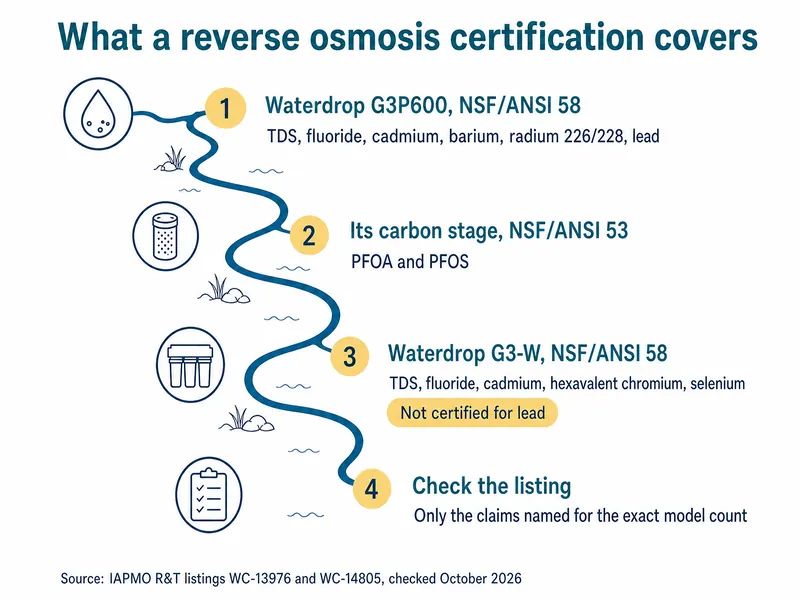
Anything not on the list is a seller's claim, not a tested one. Product pages for RO units often list arsenic, bacteria, "heavy metals" or long chemical lists; if those words are not in the certifier's claims for that model number, this site treats them as unproven.
Is reverse osmosis worth it on Fort Wayne city water?
For most Fort Wayne homes on city water, reverse osmosis is a preference rather than a need. City Utilities' 2026 report (2025 data) shows every regulated contaminant in compliance, none of the six regulated PFAS detected, and nitrate at 4.774 ppm against a limit of 10.
The strongest local reason is lead. The water is lead-free leaving the plant, but a lead or galvanized service line can add it, and 3 of 106 homes sampled from January to June 2025 were above the 15 ppb action level. If your line is lead or unknown, an RO unit listed for lead, or a cheaper certified pitcher or faucet filter, makes sense until the line is replaced; which filters reduce lead compares the options and does my house have a lead service line shows how to check.
Two trade-offs are specific to Fort Wayne. RO is certified to reduce fluoride, which City Utilities adds to a target of 1.0 ppm (0.85 ppm maximum in 2025), so an RO tap removes something the city puts in on purpose. And it won't do a softener's job: hardness averaging 130 mg/L (about 7.6 gpg) affects every pipe and appliance, while RO serves one tap. See is Fort Wayne water hard for that question.
If taste is the issue, an earthy or musty spell in summer comes from the river, and City Utilities says it is typically safe to drink (why tap water tastes earthy). A carbon filter is the smaller step for taste; read its NSF/ANSI 42 claims to see what it was tested for.
| Item | Fort Wayne 2025 result | Federal limit | On the G3P600 RO claim list? |
|---|---|---|---|
| Lead (90th percentile, Jan to Jun) | 4.26 ppb | 15 ppb action level | Yes |
| Fluoride (highest) | 0.85 ppm | 4 ppm | Yes |
| Nitrate (highest) | 4.774 ppm | 10 ppm | No |
| PFOA and PFOS | Not detected | 4.0 ppt each | Carbon stage, NSF/ANSI 53 |
| Total hardness (average) | 130 mg/L (about 7.6 gpg) | None | No (TDS only) |
Is reverse osmosis worth it on well water?
On a private well, RO can be worth it, but only after a lab test and only if the unit is certified for what the test found. Private wells are not regulated by IDEM or EPA, and the Indiana Department of Health lab charges well owners $10 each for bacteria, nitrate and fluoride and $20 for arsenic, lead and copper, plus shipping.
Arsenic is one reason well owners look at RO. EPA's limit is 10 µg/L, and a U.S. Geological Survey study found 9% of more than 800 wells in the northern glacial aquifer at or above it. Neither Waterdrop listing above names arsenic, nitrate or bacteria, so if your test shows one of those, look for a system whose listing names it. Is there arsenic in Allen County well water and what well water treatment do you need cover the order to treat things in.
What should a reverse osmosis certification say?
It should name the standard, the certifier, the exact model and each contaminant. For RO that means NSF/ANSI 58 from an ANSI-accredited certifier such as NSF, IAPMO R&T or WQA, with a list of reduction claims; EPA points buyers to each certifier's online directory to confirm it.
Check the certifier's name as well as the standard. Quality Water Treatment's G3-W page names NSF International as the certifier; the certificate is from IAPMO R&T, which is a legitimate certifier, but the wording shows why the listing beats the product page. You can open the IAPMO certificate for WC-13976 yourself; it showed the file as active through November 21, 2027.
Reverse osmosis by the numbers
- 6contaminants on the G3P600's NSF/ANSI 58 claim listSource: IAPMO R&T WC-13976
- 0.85 ppmFort Wayne's highest fluoride result, 2025Source: City Utilities 2026 report
- 9%northern glacial-aquifer wells at or above 10 µg/L arsenicSource: USGS SIR 2007-5036
- $20state lab price for arsenic, lead and copper on a private wellSource: Indiana Department of Health
How much water does reverse osmosis waste?
Every RO system sends part of the incoming water down the drain to carry away what the membrane rejects; how much depends on the model, your water pressure and the water temperature. This site found no certifier figure for the drain ratio of the systems above, so it does not repeat sellers' percentage claims about water saved.
Ask for the ratio in the owner's manual or performance data sheet before you buy, and remember it applies only to the water you draw at the RO tap, typically drinking and cooking water rather than the whole house. The certificate does list a rated daily production of 2,715 liters for the G3P600 and 1,885 liters for the G3-W, which is a measure of output, not waste.
What upkeep does reverse osmosis need?
Plan on replacing the sediment and carbon pre-filters and the RO membrane on the maker's schedule; the certificate names the G3P600's membrane cartridge as WD-G3P600-RO. A cartridge left in past its rated life can lose its ability to reduce lead, EPA warns.
A handheld TDS meter is a simple check between changes: since TDS is on the certified claim list, a reading at the RO tap that creeps toward the reading at the kitchen tap means the membrane needs attention. You also need under-sink space, a drain connection and a spot for the extra faucet.
If you decide to buy, SoftPro Water Systems sells the lead-certified Waterdrop G3P600 (sold by SoftPro Water Systems, same owners as this site), listed at $429 in October 2026. Quality Water Treatment sells the Waterdrop G3-W (sold by Quality Water Treatment, same owners as this site) ($459 in October 2026), which is certified for TDS, fluoride, cadmium, hexavalent chromium and selenium but not for lead, so it is not the one to buy for a lead line.
How this answer was put together
This answer is based on IAPMO R&T certificates WC-13976 (NSF/ANSI 58) and WC-14805 (NSF/ANSI 53), City Utilities' 2026 water quality report (2025 data), two EPA consumer documents (on PFAS filters, April 2024, and lead filters, June 2024), EPA's lead page, the state health department's private-well lab prices and USGS report SIR 2007-5036. Sources were read in October 2026. Not included: sellers' water-saving, purity and health claims, any drain ratio without a certifier figure, and product rankings.
Follow-up questions
Does reverse osmosis remove fluoride from Fort Wayne water?
Both Waterdrop systems above are certified under NSF/ANSI 58 to reduce fluoride. City Utilities adds fluoride to a target of 1.0 ppm, and 2025's highest result was 0.85 ppm, so an RO tap will deliver less than the city intends.
Does reverse osmosis take out calcium and magnesium?
It reduces total dissolved solids, which include the calcium and magnesium that make water hard. This site makes no health claim either way about minerals in drinking water.
Can reverse osmosis replace a water softener?
No. RO treats water at one tap, while hardness scales pipes, water heaters and fixtures throughout the house. The softener question has its own page.
Does reverse osmosis kill bacteria in well water?
Neither certificate above lists bacteria. A positive coliform test calls for finding the source and disinfecting the well, then retesting, before any filter.
Is a countertop RO unit as good as under-sink?
It depends on the listing. One countertop model sold online is certified under NSF/ANSI 58 for TDS only, so check the claims the same way.
How long does an RO membrane last?
The maker sets the interval in the manual. A TDS meter reading at the RO tap tells you between changes whether the membrane is still doing its job.
Does Fort Wayne require a permit to add an RO faucet?
This site could not confirm local permit rules. Check with the building department before you start, especially if you are adding a drain connection.
More questions about filters
Have another question? See Fort Wayne home water questions, answered.