Topic · 6 questions
Water Softeners and Filters: Fort Wayne Questions
Which water softeners and filters make sense in Fort Wayne? On city water, all of them are optional comfort choices except a certified lead filter where a lead line may remain; on a well, a lab test decides.
Answered by the Three Rivers Home Water desk · Last updated
The short version
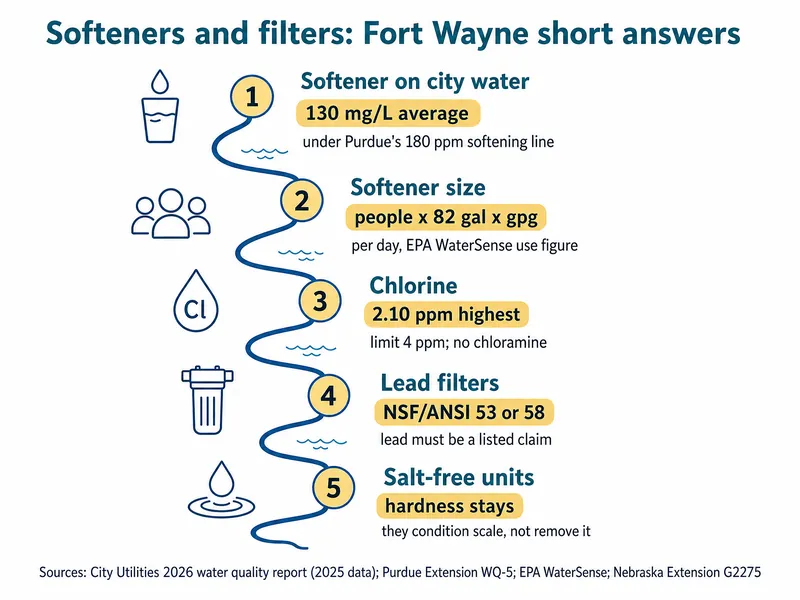
- Fort Wayne's tap water came in at a 130 mg/L hardness mean for 2025, roughly 7.6 gpg, per City Utilities' June 2026 report, below the 180 ppm level where Purdue Extension says to soften.
- Softener size is people × daily gallons × gpg; EPA WaterSense's figure is 82 gallons per person a day at home.
- Salt-free conditioners keep the hardness in the water; Nebraska Extension calls them "descalant devices."
- Fort Wayne disinfects with free chlorine plus chlorine dioxide; chlorine's highest 2025 reading was 2.10 ppm against a 4 ppm limit.
- A filter reduces lead only if it is certified to NSF/ANSI 53 or 58 with lead listed for that exact model.
- None of these units treats bacteria, arsenic or nitrate in a well unless it is certified for that claim.
This page gathers every softener and filter question on Three Rivers Home Water. The answers are written for Fort Wayne City Utilities water first, with a line on wells where it differs; well treatment has its own Allen County wells topic.
Softeners and filters, by the numbers
- 130 mg/LMean hardness of city tap water over 2025Source: City Utilities 2026 report
- 180 ppmPurdue's softening threshold for hard waterSource: Purdue Extension WQ-5
- 2.10 ppmHighest chlorine reading in 2025 (limit 4)Source: City Utilities 2026 report
- 82 galAverage daily home water use per personSource: EPA WaterSense
Do water softeners make sense on Fort Wayne water?
Water softeners are optional on Fort Wayne city water and usually worth it on a well. The plant lime-softens river water to a 2025 average of 130 mg/L (range 94–174), under the 180 ppm line in Purdue Extension's WQ-5, while Purdue says "virtually all" Indiana groundwater sits above that line.
On city water, the case for a softener is less spotting and scale. EPA WaterSense's May 2026 softener guide says softeners "are not needed in all homes," and Nebraska Extension notes that softening adds about 8 mg/L of sodium per gpg removed.
How do you size a water softener?
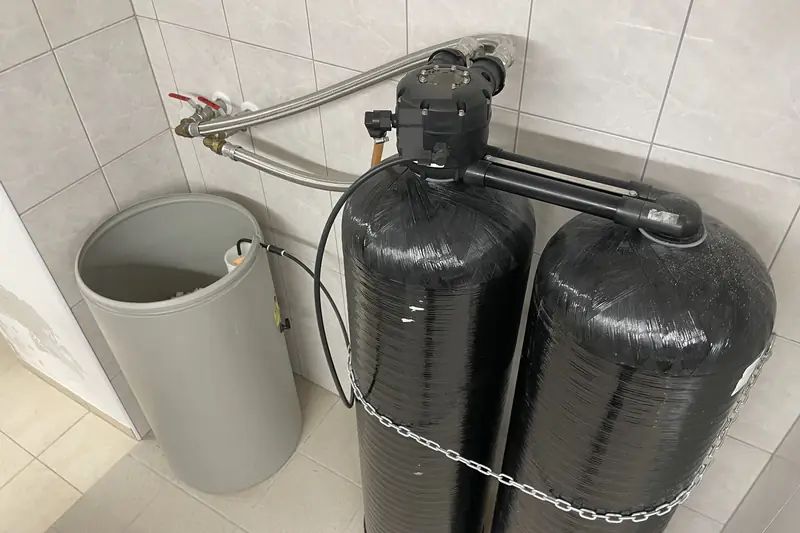
You size a water softener by multiplying people, daily gallons per person and hardness in gpg, then multiplying by seven for a week. For four people at the city's 7.6 gpg mean, that is 4 × 82 × 7.6 ≈ 2,493 grains daily and roughly 17,450 over seven days. Well owners start from their lab's hardness figure and, following A. O. Smith's manual, add 5 gpg per ppm of dissolved iron.
EPA's guide warns against oversizing and recommends demand-initiated regeneration, which counts the water you actually use. A well-matched unit regenerates about once a week; Penn State Extension's own worked example lands at 6–7 days.
Are salt-free conditioners worth it?
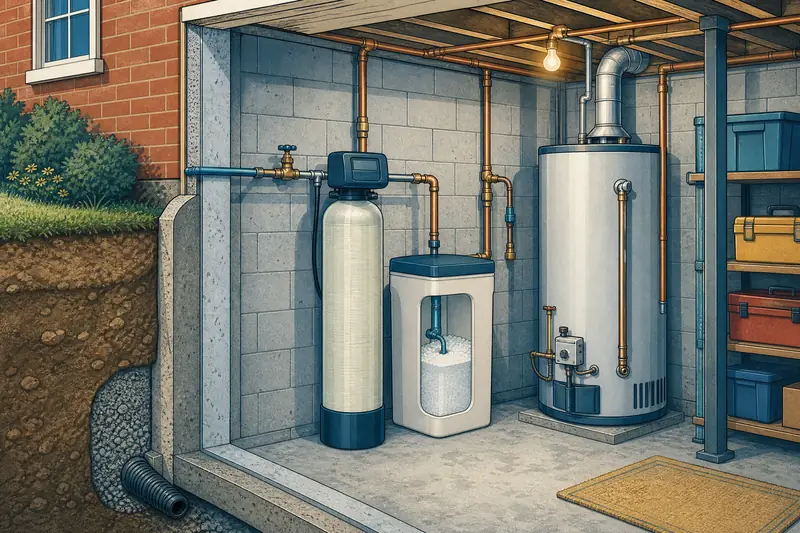
Salt-free conditioners are worth it only for a narrow case: clean city water, a wish for less scale, and a reason to avoid salt. Nebraska Extension's NebGuide G2275 says template-assisted crystallization converts hardness to tiny crystals rather than removing it, that these units are generally not designed for iron or manganese, and that few conclusive studies confirm how well they work in homes. EPA points buyers to the IAPMO/ANSI Z601 standard for scale reduction devices.
Which filters handle chlorine?
Activated carbon filters handle chlorine, at one tap or for the whole house. City Utilities' water quality page says the plant uses free chlorine and chlorine dioxide, and the 2026 report lists chlorine at 1.54–2.10 ppm in 2025, within the 4 ppm federal limit. No city source mentions chloramine, so filter claims written for chloramine systems don't apply here.
Filtering chlorine is a taste and smell choice, not a safety fix. A filter at the kitchen tap covers drinking water; a whole-house unit also covers showers and laundry.
Which filters reduce lead?
Filters reduce lead only when they are certified for it. EPA's June 2024 consumer guide to lead filters says to look for NSF/ANSI Standard 53 with a lead-reduction claim, and reverse osmosis units are certified under NSF/ANSI 58. The certification has to name lead for the exact model.
That matters most in homes that may still have a lead service line. City Utilities' 2025 tap sampling put the 90th percentile at 4.26 ppb and 2.61 ppb in its two rounds, under the 15 ppb action level, with 3 of 106 homes over it in the first round. Its report advises a filter certified by an ANSI-accredited certifier for anyone concerned. A softener does not remove lead.
When is reverse osmosis worth it?
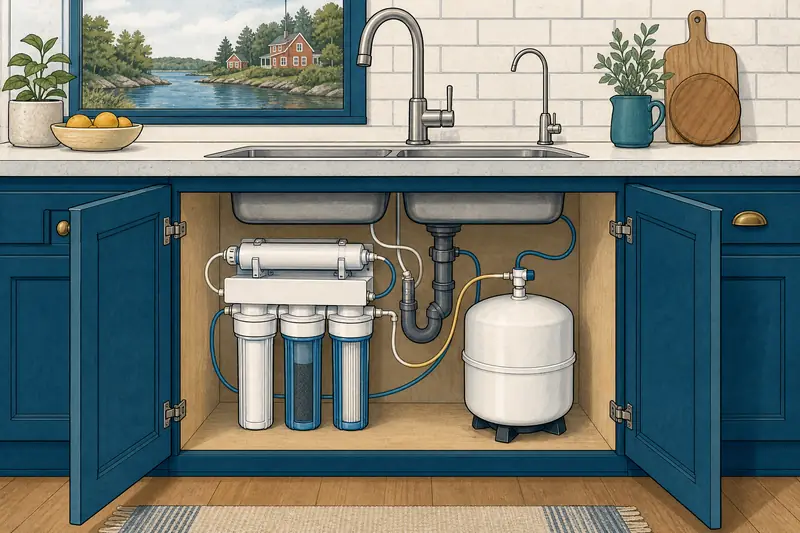
Reverse osmosis is worth it when you need one tap of drinking water treated for something it is certified to reduce, such as lead from a lead or unknown service line. It treats only the water drawn at its own faucet, sends part of the incoming water to the drain, and needs under-sink space and a drain connection.
On a well, RO earns its place only after a lab test shows something the model is certified for; check the certificate, not the box. The Indiana Department of Health's lab charges $20 for an arsenic, lead and copper test.
| Unit | Treats | Doesn't treat | Source |
|---|---|---|---|
| Salt softener | Hardness (to 0–1 gpg) | Chlorine, lead, bacteria | Purdue WQ-5; Nebraska G2275 |
| Salt-free conditioner | Scale formation (hardness stays) | Hardness, iron, manganese | Nebraska G2275 |
| Carbon filter | Chlorine taste and odor | Hardness; lead unless certified | City Utilities; EPA |
| NSF/ANSI 53 lead filter | Lead, when the claim is listed | Hardness | EPA lead filter guide |
| Reverse osmosis (NSF/ANSI 58) | Claims listed per model, at one tap | Whole-house water | EPA; certifier listings |
How this answer was put together
This topic page condenses its six question pages. Behind them: the city's yearly report (published June 2026, covering 2025) and its water quality page; Purdue Extension WQ-5; EPA WaterSense's statistics page and May 2026 softener guide; Nebraska Extension G1491 and G2275; Penn State Extension's water softening page; the A. O. Smith softener manual; EPA's June 2024 lead filter guide; and the Indiana Department of Health lab's price list. All were read in October 2026, and each figure matches its question page. Store products appear only on the question pages, with the ownership noted there.
Follow-up questions
Do I need both a softener and a carbon filter on city water?
Neither is required. A softener addresses hardness and a carbon filter addresses chlorine taste; choose either, both or neither depending on what bothers you.
Does a softener remove chlorine?
No. Purdue Extension says softeners are designed only to remove hardness. Chlorine is a carbon filter job.
Will a whole-house filter remove lead?
Only if that model is certified to reduce lead. None of the whole-house carbon filters this site checked at NSF, WQA and IAPMO carried a lead claim, so a certified unit at the drinking tap is the usual answer.
Which goes first, the filter or the softener?
EPA's softener guide says to install the softener after water leaves a whole-house filter, so chemicals and sediment are filtered out before softening.
Is there a city rebate for softeners or filters?
No City Utilities rebate for home softeners or filters was found. Its lead line program covers service line replacement, not filters.
Do New Haven homes face the same choices?
Largely, yes. New Haven's report lists 122 mg/L of hardness for 2024 and the same chlorine plus chlorine dioxide disinfection, but read its own report for current figures.


Have another question? See the full list of Fort Wayne home water questions.